It’s one thing to announce that we want to move to Portugal. And it’s a whole other thing to start putting our money where our mouth is.
A thing to know is that the adventure of living as an expat is something I’ve always wanted to do. So, this whole move to Portugal adventure is MY thing. Because it’s important to me, Jill has made it HER thing, too. I mention that because, Jill is totally leaning into this adventure and is willingly taking on the heavy lifting of ticking both the procedural and practical boxes that we need to tick in order to make the move happen.
One such box that is both practical and procedural is finding a place for us to live. In addition to needing a roof over our head, being able to demonstrate that we have lodging lined up was a requirement for the D-7 visa application.
Upon deciding that SMP was our town, Jill set about trying to find us a 12 month rental. She created a custom search area on Idealista (Portugal’s go-to real estate site) and subscribed to multiple Facebook groups. We’d also heard that an inconvenient aspect of Portuguese culture is that they’re not big on returning electronic inquiries, especially from non-Portuguese mobile numbers. After launching inquiries on multiple Idealista properties and getting no response, Jill can confirm that is indeed the case. Potential landlords who don’t respond to electronic inquiries make finding a place to rent in SMP from 4,000 miles away a challenge. And then there’s the added complication of finding a landlord willing to accept both us and our two golden retrievers.
Not to be deterred, Jill refocused on her energies on the Facebook groups in hopes of finding an expat landlord who was more likely to respond. In mid-October Jill came across a high-potential listing on the Facebook and lo and behold our current landlord, Sevilla, hopped on the phone right way and she and Jill chatted for a few minutes. I was in the other room and I heard Jill say “Okay, there may be one thing that’s a deal-breaker. We have two dogs.” A few seconds went by and then Jill said, “No, they’re not under 50 lbs.” And I thought that was that. They chatted for a few more minutes and then Jill joined me to debrief.
It’s funny how things work out. It turns out that Sevilla, who lives in Georgia, was in Wimberley (a small town about 45 minutes from Austin) with her partner Scott at that moment and would be there for a few more days. Sevilla shared with Jill that they REALLY needed to make a run to Trader Joe’s in Austin to pick up some essentials and that they’d be willing to meet with us and interview Woody and Bulleit while in town to see if they would be willing to make a weight-limit exception.
Jill coordinated the meeting that weekend at an outdoor patio at a dog-friendly restaurant. Before leaving the house, we sat Woody and Bulleit down and told them in no uncertain terms that they needed to be on their BEST behavior. We needn’t have worried because Bulleit took it upon himself to launch a charm offensive and spent the entire interview with his head under Sevilla’s hand. We got on well with Sevilla and Scott and now we have two new friends, who are now also our landlords in SMP.
This past Wednesday, January 24th, Jill and I boarded a plane in Austin en route to Lisboa via Newark to bring over a couple of suitcases full of essentials to our new digs. We rendezvoused with Jill’s sister Stephanie in Newark and traveled on to Lisboa together.
Here we go!
The trip went super smoothly, with the only dodgy bit being getting three adults, three full-sized suitcases, and three duffels into our SIXT-provided Renault Arcana for the one hour and ten minute drive from LIS to the rental house.
Speaking for myself, I was a little anxious – just because we’d rented this place based purely on Facebook pictures and a conversation with Sevilla. I can now report that it exceeds expectations!
Here we are ready to unlock the front door for the first time.
We ferried all of our assorted luggage into the house did a little unpacking, went down for a tactical one-hour nap, then showered and put on fresh togs.
We sherpa’d over a suitcase full of essentials we suspect will be hard to find in Europe – For example, pharmacies here sell Ibuprofen in blister packs of 8 pills so we brought Costco bottles of Ibuprofen and Acetominaphen, which the EU calls Paracetamol.
And then headed for city center for a toastie and a cappuccino!
Our view from the cafeFirst toastie of the trip!Doing everything we could to stay moving and upright until bedtime on the first day, we took Stephanie on a walking tour of the harbor.
Then we went to the local Intermarché to load up on a few essentials and were back in time to catch our first sunset from the pool deck below our unit.
Jill could not have done any better in finding this place: Three bedrooms, ocean views, green space for W&B, and a 15 minute walk to city center. We have lots to learn about living in Europe, but we now have a great home base!
A fun fact about Portuguese is that any city or town whose name has a specific meaning always uses an article in the name. Porto (pronounced PORT-oo) means “port” – thus it is always referred to as O Porto (THE Port). Another example is the town of A Figueira da Foz (the fig tree at the river mouth). I mention this because with our fledgling knowledge of Portuguese we don’t know which town names translate to actual words and are constantly being gently, and politely, reminded that we need to put the article in front of certain names. Which brings us to O Porto…
With our business concluded in Nazaré we set out north toward O Porto, a trip of about two hours on very nice roads. Because we are now professionals, we made a very efficient stop along the way at a Repsol station to top off the trusty Renault Clio and get Jill a bottle of sparkling water. Since we were flying home from O Porto, we drove straight to the airport (and now you airport nerds know why it’s OPO) and dropped our car with the nice SIXT people and took a taxi into town.
Having decided that SMP is our target destination in Portugal allowed us to have a fun perspective during our time in O Porto. We viewed O Porto through purely the lens of how we might enjoy trips to the big city when living in SMP – either solo or with visitors in tow.
Jill booked us into the A.S. 1829 Hotel in the heart of O Porto for three nights. Another shout out to Rick Steves and company – the A.S. 1829 was the latest in an unbroken string of successes we’ve had when following their recommendations.
There was also a nice plaza with restaurants and tasteful live music right outside of the hotel.
View from our room at the A.S. 1829
Not surprisingly, O Porto-proper is fantastic. The heart of the old city is hilly but very walkable with lots of neat stuff to see.
O Porto is home to the world’s swankiest McDonalds.Perhaps the most comprehensive and confusing road sign we have encountered in our travels.Legend has it that this library/bookstore inspired some of the Hogwarts visuals in Harry Potter.Hills, hills, and more hills…Lots of amazing tile workThe interior of the Stock Exchange buildingThe Luis I Bridge and the old monastery above it by nightAnd, of course, the Douro River.Late afternoon espresso martinis by the riverfrontI am a powerful being and I can accomplish anything I set my mind to…View from atop the Luis I Bridge.The top of the Luis I Bridge is an active railway. I can report that if you have a fear of heights and are walking on an elevated railway when a train comes rumbling by and shakes the entire structure, your legs will no longer obey the signals from your brain to keep moving
We walked almost 10 miles each day seeing all of the sights in O Porto. And in doing so we worked up a big appetite. We found a great Italian restaurant called La Salumeria a couple of blocks from the A.S. 1829 where we ate two of the three nights we were in Porto. If you are ever in O Porto, run do not walk to La Salumeria.
By the time we left we were regulars at La Salumeria. Note the “Reservado” sign. We made friends with the owner and now that’s officially our table.
For our last day of the trip Jill booked us a full day with Bruno, a guide from Tours by Locals, to go explore the Douro Valley. We are big fans of Tours by Locals and we LOVE Bruno. Bruno picked us up at the A.S. 1829 after breakfast and we set off on the 2 hour drive to the Douro Valley. The scenic drive gave us plenty of time to get acquainted with Bruno and we became fast friends. The conversation ultimately came around to our desire to move to Portugal and Bruno gave us lots of useful information on that front.
For example, when I asked Bruno about acquiring a car in Portugal he gave very practical guidance. Here are the three most important things we learned from Bruno on that front:
New cars come with a 33% tax (23% VAT and 10% ISV) and there is no tax on used cars
Every village with more than 100 people has a Renault mechanic and Renault parts are very easy to get in Portugal
Abandon the American ideal of keeping your car in pristine shape – narrow, cobbled roads, and tight parking spaces will breed dents and scratches. That’s just part of the deal for car owners in Portugal
Lest you think Bruno was shilling for Renault, he was driving a Peugeot wagon. And he shared that he’d personally had problems getting parts for his Peugeot.
Bottom-line Portugal car advice from that conversation with Bruno: Take a look at the full Renault product line and pick a model that meets your needs. Then engage a car broker to find a two-year-old version of that model in Portugal that still has some warranty left. Get it serviced at the dealership until the warranty runs out and then shift to your local mechanic. And don’t worry about cosmetic flaws because you’re going to accumulate more.
And, this bears repeating, Bruno is yet another example of the phenomenon where everyone we’ve met in Portugal, upon hearing that we are considering making the move, is welcoming, supportive, and gives us additional reasons that it’s a good idea.
When we weren’t talking the practicalities of moving to Portugal, Bruno was showing us around his backyard…
With Bruno on one of the lookouts above the Douro ValleyEven though every town in Portugal produces wine, the Douro Valley is officially Portugal’s wine region.Typical Douro Valley sceneryIt would have been rude not to do the wine tastings…
We had a fantastic day with Bruno and we look forward to him showing friends and family around the Douro Valley when they come visit.
One last sunset in O Porto before heading home.And one last stop for pizza!
The next morning we got up, had one last delicious breakfast at the A.S. 1829 and took the hotel-arranged cab to the airport for our flight home.
One last cappuccino and ham and cheese baguette at OPO and we were homeward bound.
And, just like that, our second scouting trip to Portugal drew to a successful close.
Nazaré, about 10km north of SMP, has been a fishing town for hundreds of years. About 10 years or so years ago, big wave surfers discovered Nazaré and started changing the character of the town from fishing village to surf and tourism destination. If you’re interested, HBO has made a documentary series called “100 Foot Wave” that chronicles the discovery of the big wave and the emergence of Nazaré as a Mecca for big wave surfers.
With that knowledge in hand, Jill and I were very interested to see Nazaré for ourselves. Arguably, showing up to see Nazaré in late September should have yielded a low key off-season glimpse of Nazaré. That was not to be our experience.
Jill booked us into the Hotel Praia for two nights in Nazaré. The Hotel Praia has an underground parking garage, which turned out to be a real plus as there is very little street parking available in Nazaré. As is our custom, we arrived at the hotel before checkin and Jill hopped out of the car like a seasoned professional to get the lady at reception to let us into the parking garage.
Knowing that we had a couple of hours to kill before we could check in, we set off on foot toward the famous funicular that goes from city center at sea level to Sítio, one of the three neighborhoods that makes up Nazaré, about 320 meters above sea level. The reason I mention the altitude of Sítio is that upon arriving at the funicular station we learned that the funicular was out of service. There is, however, a switchback path that goes from city center to Sítio. Having nothing but time on our hands we set off intrepidly up that path. The climb was totally worth it. The views from Sítio are amazing.
View of Nazaré from the footpath to SítioJill, approximately 320 meters above sea level.Big plaza in Sítio at the top of the cliff with the Sanctuary of Our Lady of Nazaré in the background.
One of the other things that you can get to from Sítio is the lighthouse, which is actually an old fort – Forte de São Miguel Arganjo, that figures so prominently into “100 Foot Wave”. We figured we were most of the way there already so, after a Coke at a cafe, we trudged onward toward the lighthouse.
This was about the time that it became clear to us how much of an impact “100 Foot Wave” has had on Nazaré. As we got closer to the lighthouse there was a never-ending stream of tourists, like us, who wanted to go to the lighthouse and see where the big wave breaks. And to support that stream of tourists there were food trucks and vendor stalls as far as the eye could see. Plus there were golf carts ferrying people down the hill to the lighthouse and back up that we had to dodge. And this was late September – supposedly the quiet time for Nazaré. I can only imagine what it’s like when the big waves are breaking and people are trying to get a glimpse of the surfers.
What I like to think of as a surf minotaur guarding the path to the lighthouse.Jill fell in love with these guys on the wall of the lighthouse and has stalked the artist on The Facebook so that she can acquire one for our house in Portugal.View below the lighthouse. On the most recent season of “100 Foot Wave” one of the surfers got washed into those rocks when the waves were huge and, miraculously, came out unscathedProof that it’s a lighthouseView north from the lighthouse.
Having made the requisite pilgrimage to the lighthouse, we about-faced and headed back toward our hotel to check in. By the time we got back down to sea level we were mighty thirsty, the kind of thirst that calls for a gin and tonic.
All over Portugal G&Ts are served in these goblets
Thirst slaked, we made it back to the Hotel Praia to check in whereupon we propped our feet up and rested until dinner time.
There’s a street that fronts the beach in Nazaré and we found a touristy restaurant where we could eat dinner and watch the sunset.
Sunset in Nazaré. That’s the lighthouse on the cliff at the right.
There’s a low wall separating the street from the beachfront. Locals and tourists apparently perch on that wall at sunset every day. Not a bad view.
There’s a chain of gelaterias in Portugal called Gelatomania (If you recall Pop’s from our time in Costa Rica, Gelatomania seems to be the Pop’s of Portugal). Apparently sunsets are good for gelato sales, because after sunset we followed our fellow wall-sitters to Gelatomania.
After dinner, in the hotel room, we crossed Nazaré off the list. Nazaré has plenty of beauty to ogle, but we think the tourist crush would drive us crazy.
We decided that the next morning we would get in the car and go back toward SMP. Plus we still hadn’t swung by our friends Mike and Ron’s construction project to get them some pictures. And that was on the way to SMP.
After a good night’s sleep and a go at the hotel’s buffet breakfast we hopped in the Clio and headed south to the little town of Famalicão, where Ron and Mike are building. We found Ron and Mike’s place with no trouble and snapped some pictures for them. Then we decided to take the coast road from Famalicão to SMP. That was a good decision.
The coast road runs along the top of a ridge and we could see an amazing-looking beach below. We saw a turn with a sign that said Praia Salgado (praia is Portuguese for “beach”) and we took that turn and followed the road down to a small parking area on the beach.
Here’s Jill on Praia Salgado. Those people in the background were the only other humans on the two mile stretch of beach. That’s Nazaré and Sítio over Jill’s left shoulder.
Praia Salgado starts just north of SMP and runs all the way to Nazaré beach. It’s unspoiled and amazing. After a nice little walk on the Praia Salgado we headed back to the car and took the coast road into SMP.
We stashed our car in roughly the same place as the day before and headed back to what we were already thinking of as “our” cafe for a cappuccino and a toastie. SMP had not lost any of the luster that we’d ascribed to it the day before. We consulted Google maps and found the SMP farmer’s market several blocks inland and set out in that direction. Along the way we passed the local train station which is exceptionally cute. The farmer’s market was great. We kept walking in a big circle and ended up on the waterfront again.
View of SMP from the other side of the harbor.Jill also found her favorite shop in SMP called Surge. It’s home furnishings upstairs and apparel downstairs.
When we’d seen everything we could think of that we needed to see, we made our way back to the car and headed back for Nazaré.
Over a pre-sunset glass of wine at one of the beachside restaurants in Nazaré, Jill put pen to paper to compare Carvoeiro, our favorite place in the Algarve, with SMP, our favorite place on the Silver Coast. Below is what we came up with:
As you can see, we are data driven!
The conclusion we came to is that there really isn’t a “wrong” answer, but in the end we decided that the more Portuguese flavor of SMP is what we are looking for vs. the expat-forward flavor of the Algarve, with the big unknowns being how cold and wet are the winters in SMP (we’ve heard it’s like southern France – whatever that means) vs how hot are the summers in Carvoiero (coming from Texas, we certainly know what hot means).
That settled, we headed off for a celebratory last dinner in Nazaré, which was pizza!
I had the Salami & Gorgonzola pizza…Delicious! I suspect that when we live in SMP we will head for Nazaré or Caldas da Rainha when we want to add variety to our dining-out options.
Decision made and weight lifted we went to bed happy!
Fresh off of a great day in Cascais, we packed up the next morning after breakfast and made the easy hour and fifteen minute drive to Foz do Arelho, the next of our scheduled stops. On paper Foz do Arelho could not be any different from Cascais. Where Cascais is a vibrant medium-sized town in the shadow of Lisbon, Foz do Arelho (pronounced fazh doo ah-RELL-yo), is more of a sleepy hamlet. The greater Foz do Arelho area has 1600 or so residents spread out through the hills and the town-proper appears to have just a few hundred residents.
Foz do Arelho is across the Óbidos lagoon from the ancient walled city of Óbidos (pronounced OH-bee-dosh), with the Óbidos castle within the walls being a popular tourist destination. The Óbidos lagoon was our main reason for stopping in Foz do Arelho. The shallow sandy lagoon is fed by the rivers around Foz do Arelho and the channel to the ocean at the mouth of the lagoon is only passable when the tide is in. The area where the fresh water flows into the lagoon is composed of beautiful wetlands that seem to host lots of wildlife.
The overall geography is hills with freshwater streams and rivers feeding into the back half of the lagoon and picturesque sand dunes transitioning to cliffs fronting The Atlantic on both the north and south of the lagoon. It’s beautiful.
Jill booked us a room at the Quinta da Foz, in the center of Foz do Arelho for just one night. The Quinta da Foz which is the ancestral manse of Francisco, the current proprietor, dates back to 1568 and is fantastic.
Quinta da Foz
The property used to have a hundred cultivated hectares that stretched all the way down to the lagoon, but parcels of land have been sold off through the centuries and what’s left is the manor house with a few hectares behind the house for the livestock and crops. There’s an exceptionally friendly Great Dane, named Foz, who greets all the guests upon arrival.
Jill with Foz
We arrived before lunch at Quinta da Foz and, luckily, Francisco had our room ready early. We dropped our bags in the room and at Francisco’s direction started walking downhill toward the lagoon in search of lunch. There’s only one main street in Foz do Arelho so we just followed that street until we got to the lagoon and then a little further along the banks of the lagoon to a small group of restaurants that are built out onto the beach that fronts the lagoon.
We didn’t see a soul on the walk until we got within sight of the lagoon, where there was a caravan park with a few late season camper-van tourists playing along the water’s edge. Over the course of that walk we pretty quickly categorized Foz do Arelho as being too sleepy to be a viable candidate as a place to live, but the geography was right in our sweet spot. Once again we were freed up to be tourists.
The restaurants were just a little further on and we had no trouble getting a table given that we were at the tail end of tourist season.
We started with a cheese plate…… and enjoyed our view of the sand dunes and cliffs across the lagoon from the restaurant.
Everything was going swimmingly at lunch until I made the rookie mistake of ordering a “hamburger” at a restaurant that clearly specialized in seafood. Jill even tried to warn me off by asking “Are you sure?” It was actually a “sausage burger” with kind of mushy pork sausage in lieu of a beef patty. Nothing catastrophic happened, but I will endeavor not to make that mistake again.
After lunch we continued walking a little further down the road and found a surfer-themed cafe, where we enjoyed a post-lunch cappuccino in the early afternoon sun. We have become BIG fans of these cafes in Portugal. They’re a reliable place to grab a coffee or a toastie (or both) and it’s always a great experience.
Topped up with caffeine we ambled back the way we’d come, checking out the rest of the town along the way. We found a corner shop near the hotel to buy some sparking water and snacks.
We spent a lazy afternoon back at the Quinta da Foz reading on the balcony watching the peacocks and other members of the resident menagerie.
Our fantastic room at Quinta da Foz. The brick ceiling was fascinating.Peacock on the wall by our balcony
For dinner we hopped into our Renault Clio and found a delicious seafood place just past the surfer cafe where we’d enjoyed our afternoon cappuccinos. This time I CORRECTLY ordered us a large bowl of the small local clams poached in a delicious buttery garlicky broth that we soaked up with rustic bread.
We left the restaurant around 9PM and it was capital D DARK. So, we had a great view of the stars on the walk to the Clio. And we used the flashlight on my phone to get through the gate at the Quinta da Foz and to our room.
The next morning we had a delicious communal breakfast in the manor house with the 6 other guests and Francisco took us on a tour of the house.
One of the stipulations for every descendant that Quinta da Foz is passed down to is upkeep of this chapel in the manor house. It’s also the case that they maintain a room for the clergy in the house.More brick ceiling on the lower floor of the manor house.
After breakfast we packed up and headed toward our next destination, which was Nazaré, about a 30 minute drive from Foz do Arelho. If you’ve run across the HBO series “100 Foot Wave”, that’s mostly filmed in Nazaré. Prior to the surfers discovering the big waves in Nazaré about 10 years ago, it was a sleepy fishing village that had some beach tourism in the summer time. Now Nazaré is a year round tourist destination, with the beachgoers in the warm season and the surfers in the winter months. Just based on what we’d seen on HBO and heard from our friends Ron and Mike (more on that in a moment) Jill and I were both thinking that Nazaré might hold a lot of promise as a possible place to live.
Once we decided to move to Portugal, we were introduced to Ron and Mike by a mutual acquaintance. Ron and Mike live about 25 minutes from us in Lakeway and are also planning to move to Portugal. They are building a house in Famalicão, which is on the inland side of the coastal ridge on the road between Foz do Arelho and Nazaré. Jill and I had made plans to drive by Ron and Mike’s while we were in Nazaré to send them some pictures of the construction progress.
There was also one more coastal town on the way, São Martinho do Porto (SMP), population of around 3,000 people. We’d planned to just do a drive by of SMP – thinking 3,000 people was a little on the small side.
It’s funny how things work out. From our first glimpse of SMP we were smitten.
That’s SMP nestled around the bay.There’s a beach that runs all the way around the harbor. The opening on the left goes out to The Atlantic.
We immediately decided that we needed to stop in SMP and explore the town. First stop? You guessed it… a cappuccino and a toastie at a cafe fronting the harbor.
The view from our table at the cafe.
We enjoyed a leisurely cappuccino, a “tosta mixta” (ham and cheese toastie), and a bottle of the local sparkling water and just watched the morning unfolding around us in SMP. The cafe had, and I take this as an omen, the exact same automated payment kiosk that we’d learned to use at the Belo Cantinho in Lagos. When we were ready to leave and go explore SMP on foot, I went and stood by the kiosk and waited for our server to make eye contact with me, whereupon he did his bit and I did my bit – depositing €8 in notes against our €7,10 bill and deftly dropping the coins returned out by the kiosk into the coffee can doubling as a tip jar on the top of the kiosk. With an “Obrigado!” to our server we were off.
We walked rest of the way around the harbor and came across, in no particular order, a number of perfectly serviceable dining outlets (Indian, Mediterranean, Italian/Pizza, fish and chips, seafood, gelato, and a hamburgueria – which I will view with a skeptical eye now that I’ve been burned once), a large green space right on the harbor with a lady walking a Labrador retriever, and an intriguing high-end hotel – called The Storyteller’s Palace – that looks like our kind of happy hour destination.
There’s also a tunnel through the headland at the far end of the harbor that goes out to the Atlantic. That was an interesting juxtaposition because the harbor was dead calm, but the Atlantic Ocean had plenty of energy outside the protected harbor.
The harbor-side entrance to the tunnel leading out to the AtlanticThe waves outside the tunnel were running 5 feet or so
At that point, we’d seen enough make three quick conclusions:
With 3,000 people, SMP was not “too small” as I’d assumed it would be. It even has an Intermarché, the fabulous French super market we’d first experienced in Carvoeiro! And one of the clear benefits of a town the size of SMP is that there is green space within easy walking distance of town center. In fact it’s better than that. We’d passed an extensive boardwalk/walking trail on our way into town with lots of people walking their dogs along the water’s edge.
Unlike the expat resort flavor of the Algarve, SMP is a town full of Portuguese people. But we saw enough expats in that first visit to believe that there was enough of an English-speaking population for us to find a friend group while we are getting our Portuguese up to scratch. Plus our friends Ron and Mike are building a house 5km away.
With two Cascais-sized towns – Nazaré having 20k people and Caldas da Rainha having 50k people – within 20 minutes, anything that SMP doesn’t have is only 20 minutes away.
We were trying to keep our excitement in check, plus we still hadn’t seen Nazaré yet. So, after our walking tour of the SMP harbor area we strolled back to our car and headed off for Nazaré to see how it stacked up.
With our first trip to Portugal being an unqualified success and knowing that Carvoiero is a viable option for an expat adventure, Jill and I sat down to talk about next steps. The Algarve has a whole lot to like with only three potential negative marks on the ledger:
We’ve been told the Algarve is feast or famine in terms of high season being very crowded and low season being deserted – with a lot of businesses either on restricted hours or closed outright during low season.
The Algarve seems to have taken on the flavor of the tourists and expats who flock there, meaning that it’s feels more like a resort area than an authentic Portuguese cultural experience.
It’s a 3-ish hour drive to the Lisbon airport. There is an international airport in Faro, but, at least at the moment, all US departures fly into Lisbon. That would make for less-than-ideal logistics for our periodic returns to the US and also fetching any visiting dignitaries.
Because the Algarve has what approximates a Mediterranean climate and is also a National Geographic highlight reel of beautiful landscapes, none of the above concerns rise to the level of serious deterrent.
The logical next step in our evaluation process was to make a second trip to explore the Silver Coast, the coastal area starting just south of Lisboa and stretching north to O Porto. Jill went into research mode and plotted out a 9-day September itinerary that would have us fly into Lisboa and out of Porto with overnights in five different candidate locations.
On September 19th, we boarded a United flight in Austin and made our now-familiar trek to Newark and on to Lisbon. We got a last minute offer to upgrade to business class for a very reasonable price on the EWR-LIS leg, which we jumped on. The only downside to that was the two available lay-flat seats were on different sides of the aircraft.
Jill – excited to trade her Premium Economy seat for a lay-flat seat in Business Class!
On approach to LIS we came in over the hills. There was a blanket of fog in the valleys which left just the hilltops protruding like islands in a sea of clouds. And it was just after sunrise so the fog was sparkly from above. It was one of those right place at just the right time moments. I waved my arms to get Jill’s attention from across the cabin to make sure she took a look out the window. It was a pretty magical moment for me and felt like a good omen for the visit we were embarking on.
During the walk from the plane to immigration, Jill and I compared notes on how much sleep we’d gotten on the flight and what we’d each had for dinner. We also found that we were both over the moon excited to be back in Portugal, which is probably a good sign for people who are thinking about moving to Portugal.
The high of being back in Portugal, aided by the sleep we’d gotten in our fancy lay-flat seats, carried us through immigration, baggage claim, and on to the SIXT car rental counter – where we were assigned a Renault Clio. We bopped up to the garage, got our key, and we were off!
Our first destination was Setúbal (pronounced SHTOO-ball) a city of a little over 100,000 people about 30 miles south of Lisboa on the Sado River. Setúbal sits at the mouth of the estuary formed by the Sado.
Jill had booked us into the Rio Art Hotel, once again curated by Rick Steves and company, in Setúbal for one night. We only did one night in Setúbal for a couple of reasons:
With our early morning arrival in LIS and Setúbal being less than an hour from LIS we had the benefit of being there by 10AM and having the full day to explore.
We knew Setúbal was likely on the larger end of what we were looking for so we just wanted to get a feel for how a larger town felt after our Algarve experience.
First off, the Rio Art Hotel is fantastic. It’s centrally located, the rooms are very nice, and Ana, the manager, was exceptional. In keeping with our pattern we arrived at the hotel a few hours before check in time, but because we’d learned in Lagos that the parking space marked with a “X” in front of the hotel is for loading and unloading we pulled into that spot like the professionals we aspire to be, dropped our bags with Ana and she gave us directions to the pay car park a few blocks away. And when I say “directions”… Ana told us exactly where the lot was and that the credit card reader was broken so we needed to make sure we had € coins to feed the machine when exiting the lot the following day. In our experience little things like that make such a HUGE difference. Armed with that knowledge it was easy enough for us to make sure we had the €4 in coins the next day to exit the lot. The people in Portugal really seem to go out of their way to be helpful.
We walked back to the hotel after dropping the car at the car park. We asked Ana what we should see in Setúbal and ended up having a 45 minute conversation with her, where she poured us a small pre-lunch glass of Setúbal’s local wine. By the end of that conversation we had a new friend.
While Setúbal is lovely and we can see why people would like living there, we very quickly decided that it wasn’t right for us. There were a couple of factors that disqualified Setúbal from consideration, but the major one is that we couldn’t find any significant green space within walking distance of city center. If it was just me and Jill that wouldn’t be a showstopper, but we have Woody and Bulleit to think about. The Goldilocks setup for us is finding a spot to live with green space to walk W&B but also walkable to all of the city center destinations – market, cafe, restaurants, etc. We plan to have a car, but our goal is not to need it on a daily basis.
This is by no means a scientific observation, but our experience in Portugal is that houses with gardens (what we in the US call yards) or any kind of green space tend to be on the edges of towns. Most of the towns in Portugal are at least 600 years old and some of them go back to Paleolithic times. As such they tend to be compact with high-density housing and favor cobblestones and hardscaped plazas. There are a few green parks here and there in the larger cities, but those seem to be exceptions.
All of that is to say that we were rapidly trending toward the conclusion that we needed to find a town that was big enough to have everything we need, but not so big as to preclude us finding a walkable place on the edge of town suitable for a combined 160 pounds of Golden Retriever.
A benefit of deciding early that Setúbal was too big is that it freed us up just to be tourists and take in the city.
Naturally our first stop after our primer from Ana was at a cafe for a cappuccino and a toastieLots of civic prideSetúbal is a working portThe presence of a Tex Mex restaurant made us wonder if that was more important than green space for Woody and BulleitRepresentative shopping street, festooned for the Sardine FestivalThe purple building is city hall. This was also the one bit of green space in city center.Chat!Charcuterie stall at the market. Note the intensity of the two customers watching the expert shaving of the ham.The local markets are one of my favorite things about PortugalThe tiles around the market are pretty fantasticNot quite refried beans, but signs of life. Note that a can of pinto beans, almost certainly imported, is €2.Our super cute room at the Rio Art Hotel
After a full day of strolling around Setúbal, we found a spot on the main square for a gin and tonic and some live music. Then we went to a pizza place (shocker!) near the hotel for dinner before collapsing into bed in a jet-lagged stupor.
We awoke the next morning to the sound of rain on the windows, but by the time we’d had our breakfast the rain had slacked enough for me to make the jog to the car park to retrieve our trusty Renault Clio – after nimbly thumbing my €4 coins into the kiosk at the car park. I pulled into the loading zone just as Jill was finishing the checkout process. We bid farewell to our new friend Ana, loaded our bags into the car, and set off for our next scheduled stop – Cascais.
Cascais (pronounced cash-KAI-eesh) is about an hour from Setúbal and half hour pretty much due west of Lisbon. At this point a little background is in order…
Following our first trip to Portugal, we (and by we I mean Jill) had started getting our ducks in a row to apply for Portugal’s D7 visa, which would allow us to become full-time residents in Portugal. On the recommendation of some friends we’d engaged an attorney, Ana Rita, in Lisbon that Jill and I both like to help us get our Portuguese tax ids, called NIFs. The process of getting our NIFs required us to get a bunch of documents including tax returns, pay stubs, and passports apostilled by the Texas Secretary of State for Ana Rita to submit to Financas – basically the Portuguese IRS. Interestingly, Ana Rita’s firm had to “sponsor” us in our application for NIFs. I assume this puts some onus on attorneys to vet their clients. One of the other requirements for applying for a D7 visa is that we open and fund a bank account in Portugal. Knowing that we had another scouting trip coming up, Ana Rita had connected us with our banker, Monica, at Novo Banco, one of the two banks in Portugal that will allow non-residents to open an account. Ana Rita had forwarded all of the necessary documents to Monica. Monica had done all of the pre-work and we’d transferred €1,000 to fund the account on opening.
Process note: When you open a bank as a potential expat in Portugal you actually have to fund the account in advance of the account being fully opened.
And all that was left to get our accounts fully opened was for us to present ourselves at a Novo Banco branch and sign all of the account applications. However, Monica is in the university town of Coimbra, which was not on our path for this trip. So, once we’d set our itinerary, Monica coordinated with the Novo Banco branch in Cascais to have our paperwork waiting for us to sign at a 2PM appointment on the day we were in Cascais. More on that later.
Jill and I got a good feeling about Cascais from the moment we rolled in. Cascais is picturesque in all dimensions and has a population of around 15,000 people. Jill had booked us into the Hotel Baia, which fronts the beach in Cascais and is right in the middle of town. Once again we’d arrived a couple of hours before our room was ready. We stashed the car in the Hotel Baia’s underground parking garage and set out to find a cappuccino and a ham and cheese sandwich for second breakfast.
We succeeded in our quest
Freshly fortified with caffeine and a tasty sandwich, we set off to explore Cascais. The first thing we did was walk to the Novo Banco branch to see how far it was for our meeting that afternoon. Turns out it was a 10 minute walk from the hotel. Along the way we passed a nice tree-lined park with a couple of restaurants around the edge of a large grassy area and a carousel, conducive to city living with W&B.
I didn’t do a good job of capturing the relatively large grassy area behind the carousel, but if you peek on both sides of the carousel you get the idea. But you can also get an idea of the extent of cobblestones surrounding the grass.
Cascais has a beautiful protected harbor with a nice beach.
The view of the harbor and beach from our room at Hotel Baia
We wandered all through the hilly neighborhood to the right in the picture above. Lots of cute houses and restaurants.
Even with all of the cobbles people find a way to have greenery.
By then our room was ready so we headed back to the hotel to check in. It was a beautiful day and the hotel had a rooftop dining area so we popped up there after checkin for lunch.
Potstickers, bruschetta, and tempura shrimp for lunch. Yum.
After a leisurely lunch, we checked to make sure we had our passports and headed off for our Novo Banco appointment with plenty of time to spare. We got there about 20 minutes early so we decided to keep walking for an additional 10 minutes and then double back. As luck would have it we stumbled across the local market right at the end of our 10 minute extension – so we didn’t get to go in.
The exterior of the market in Cascais. It appears that every market in every town in Portugal has a beautiful tile facade.
We doubled back and still arrived at Novo Banco a few minutes early for our appointment with Luis, Monica’s colleague who was pinch-hitting for her in Cascais. We checked in with the person manning the reception kiosk and took a seat in the corner. About that time a panicked man, clearly American, came rushing in and asked the person at the reception kiosk if there was someone he could talk to about an “urgent matter”. Best we could tell from overhearing the conversation, the panicked guy had showed up to a residency appointment sans some necessary bank documentation and had to provide that documentation before the end of the business day. It was pretty clear that the reception person did not share the panicked man’s urgency and she calmly directed him to a chair to sit and wait. At that point it was 2:00 and the bank was slated to close at 3:00. About that time Luis came out and got us and took us back to the conference room to execute our account documents.
Luis, who was delightful, asked for our passports to make copies and started doing his final validation of the documents he’d printed for us to sign. About that time, the lady from the reception kiosk came in and whispered something to Luis. The next thing that happened was the single funniest thing I’ve seen in Portugal…
Luis went from a smiling expression to a pained one and, I’m not making this up, proceeded to lean forward and ritualistically bang his forehead on the table three times in frustration. Luis then regained his composure and told us with a polite smile that he had to step out for a moment. We have no idea what was said to Luis, but we are pretty sure it involved the panicked man in the lobby. Luis was gone for about 10 minutes and then he returned along with his smile and we recommenced the process.
We had 10 minutes to ourselves in the conference room before Luis returned.
I can report that there are no fewer than 14 forms that we had to sign to get our Novo Banco accounts opened. That’s a lot of signing so there was some time for chit-chat with Luis during the process. Luis asked us if we knew the protocol for ATMs. I thought that was an odd question so I asked what he meant. Luis started by saying there are two things you need to know:
You cannot withdraw more than €300 per day. Luis reported that was mostly a matter of all banks being required to all large bills to the Portuguese banking authority in Lisbon every Friday and so the banks tended to limit cash withdrawals to just avoid dealing with large bills.
If you’re ever behind an older person at an ATM you should just leave and come back later. Apparently ATMs are capable of bill payment in Portugal and lots of older Portuguese people don’t have computers at home. And they find ATMs less intimidating than the Novo Banco smartphone app. So they will routinely post up at the only ATM in the area for 30-45 minutes paying all of their bills.
We finally finished the signing ceremony and Luis went out and fetched our very first balance inquiry from the printer showing our €1,000 safely on deposit in our Novo Banco account with both our names on the statement (a requirement for the visa process). We shook hands and he walked us out. About that same time the reception person was handing the panicked man a piece of paper and he was now smiling, too. So, in both cases, all’s well that ends well. And we got a fantastic story out of it.
We wandered back to our hotel, all smiles with our shiny new bank account, to have a celebratory glass of vinho verde.
We’d chosen an Italian restaurant that we’d passed on our afternoon walkabout for dinner that night.
We didn’t get a picture of our Italian restaurant, but it was on this street with lots of delicious looking restaurants.
We had just been seated when a man walked in with a Golden Retriever to pick up his takeout order. We, being Golden Retriever People, asked if we could pet the dog and we struck up a conversation with the dog’s owner while they were fetching his order. Turns out he was an American expat from NYC who’d lived in Cascais with his wife and dog for several years and loved it and had been totally embraced by the community. He also was working on finishing his A2 levels in Portuguese to take the required test in Portuguese to get on the path to become a Portuguese citizen. His only complaint was that they’d not been able to find a place with a yard and had bought a beautiful 5th floor apartment in a building that had undergone a total renovation – which made taking the dog out a bit of a chore. So… American expat with Golden Retriever being treated like a local at the restaurant, successfully learning Portuguese, and nothing but good things to say about Cascais. That felt very much like an omen. After the day we’d had in Cascais, we’d decided that Cascais may have just knocked Carvoeiro off the top of the podium. And it didn’t hurt that Cascais is only 30 minutes from the Lisbon airport.
We trundled back to the hotel feeling pretty fulfilled for having opened a bank account and having a great conversation with the expat at the restaurant about living in Cascais.
The morning following our lunch with Martha and Jacques it was time to pack up and head back to Lisbon or, as the locals call it, Lisboa. The plan called for driving back to LIS, returning the rental car to the nice people at SIXT, taxiing to our Lisboa hotel, and spending the last full day in-country on a walking tour of Portugal’s capital city.
We got an early start out of Tavira. The drive from Tavira to Lisboa is a leisurely three hours of stunning countryside that gradually gives way to the suburbs of Portugal’s beautiful capital city. Of Portugal roughly 10 million inhabitants, 3 million of them live in Lisboa and its environs.
A quick observation about Portugal’s highway fuel/rest stops:
There appear to be a handful of EU fuel/convenience store chains that compete for designated roadside concession locations on Portugal’s main motorways. Repsol, Orange, and Tangerine appear to be the most common brands. There are several things I find nice about this model:
Whoever has the concession for a given location sets up shop on both sides of the highway – meaning it’s always exit to the right, pull in to a pump, fuel up, and then pull out the far side of the facility and merge left back onto the highway.
The concessions seem to be spaced at 20-30km intervals and there are signs 10km, 5km, and 3km out from the approach that tell you what brand is coming up and what their fuel price is. So, for example, if you’re partial to Repsol (as Jill and I are following our gassing-up tutorial from the nice Repsol man in Vila do Bispo) you get 10+ minutes notice at highway speeds to know when you’re coming up to a Repsol station and what each grade of fuel costs. To be fair to Orange and Tangerina, we’ve had good experiences there as well – we just imprinted on Repsol.
The bathrooms are universally clean and their food selection puts the US’s hot-dog-roller convenience store culture to shame.
We successfully negotiated mid-morning Lisboa traffic, found our way to the airport and pulled in to the SIXT car rental return lane. Jill and I are loyal SIXT customers for life and here’s why…
When we pulled forward to drop off the car, a SIXT employee scanned the barcode on the windshield and started the return process while Jill and I set about getting our personal effects sorted and our luggage out of the boot. About 10 seconds into that process the SIXT person realized that I probably still had the proximity key fob for the car in my pocket – again, this was done gently with no intent to embarrass me. I sheepishly dug the fob out of my pocket, handed it back, and we resumed our clear-out of the car. The attendant signaled we were good to go and that the receipt had been emailed to Jill. We smiled, said “Obrigado!”, shouldered our backpacks, and headed for the exit.
We decided to hit the restroom at the arrivals hall before grabbing a cab to our hotel. When Jill walked out of the ladies room she had a look of TERROR on her face. When we were within earshot she said “I can’t find my phone!” She dug through her backpack one more time to confirm that the phone wasn’t there and I called her phone to see if we could hear it ringing… No joy. If you don’t know Jill – she NEVER misplaces anything. We quickly decided the only place it could be was in the rental car. I grabbed Jill’s bag so that she could hotfoot it back to SIXT.
I arrived at the car return area about 2 minutes behind Jill and she was already engaged in a discussion with the manager, who told her the car had already been cleaned and no cell phone had been found, but he’d be happy to check again if she could give him the license plate number. The irony of that request was that of course Jill had studiously taken a picture of the license plate when we rented the car, but that photo was ON HER PHONE! Never fear, the nice man said, as he looked up our rental and made a call upstairs. By that point Jill had worked out what had likely happened. She was gathering up her purse and phone when the attendant noted that I hadn’t returned the key fob and that momentary distraction was enough to make her miss her phone, which had been placed in a recessed area in the center console to let the Waze lady talk us in to the airport. So, she told the manager that’s where it likely was. He was still chatting on the phone in Portuguese and he relayed that information and about 10 seconds later gave a Jill a big smile and a thumbs up. About two minutes later a nice young man came trotting downstairs with Jill’s wayward iPhone and all was well.
There were so many ways that story could have ended badly. If we hadn’t made a pitstop at the arrivals hall who knows when we would have detected the missing phone. And maybe by that point the car would have been re-issued to the next customer. But instead we have a great story that makes us love the people at SIXT!
On our subsequent taxi ride to our Lisboa hotel Jill confessed that, while she didn’t relish the idea of replacing a $1000 phone, she was in agony over whether she’d had an opportunity to back up all of her photos of our experiences in the Algarve to the cloud (it turns out she had).
Jill is SERIOUS about her pictures. A little over a decade ago, when Jill and I decided to spend the rest of our lives together she famously said to me: “When they wheel us into the old folks home, I don’t need to take any stuff but I want to be surrounded by pictures of all the things we’ve done.” There are lots of ways in which Jill and I are well aligned, but that was an early indication that marrying her was the best decision I ever made.
Our ride from LIS to our hotel, MyStory Rossio, was a tidy 20 minutes. So, roughly 25 minutes after recovering Jill’s phone we were dropping our bags at the hotel and setting off to explore Lisboa on foot.
I have to say that to this point the itinerary that Jill had originally mapped out for her trip with Stephanie could not have been any better. Having never been to Portugal, Jill had placed her trust in Rick Steves and company when selecting lodging at each stop – to that I say “Thanks, Rick!”
The view of the Plaza Dom Pedro IV from our room at the MyStory Rossio. That’s the Castelo de São Jorge on the opposite hill.
Lisboa is fantastic!
Pro-tip: Wear sensible shoes and be prepared for some serious elevation change as you walk the city. The locals claim Lisboa is the “City of the Seven Hills”. No disrespect to Lisboa intended, but I’m pretty sure Rome is the OG “City of the Seven Hills”. Upon further investigation the cities claiming to be built on seven hills are legion. Regardless, Lisboa definitely has seven hills and most everything we wanted to see on our walking tour was apparently at the top of one of them. A thing Jill noticed while we were walking the city is that a dominant trend in ladies’ fashion in Lisbon is that, regardless of the ensemble, the footwear is cute sneakers. Cobblestones and hills require traction!
Our first stop was the Castelo de São Jorge, which, while requiring a serious uphill trek, offers fantastic views of the whole city.
View from the CasteloAnd the opposite directionThe castles only full time residents at this point are peacocksThe moat was in need of some water and alligators
After the hike up to the castle we were famished so we popped into a restaurant on the way back down the hill for a delicious lunch with a spectacular view across the harbor.
Our view at lunch. The statue on the opposite hill was inspired by its more famous counterpart in Rio de Janeiro
After lunch we walked down to the waterfront plaza.
The gate to the plaza and statue of Dom José IA squadron of Iberico hams. This storefront was perhaps my favorite view in Lisboa
After a full day of tromping up and down hills sightseeing I was in the mood for… pizza! We found a fantastic place called Pizzaiollo a few blocks and, not a surprise, significantly uphill from our hotel.
A theatre building lit up on our way to Pizzaiollo
For our last dinner of the trip we had a bottle of local wine, a starter of bruschetta with Iberico ham, a delicious pizza, plus a bottle of sparkling water. Total bill €23. I only mention that total because the locals complain about how expensive Lisboa is compared to the rest of the country.
I somehow managed NOT to get picture of the pizza, but here’s the delicious bruschetta with the Iberico ham I’d been ogling earlier in the afternoon.
Fortunately, after dinner it was downhill all the way back to our hotel.
The next morning we caught a taxi back to the airport for our flight home. As we were waiting for our flight to board, there was a departure announcement for the next gate over. That flight was going to Marrakech with a flight time of 1 hour 30 minutes. That caught our attention. One more plus to potentially living in Portugal is just how convenient it is to other locations that are on our bucket list.
Two very contented travelers headed home from an amazing adventure.
We concluded the trip with the mindset that living in Portugal was a grand adventure that was both appealing and within reach – with Carvoeiro setting the standard as a possible landing spot. We knew we had lots more to research and explore. More to come…
It’s still my plan to document the rest of our first trip to Portugal in February and our follow-up trip in October, but today was a VERY EXCITING day!
We did it!!!!
Today at 9AM EST we had our Portugal D7 Visa appointment in Washington, D.C. with VFS Global, the agency that handles visa appointments for Portugal, the Netherlands, Iceland, and a handful of other European countries. Those countries contract with VFS Global to ensure that visa applicants submit packets with the required elements.
Clearing this milestone was the culmination of a process that formally started on October 3rd, when Jill lined this appointment up for us. In the intervening time before the appointment we (and by “we” I mean Jill) had to clear the following hurdles:
Establish a relationship with our trusted attorney in Portugal
Apply for and receive Portuguese Tax IDs (called NIFs), which involved gathering lots of documents and getting them all apostilled (authenticated for international purposes)
Open and fund a bank account in Portugal (to prove that we won’t be on the dole when we arrive)
Find and secure a fantastic initial place for Team Praisner to live and get the lease registered with the Portuguese Finance Department (to prove that we won’t be homeless when we arrive)
Get fingerprinted and pass FBI background checks and authorize Portugal to do it’s own criminal check
Provide proof that we have monthly passive income (so we can support ourselves long-term in Portugal)
Provide proof that we have qualified travel insurance that’s good for at least 120 days from the start date of our visa (which can be a bit challenging if you don’t know when your visa will start)
Submit copies of our passports showing enough time for the visa process to be completed before they expire
Submit two unflattering (no smiles please) European-sized passport photos
Write our personal statements for why we want to move to Portugal
Complete the D7 Visa application
This has been nearly a full-time job for Jill for the last two months and I was so relieved that she took ownership of this task. There’s a fantastic and supportive Facebook group (Americans & FriendsPT) that provided the roadmap through this process.
When we rolled into the VFS office the security guard and staff were very clear that there are no mobile phones allowed in the processing area – otherwise I would have gotten photo evidence of Jill slaloming deftly through the administrative gates.
We showed up with two file folders, one for each of us, and, since only one person is allowed at the window at a time, Jill took first chair and I sat in the waiting area directly behind her. Atul from VFS Global, who is rightly Facebook-famous in Americans & FriendsPT for being very helpful was training Richard today. So, Richard led the process with Atul checking his work every step of the way. My only role in the process was to come forward and sign my application (which has to be done on-site while they are watching) and to sign the UPS return label for sending our passports back to VFS Global once to have the visa pasted in once we are approved.
Given the scarcity of visa appointments and the requirement to come to DC, Jill and I were both feeling the stress of needing to get this right on the first try when we walked in. Atul’s supervisor asked Jill if she was nervous and when she answered honestly, he very kindly told her it was all going to be fine. I suspect he noticed the very organized file folders she had under her arm. Can’t say enough good things about the nice people at VFS Global.
The whole process took 30 minutes. While I was sitting in the gallery watching Jill and straining to hear the conversation she was having with Richard and Atul, I saw two other people bomb out of the VFS process for not being prepared. One was going to the Netherlands and then on language school in Poland and did not have his acceptance letter from the language school. And, best I can tell, the other was trying to obtain a visa with 2 weeks lead time and Atul’s supervisor had to explain to that person the visa process for that country takes 3 three weeks.
Jill, on the other hand, CRUSHED IT! She’d pored over the instructions from Americans & FriendsPT and had everything in sequential order so that when Richard requested the next document she just had to remove the paper clip (no fasteners of any kind are allowed in the packet) and say “This one is for Christopher and this one is for Jill.” The only thing that kept Jill from getting a perfect score was that the copies of our drivers licenses were only of the front side. But because she’d already impressed the VFS crew, she was able to just ask me for my drivers license and Richard made the two-sided copy for us.
And now we wait. Jill has been monitoring the posts on Americans & FriendsPT and someone this morning said that they’d received their approval 31 days after their DC VFS Global appointment. Once we are approved we will put our passports in a UPS envelope and send them to VFS Global. They will paste in the visas and send our passports back to us.
There are two options when requesting the visa: request a future start date or have it start immediately upon approval. We requested our visas start on March 1, 2024. The other thing that may or may not happen when we get our visas approved is that Portugal may also schedule our AIMA, the department that is in charge of issuing residency to visa applicants who are applying for D7 residency, appointments. The point of the visas that we have just applied for is to allow us to stay in Portugal long enough to present ourselves to AIMA to get temporary residence cards (followed at some indeterminate point by receiving our permanent residence cards by Portuguese post). Our understanding is that once in-country we show up at our AIMA appointments (which may or may not be at the same time or even in the same office – there are lots of stories of couples having appointments on the same day but on opposite sides of the country) with a packet similar to the one we presented to VFS Global along with our boarding passes from our inbound flight and our visas with a Portuguese entry stamp.
Once we are in Portugal with our visas we will be “stuck” there through the rest of the residency process. There are two reasons for that:
Once we’ve received our visas, we can only leave the country and return twice before we have residence cards without invalidating the visa. We are going to keep those two free passes in reserve in case there’s an emergency that requires us to pop back to the US.
We’ve heard that you have to be present to sign for your residence card when it arrives via Portuguese post. And we’ve also heard that if you miss that delivery your residence card takes an indeterminate path back to the issuing authority and may spend months lost in transit. We are going to ask if there’s any way we can just get notified when our residence cards are ready so that we can just go back to the AIMA offices where we had our appointments to pick them up, but we don’t have high hopes on that front. Failing that, we will do our best to be home every day when the mail comes.
This is all super exciting and slightly terrifying!
Marine One headed for the White House. We assume that’s the reason the President Biden wasn’t on hand to personally congratulate us after our appointment.We were all amped up on adrenaline post appointment – so we logged 12 miles on foot seeing all of the monuments and memorialsAnd, finally, a celebratory espresso martini at PJ Clarke’s!
After leaving Carvoiero’s Intermarché Jill navigated us back to the A22, the main east-west motorway in the Algarve, and we made short work of the remaining drive to Tavira.
Once in Tavira we threaded the narrow streets to find our hotel, the Pousada Convento, only to find that the car park was behind a gate. No problem… We were now professionals at this part of the process. I pulled into an open residents-only parking space and we quickly got the lady at the front desk to open the gate so that we could stash our car in the car park for the duration of the trip.
The Pousada Convento, as the name implies, is an old convent that has been made into an amazing hotel. A thing that I forgot to mention about our hotel in Évora, the Ablergaria do Calvário, is that it was also convent-adjacent in that it was a re-purposed olive oil production facility for the Convent of Santa Helena next door – now the diocesan administrative offices of the Catholic Church. Based on our limited data points, it appears the Catholic Church has either re-purposed decommissioned convent buildings – as it did in Évora, sold the structures to private enterprise – as in the case of our Tavira hotel, or conveyed them to the state or municipality to make museums out of them. The Pestana group appears to have made a hospitality niche for itself by buying up defunct convents all over Portugal and converting them into hotels.
The courtyard of the Pousada Convento hotel in Tavira
Our room wasn’t ready yet, so we stashed our bags with the front desk and set off on foot to explore Tavira. Tavira is in the Algarve, but, unlike the other major towns in the Algarve, it doesn’t directly front the ocean. Tavira sits a kilometer or so upstream of the ocean on the Gilão River and its main square is on the west side of a picturesque bridge over the river. Not knowing where to go, but hungry for lunch, we just walked in the direction of the main square hoping to find a cafe where we could grab a bite to eat while we waited for checkin.
The main square in Tavira has built in tiered seating. We assume that there are periodic performances that cause people to gather on those seats?A view upstream from the bridge at the main square in Tavira. The Gilão River is tidal up to the bend at the hill in the background and if you look closely you can see the tidal high water mark on the next bridge up.
Every main square in every town in Portugal seems to have at least one cafe and Tavira was no exception. There were three cafes on Tavira’s riverfront square and we just picked the one that had available seating. Sitting down at that cafe was a watershed moment, because it’s where we discovered “toasties”. The couple at the table next to us was receiving their food as we sat down and they had a toastie to share. We didn’t know what it was at the time, but we scanned the menu until we found it. Sublime is not a word I toss around lightly, but toasties are sublime. Most cafes have a “tosta quiejo” (a grilled cheese on rustic bread) and a “tosta mista” (literally a “mixed toast” with cheese and shaved ham on the same rustic bread). When I make a sandwich at home, I tend to go heavy on the ingredients between the two pieces of bread. Toasties use thicker slices of bread and go lighter on the bits between the bread. I’m fairly sure that the crispy crunch of every delicious bite is due to a generous amount of butter that goes onto the outsides of the bread in preparation for the toasting process. At any rate, we ticked another “Could we live in Portugal?” box at that first lunch in Tavira when we ordered our first toastie to share (we started off basic with a cheese toastie). Toasties are the perfect comfort food. They are good for any meal and have become our go-to for mid-morning “second breakfasts”.
Our first ever cheese toastie at the cafe on the square in Tavira
Not wanting to mess with perfection, we had several more interludes at that same cafe with the exact same order during our time in Tavira.
By the time we’d finished our light lunch it was time to head back to the hotel to check in. The person at the desk retrieved our luggage and showed us to our room. One of the things about Portugal is that hotel rooms are inexpensive by American standards. Here are some pictures of our two-story hotel room at the hotel in Tavira:
We had a lovely welcome basket in the sitting area of our roomThe grapes in the welcome basket were HUGE and deliciousThe sleeping quarters were upstairs from the sitting area
Not sure what the other rooms in the convent hotel looked like, but we were plenty happy with this one. And it was no more expensive than a Hyatt Place or equivalent in the US. We will definitely be trying out more of the Pestana group’s hotels as we explore Portugal.
We spent the next day wandering around Tavira and taking the ferry out to the beach on the barrier island…
There are beautiful stands of bougainvillea all over TaviraTavira has loads of narrow cobbled side streetsWe never get tired of seeing the fantastic Portuguese tile on buildings. Tavira has loads of it.More tileYet more tileThe ferry to the beach costs about $1.50A flock of flamingos on the way to the beachWhat I believe to be an evaporative sea salt extraction operationJillyP enjoying the scenic 15 minute ride from Tavira to the beachThe beach on Tavira’s barrier island
One of the things we were looking forward to in Tavira was our lunch with Martha and Jacques, the Tavira-resident expats we met in Évora. Jill had been chatting with Martha via WhatsApp over the course of our trip and she set a lunch date for the following day at Martha and Jacques’ favorite lunch spot in Tavira.
Jill and I dominated the next day’s lunch conversation with questions about Martha and Jacques’ move to Portugal, how they’d settled on Tavira, and what they liked and didn’t like about Tavira/Portugal. Jacques and Martha were very gracious and answered all of our questions honestly. The main “con” they reported of living in the Algarve, and Tavira in particular, was the feast or famine nature of being in an area popular with foreign tourists. They reported that in the peak summer tourist months they typically tried to be somewhere else to avoid the crowds of British, Canadian, and German tourists. And in the winter months, when there are no tourists, a lot of restaurants curtail the days they are open (or close completely for the off season) because there just are not enough full-time residents in Tavira to support the same number of restaurants that tourists keep busy all summer. We’d heard much the same thing in Lagos – with more emphasis on how busy and crowded it gets with foreign tourists during peak summer months.
The lunch conversation then shifted to Portugal’s healthcare system. They both have plenty of experience with it and had great things to say. One of the requirements for freshly-minted expat residents in Portugal is the mandate to have private health insurance until they are eligible for Portugal’s national health care system. That sounded a little intimidating until they told us that they pay the equivalent of $100 each per month for their private insurance and raved about the quality of both the care and coverage. Martha and Jacques’ advice was that, if we moved to Portugal, we should just plan to keep the private health insurance for as long as we live in Portugal. Apparently the standard approach for expats is to use private health insurance wherever possible – to avoid any potential wait/scheduling delay in the public system for elective issues. And for non-elective issues your private doctor can refer you into the public system with no wait. Fortunately, Jill and I are pretty healthy, but it was nice to hear someone who LIKES both the quality and cost of the healthcare they receive.
We wrapped up lunch with Martha and Jacques with hugs all around and another box in the “Could we really move to Portugal?” list ticked. Things were really coming up Todd and Jill!
Our remaining time in Lagos was more of the same – which is to say FANTASTIC! We went back to Pie for one more go at their fantastic savory pies and tried to explore every corner of the old town. We didn’t get back in the car until it was time to check out and head east to Tavira. Jill set about checking out of the hotel and I headed to the car park to pull the car around. A thing about boutique hotels in Europe that it took us a few tries to learn is that there’s really no such thing as automatically settling the bill on checkout. In the US, we are pretty much all accustomed to presenting a card to the hotel at checkin and any charges we wrack up go on that card when we check out. In Europe your room is charged to your card straight away when you check in, but you have to present your card again at checkout to settle food charges and incidentals. The good news is that the desk staff seem to understand that Americans really aren’t trying to skip out on the bill – we’re just generally clueless about how the rest of the world works – and have mastered the art of politely flagging us down to settle up as we drop our key card in the return bin and head for the exit.
With our Lagos Avenida Hotel bill successfully settled, we set off for Tavira which is the easternmost town of any size in the Algarve and only about 10 miles from the Spanish frontier. Tavira is only a little over an hour from Lagos by highway, but we followed coast roads for the first half of the trip – specifically so that we could do as our friendly acquaintances from lunch at Belo Cantinho had suggested and make a swing through Carvoiero on the way. We wound our way through the coastal towns of Portimão and Ferragudo to get to Carvoiero. Ferragudo is a stunning little town of 2,000 people with, due to it’s location at the mouth of the Arade River, a history as a sheltered anchorage for the Phoenicians, Carthaginians, and Romans as they were exploring/trading in the relatively close patch of the Atlantic just west of Gibraltar during their respective heydays.
When we got to Carvoeiro, Jill and I both were both a bit speechless. Carvoeiro is very pleasing to the eye. The majority of the town is shaped into the hills that ring a beautiful central square like a bowl.
All roads in Carvoiero lead to the central square and beachView from one side of the bowl to the other as we walked down steep steps to Carvoiero’s main square
That square opens onto a small postcard-worthy beach with rocky cliffs stretching both east and west from the beach. And at the top of the bowl there’s a boardwalk that stretches across the cliffs that run east of the town. The town felt very familiar as we walked it and it wasn’t until we’d walked the length of the boardwalk and were sitting at a cafe in the square sipping a cappuccino that we figured out why… Jill and I were lucky enough to be in Capri last year with the big Praisners and Capri is magical in its beauty (not to mention the GIANT lemons and gelato). We decided that Carvoeiro is like a mini-Capri. Not nearly as luxe as Capri, but every bit as beautiful and magical. We both immediately moved Carvoiero to the top of our move-to-Portugal fantasy draft board.
We walked the length of the clifftop boardwalk in Carvoiero before heading down to the square for a cappuccinoProper cappucinos at one of the cafes on the square in CarvoieroThe beach at the foot of Carvoeiro’s main square
At this point the one thing we hadn’t encountered in Portugal yet was a full-sized grocery store. We’d seen corner food shops and fantastic daily community markets with amazing produce, fresh fish, artisanal cheese, and amazing bread, but nothing that would scratch the uniquely-American itch of needing a jar of peanut butter or frozen pizza PRONTO. That may sound a little trite and small minded, but one of the things that Jill and I learned when living in Costa Rica is that when you are having a crisis of confidence in a foreign land – tucking in to some familiar comfort food can be just what the doctor ordered. In Costa Rica, we made sure we always had Ritz Crackers in the pantry and a block of Kraft cheddar cheese in the fridge. We are not sure what the equivalent will turn out to be in Portugal, but we do know we are going to need to find it.
As we were wistfully leaving Carvoeiro to continue our trek to Tavira, on the road out of town the car in front of us stopped to allow oncoming traffic to pass before turning left into a car park. In the seconds while we were stopped behind that car, Jill exclaimed “GROCERY STORE! Follow that car!” Here again, the benefit of our well-defined driver and navigator roles shines through. While I am focused on maintaining speed, proper spacing, and lane position, Jill can safely assess any roadside attractions and re-direct us as she sees fit.
Following the car ahead of us, we turned into the car park of an Intermarché. I now know that Intermarché is a French chain of supermarkets, replete with all of the potential goodness that combination invokes.
Before we get to the inside of the Intermarché, it’s worth a laugh to describe the car park. At this particular Intermarché there was covered parking all along the perimeter of the car park and there was a central island that was home to what I can only describe as an outdoor “Washateria” with an overhead sailcloth canopy. I regret not taking a picture of that particular setup, but as best I can tell the concept is that you head to the grocery store with your laundry hamper. And you pop your laundry into one of the machines before you head in to do your shopping. I’m still not sure how the timing of it works because I think at some point one of your party would have to exit the Intermarché mid-shopping to move things from the washer to the dryer? But most of the machines seemed to be spinning, so who am I to judge?
When Jill and I walked into that Intermarché, we probably only made it 15 feet through the door looked at each other and both said something to the effect of “Well, we now know that no matter what else we find in Portugal, we can live in Carvoiero.” We proceeded to go aisle to aisle and we got more and more excited along the way. For example, while almost every full-sized American grocery store has some sort of faux bakery section that sells the requisite store-baked cakes, cupcakes, muffins, etc., Intermarché has a full-on French bakery in their stores and a separate patisserie next to the bakery that has all of the French classics. And, I’m not making this up… The cheese section was 50 feet long and had an overflow cooler for even more cheese! This is of note because Jill and I both LOVE the cheeses of the world. In fact, we proudly display a dish towel at home that says “F*ck I love cheese!”
The primary cheese aisle at Intermarché in CarvoieroThe cheese annex at IntermarchéThe freshly sliced charcuterie at Intermarché was impressive by American standards, but seemed pedestrian in comparison to the cheese.
Spoiler alert: We didn’t find anyplace else on our FIRST trip that rivaled everything we loved about Carvoeiro. It’s not giving any secrets away to say that Carvoeiro remained the leader in the clubhouse until we found our new home town (SMP).
After perusing every aisle of the Intermarché (and Jill buying 5 of her favorite Narta French deodorants) we piled back into the car and set back off for Tavira. In an odd way, falling in love with Carvoeiro (and accidentally finding the magical Intermarché) allowed us to enjoy the rest of the trip even more because from that point forward we were simultaneously taking in each new thing we discovered as tourists and also looking at those things from the other side as potential future American expats in Portugal.
On our second morning in Lagos, over a leisurely breakfast at the hotel and still riding the high of the prior day’s success at the Repsol station, we revisited the topic of what it would be like to live in Portugal. This time neither of us had an immediate conceptual freakout that tabled the conversation. We each rattled off the things that we thought were important to get more data on. My list included mostly practical food/water/shelter things like confirming that we could find a serviceable grocery store to supplement the local fresh markets and that we could find a place to live that was both walkable and to city center and dog-friendly. Jill’s list was more thoughtful than mine, with her top priorities being ensuring that we could find “our people” and thinking about how we would spend our days after the newness wears off. Jill and I tend to approach most major decisions from opposite directions. The practical value of that dynamic is that between the two of us we tend to uncover any showstoppers pretty early in the deliberation process. And, where grand adventures are concerned, the longer we go without finding showstoppers the more we are biased toward embarking on said adventure.
We wrapped up breakfast and started the activities of the day with a sense of curiosity to see what we could learn about the move-related questions we’d surfaced. First up was a walk along the coastline to the lighthouse west of Lagos (Farol da Ponta da Piedade Lagos). It was a blustery day with showers so we set off with sweatshirts and rain jackets and good attitudes. It’s hard to overstate how beautiful Portugal’s rugged coastline is.
The trailhead for our walk to the lighthouse.At various points along the trail there were steps cut into the cliffs that led down to the waterAnd, once we got down to the waterline, we often discovered tunnels cut into the rockMy partner in crime is always up for adventureA welcome warmup with a cappuccino at the lighthouse
One of our favorite things that we discovered on our first trip to Portugal is that at every significant point of interest along the coast there is some sort of family-run canteen or snack bar where you can sit down and enjoy the view. Some of our favorite moments of the trip occurred at these little cafes. We enjoyed a cappuccino and a hot pastry at the lighthouse canteen before we started the trek back to Lagos.
We took a more inland route back to town just to see more sights and we ended up entering Lagos from a gate in the Roman wall surrounding the old city. At this point it was lunchtime so we kept an eye out for likely dining establishments. On a whim we popped into Belo Cantinho (literally “Nice Corner”) a cute little bakery and sandwich shop.
The decision to pop in to Belo Cantinho for lunch was a good oneThe special of the day at Belo Cantinho was a slow cooked pork shoulder sandwich on one of their fresh-baked buns. And it was AMAZING. The Portuguese know their way around pork 🐷
We were a little late for lunch so there were only a couple of other tables occupied at Belo Canthinho. There was one couple paying out at an intimidating-looking automated cashier machine as we ordered the daily special and two sparkling waters at the counter.
Process note: I’m not sure if the implementation of automated payment kiosks was Covid prompted because we don’t have a pre-Covid frame of reference, but many of the cafes that we’ve been to in Portugal have self service payment kiosks. But it’s not fully self-service. There’s a business-facing interface and an interface for the customer. When you are ready to pay you get the attention of the person who was taking care of you and they meet you at the payment kiosk and they select your table from their point-of-sale system, which presents the amount owed on the customer interface. The customer then puts in bills and coins to settle the bill. And typically there’s a little tip bucket on the top where people tend to drop their change from the transaction. This is probably a good place to talk about tipping in Portugal. Tipping is not the norm in Portugal, but what we’ve come to understand is that it’s very common for patrons to round the bill up to the next whole € on small tabs (for example on a €3,20 tab for coffee and a pastry leaving €4 is the norm) and to the next €5 on larger tabs (dinner, etc.). Best I can tell this form of modest tipping is not expected, but is genuinely appreciated when it occurs.
The payment kiosk at Belo Cantinho plays into our story because the couple (obviously tourists) that was paying when we walked in was struggling with what to do. A gentleman from one of the two occupied tables got up and walked over and patiently showed the struggling couple how to use the machine. And the three of them were all smiles and laughs as he returned to his dining companion. Jill and I had seen lots of truly helpful behaviors and attitudes in Portugal up to that point, but it hadn’t sunk in until that moment that whenever you don’t know what to do in Portugal there is usually someone nearby who is happy to show you the ropes in a non-judgmental way.
Having successfully placed our order we sat at one of the tables waiting for our food. It became apparent from overhearing their conversations that both of the other couples were originally from the UK. One thing led to another and soon the six of us were chatting away. It was good to get their perspectives because one couple was in their mid-30s and the other couple was in their 60s. The man from younger couple was working in Portugal for a multi-national company. The older couple had spent half the year in Lagos for the last 30 years. All involved couldn’t say enough good things about living in Portugal and we could easily have been friends with any of them – which played favorably into Jill’s earlier question of “Would we be able to find our people?” once in Portugal (of course we would also like to have Portuguese friends, but finding some English speakers will be necessary until our Portugues is up to scratch). The best bit of information came from the older couple, who said that they LOVED Lagos, but if they were younger and just getting started on their Portugal adventure they would take a hard look at the town of Carvoiero about 20 miles east of Lagos. We filed that away, as we were going to be heading that direction when we left Lagos for our next stop, Tavira.
All of that is to say that in the span of 4 hours since our breakfast discussion about moving to Portugal we’d quickly ticked a couple of VERY important boxes for Jill:
What would we do with our time? Exploring Portugal on foot was looking pretty promising. There is no shortage of walking trails all over the country and we currently walk at least 5 miles with the dogs everyday in Austin.
Could we find friends? Our helpful new acquaintances at the cafe made that seem much less daunting
We celebrated our progress later that afternoon with another happy hour at the Three Monkeys pub and a delicious pizza in the main square of Lagos.
If you don’t like pictures of pizza, this may not be the blog for you…

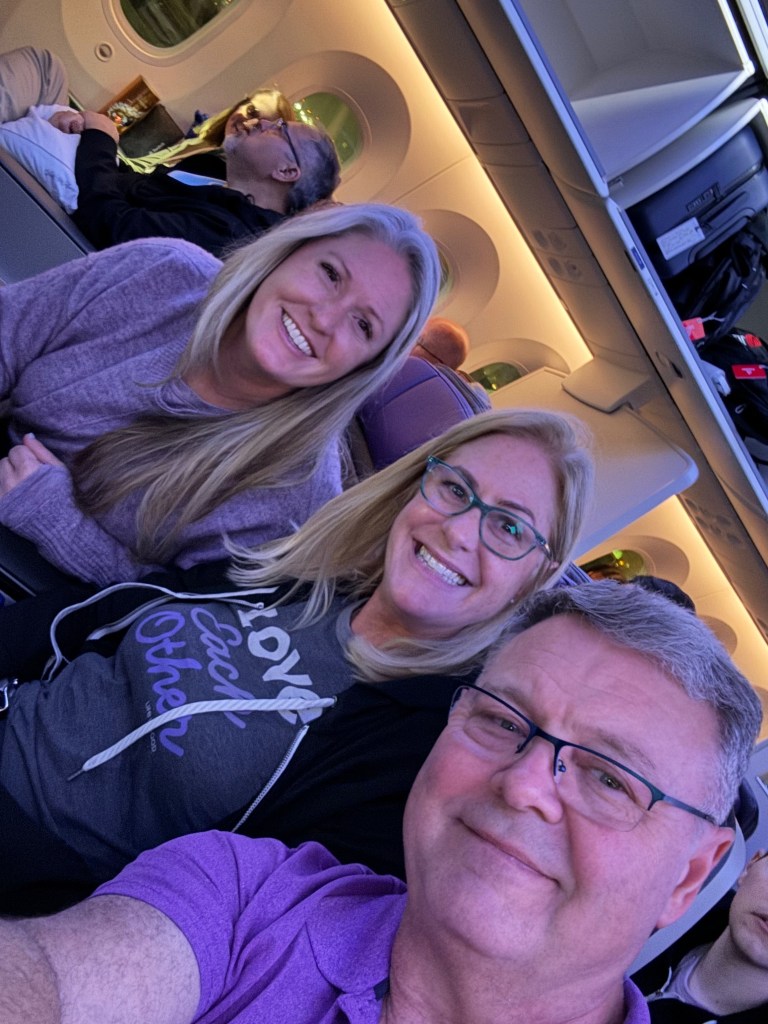

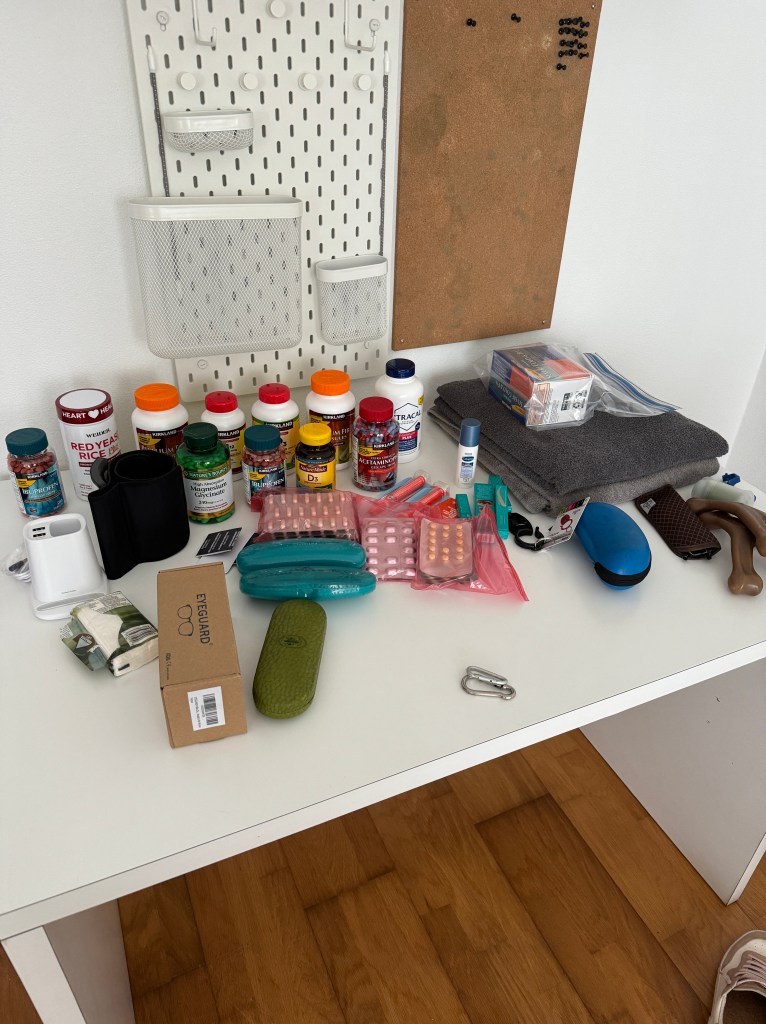
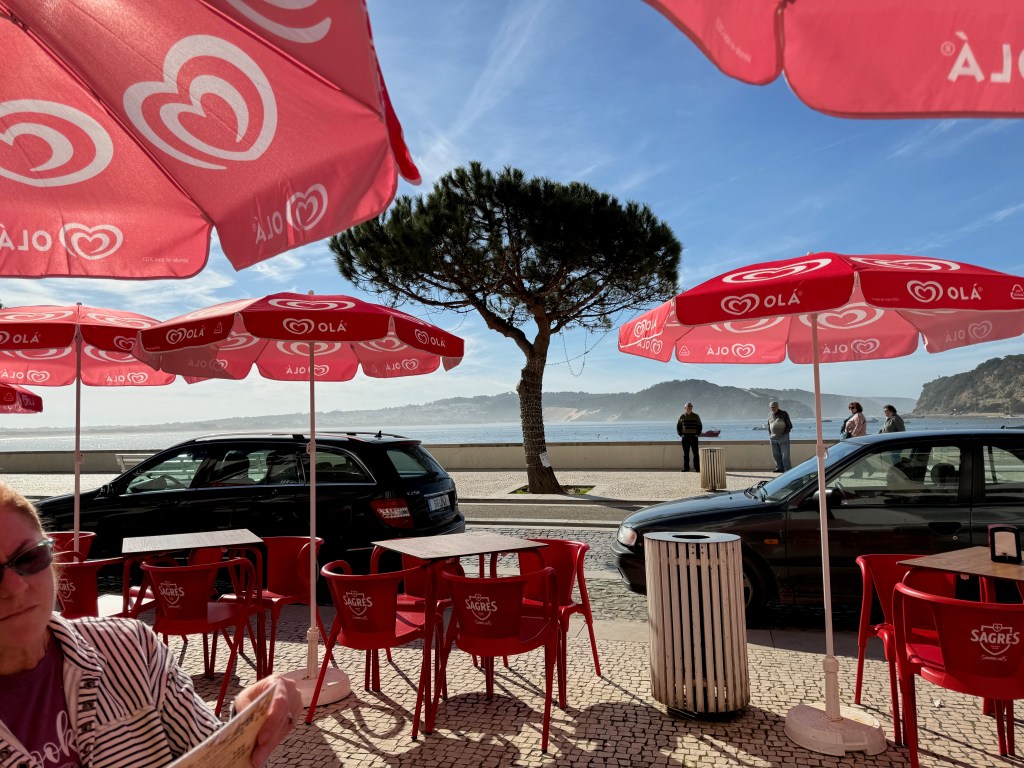
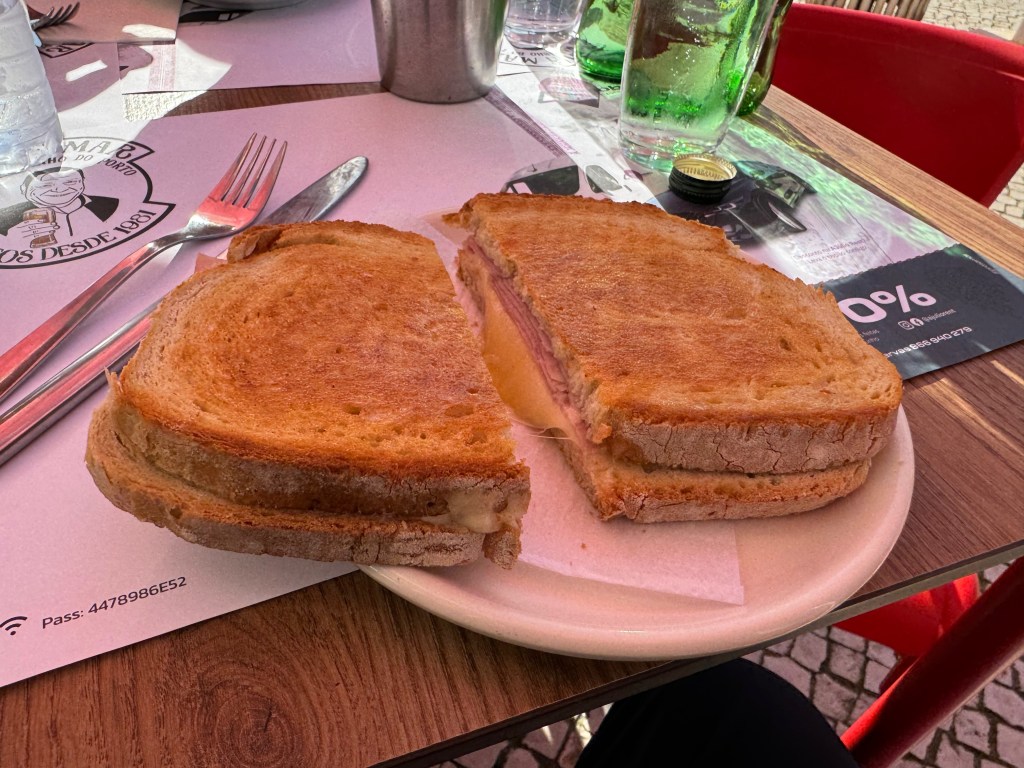
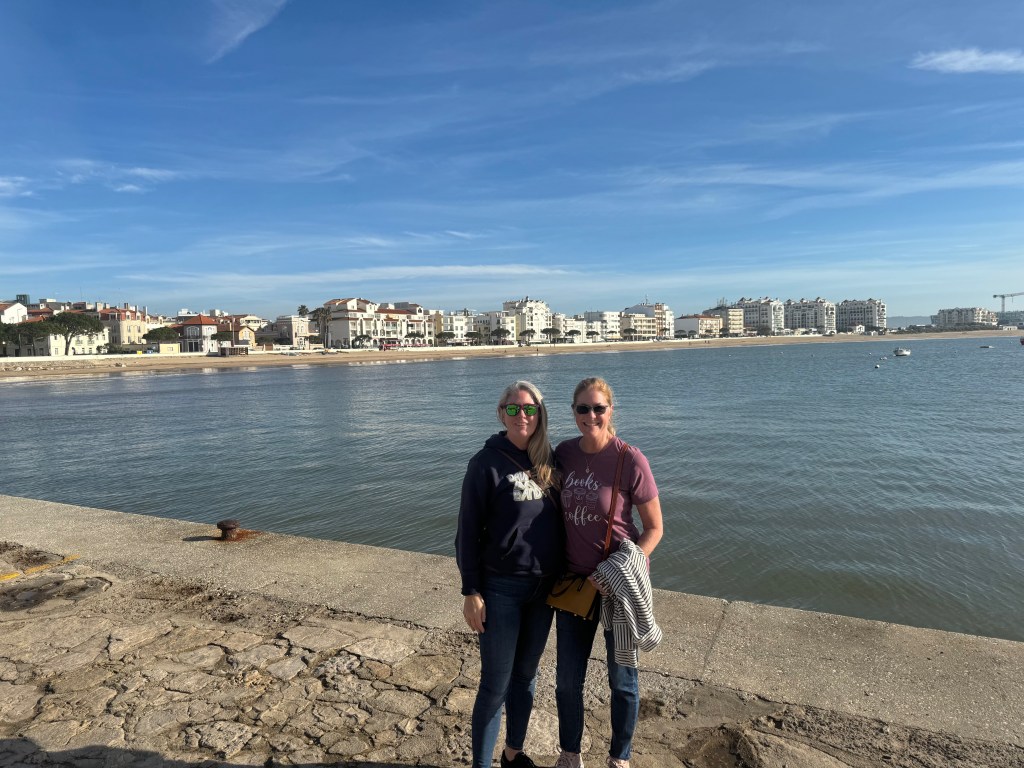
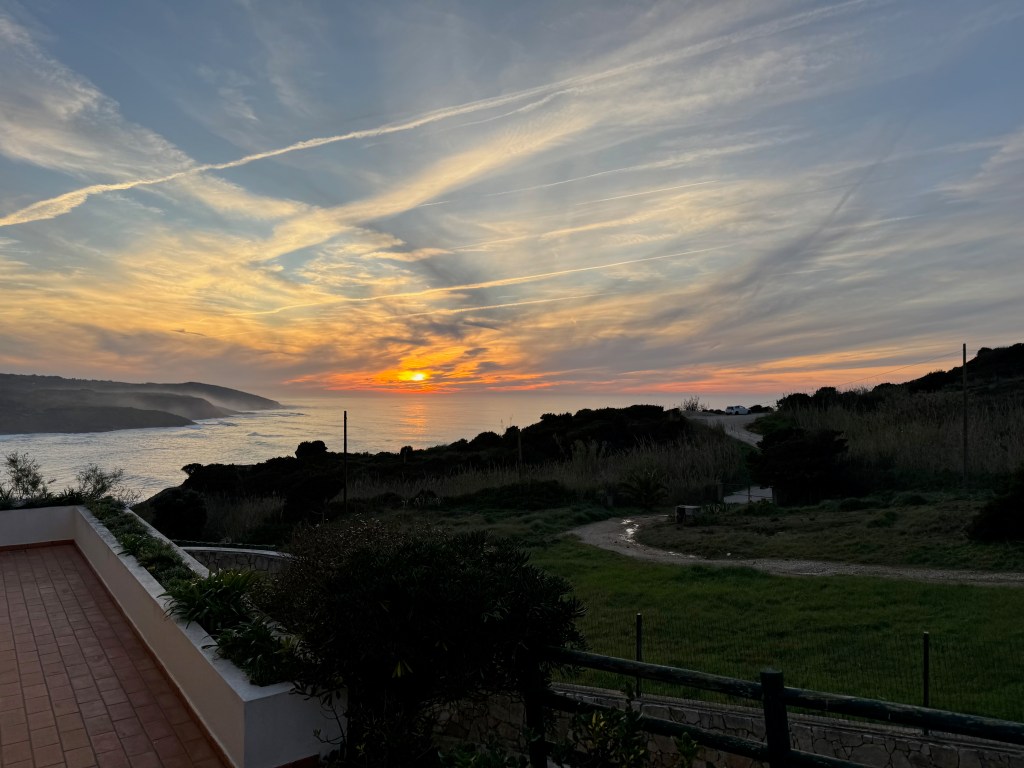
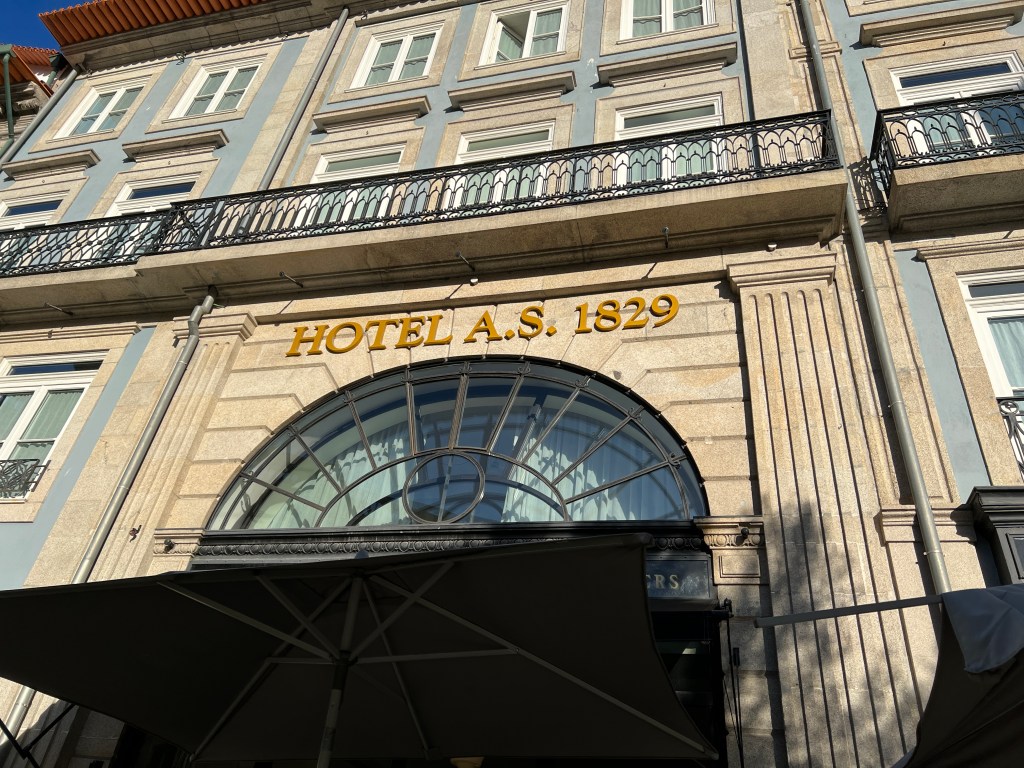
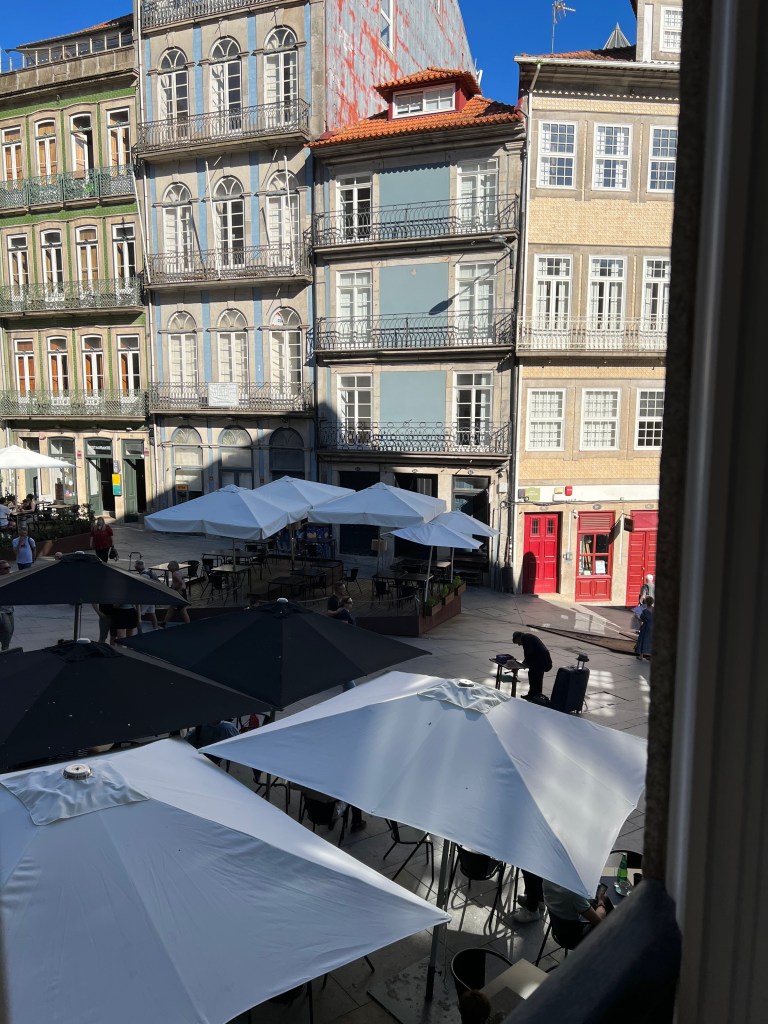
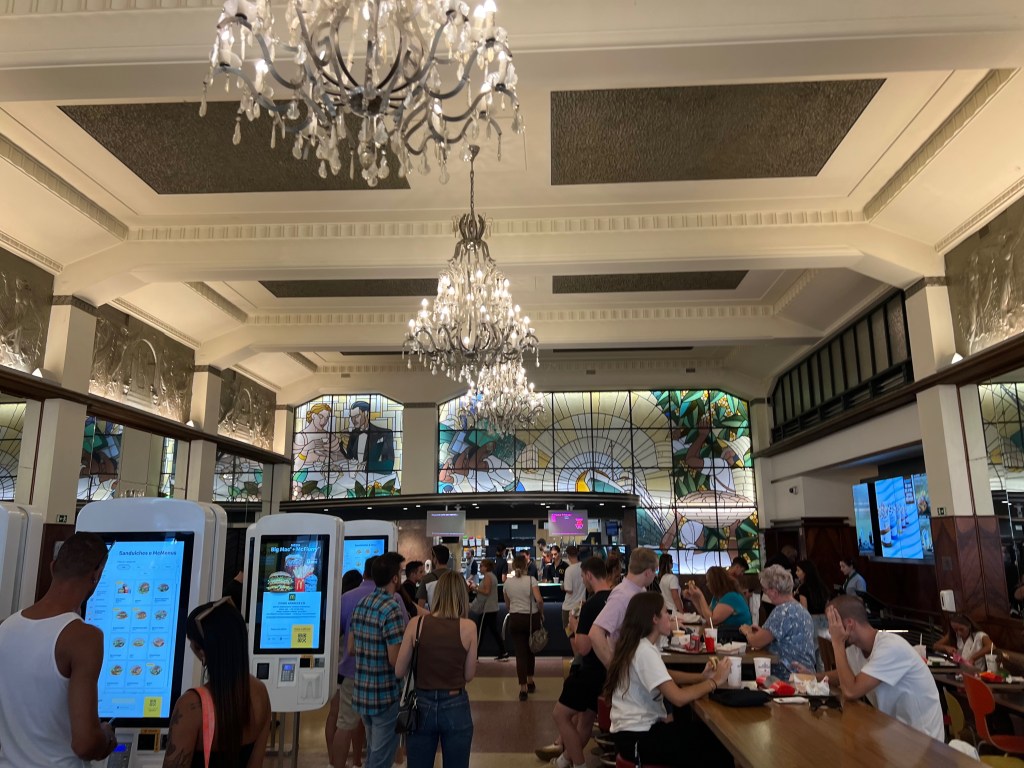
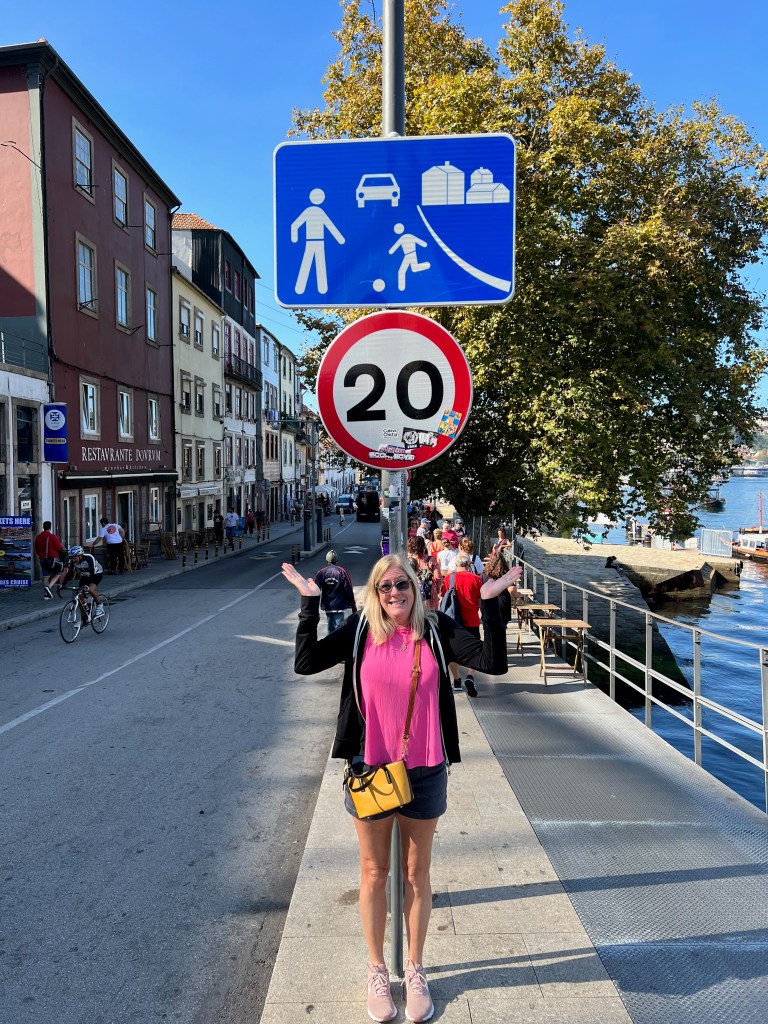
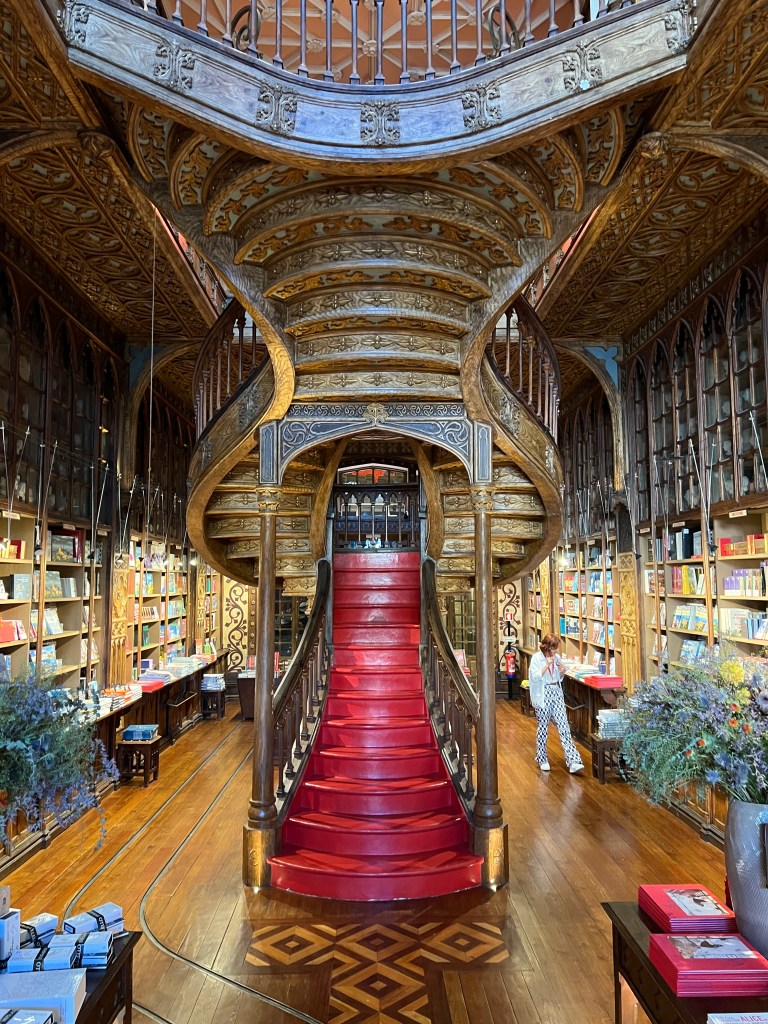
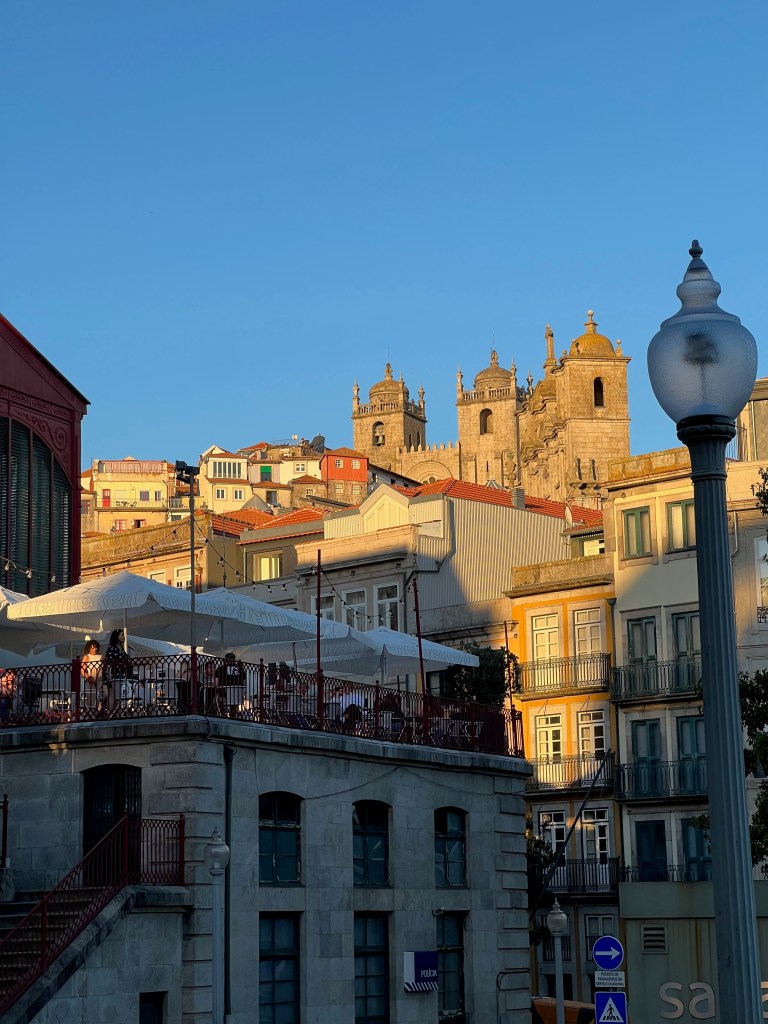
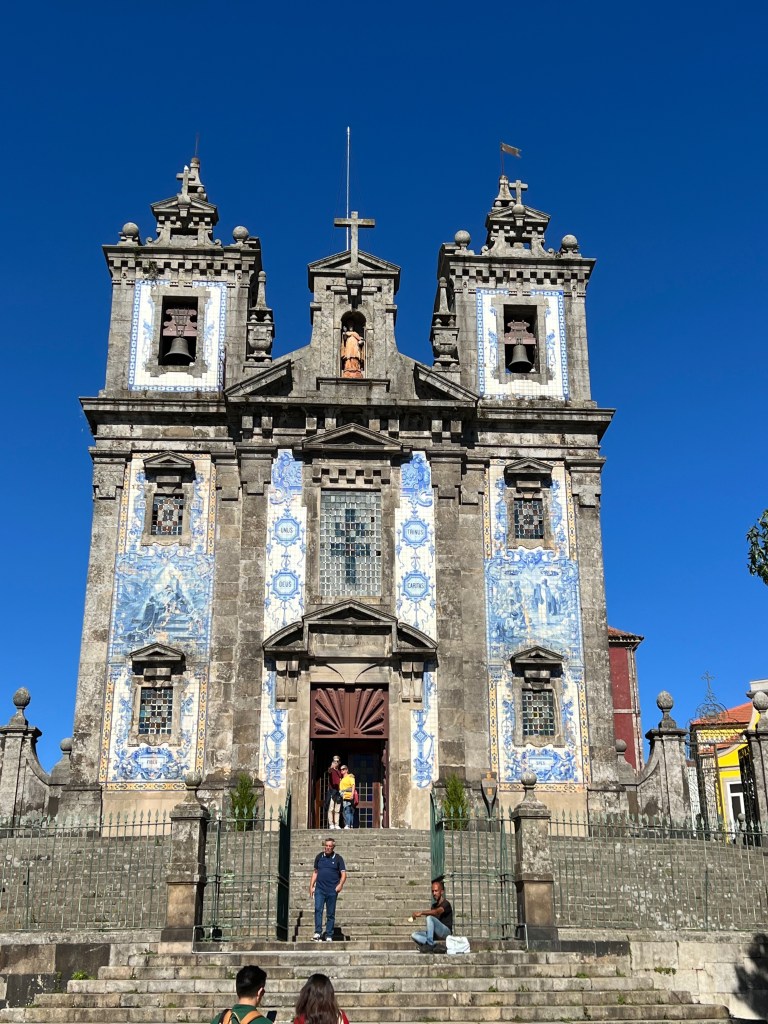
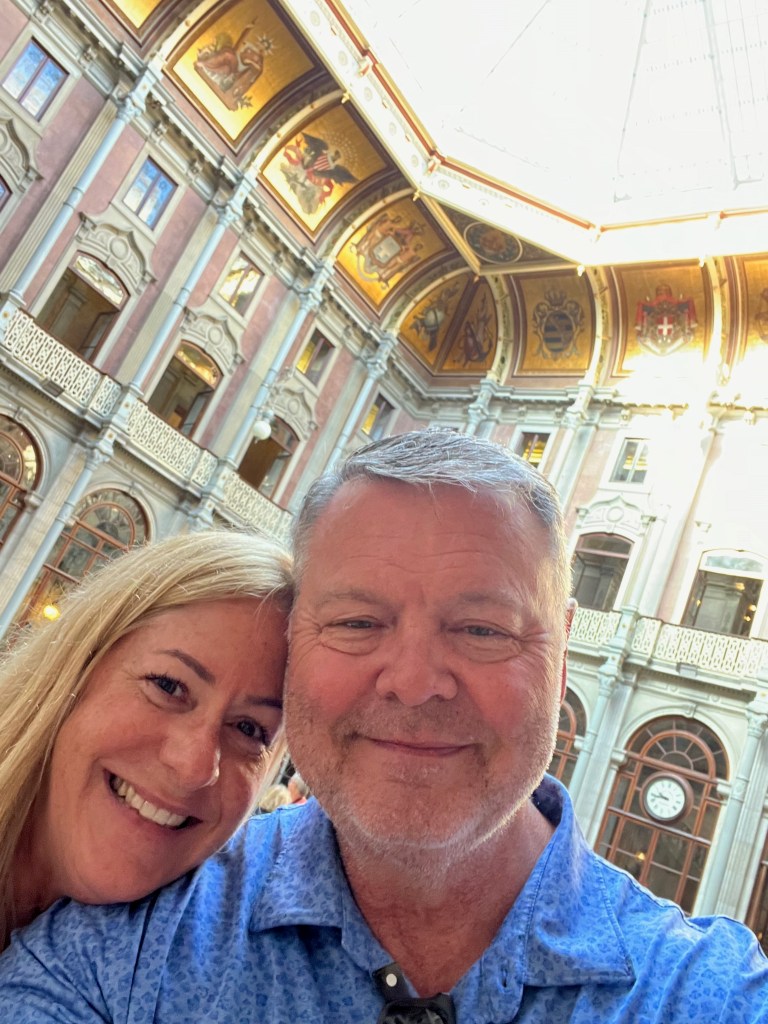
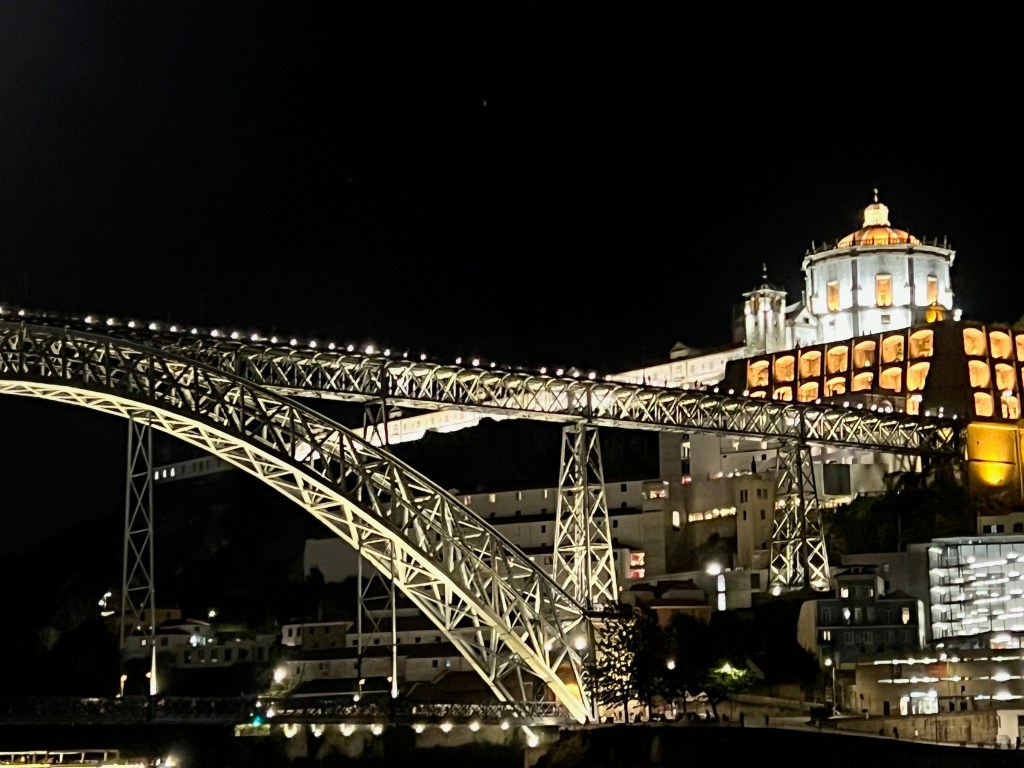
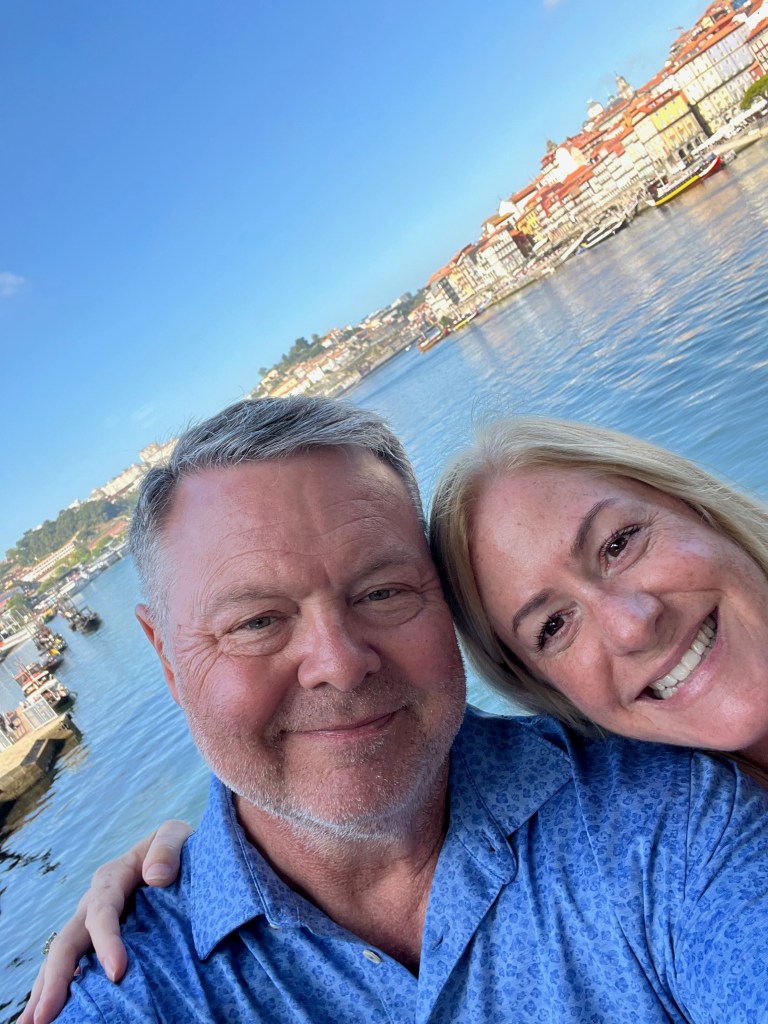
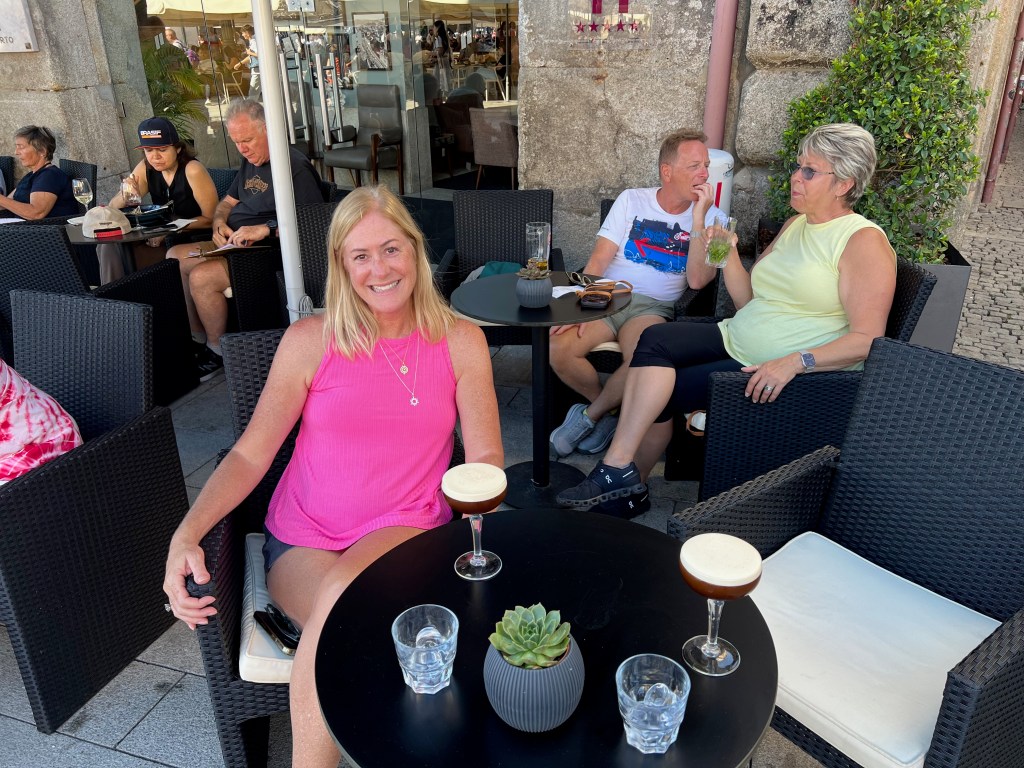
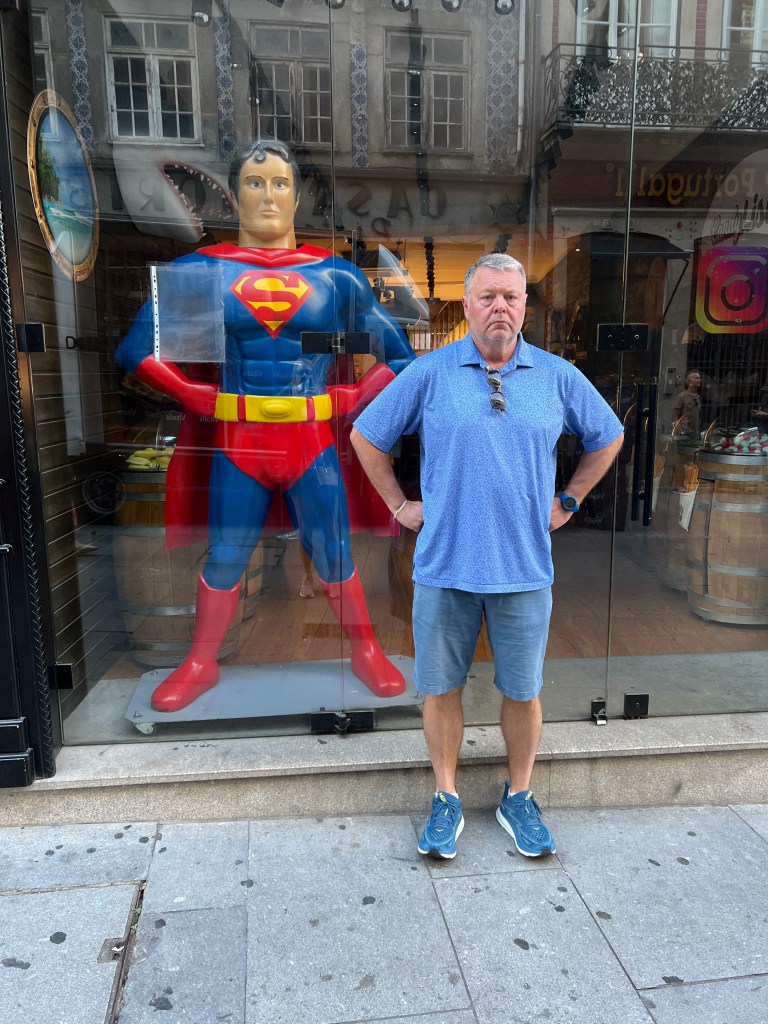
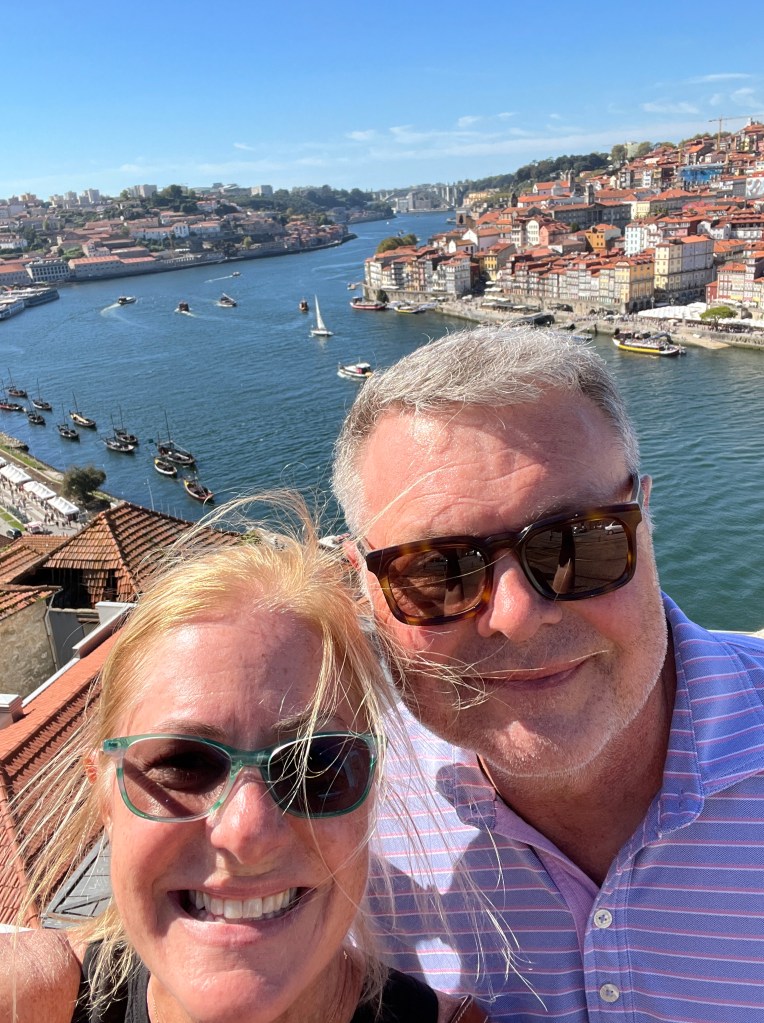
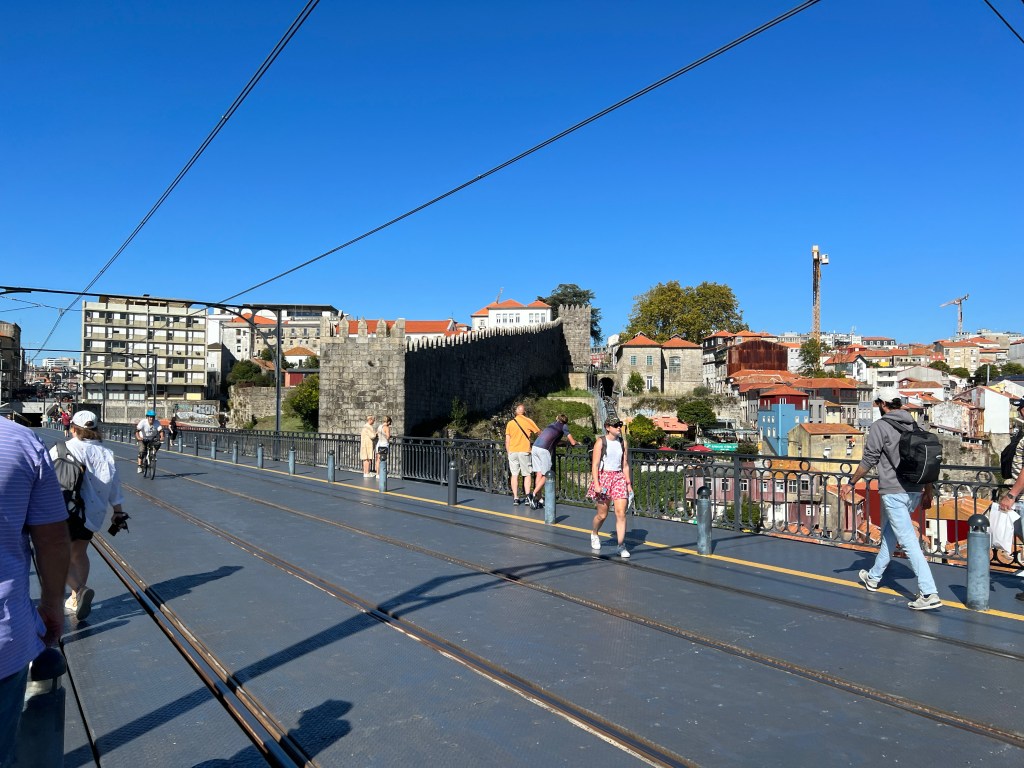
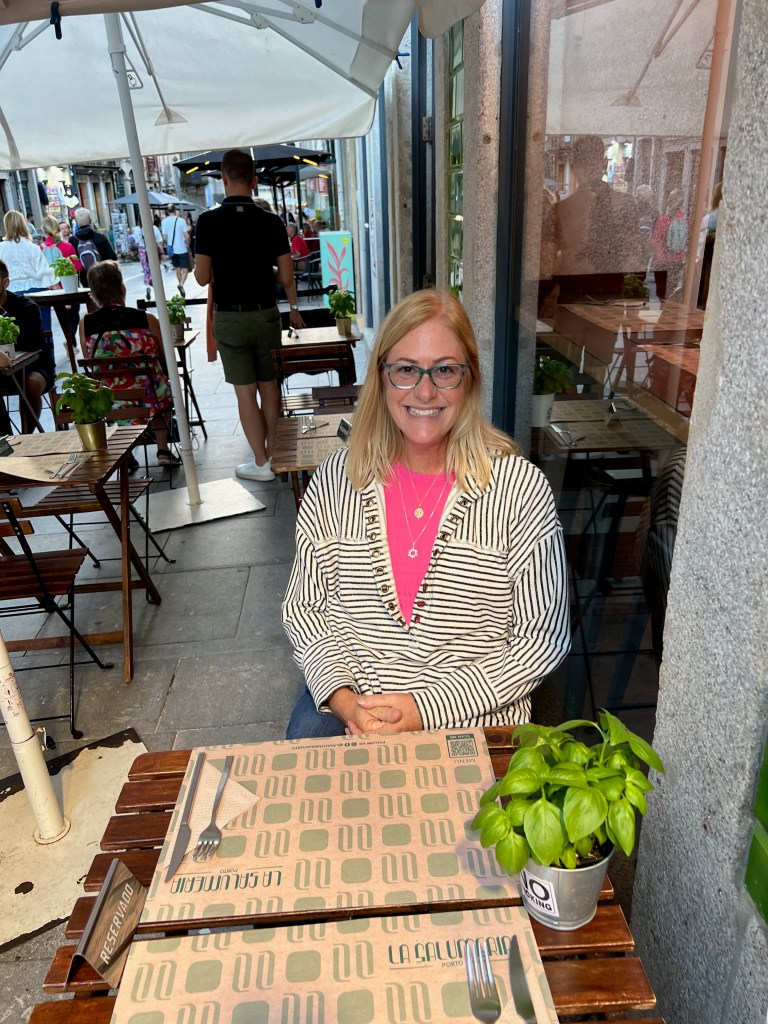
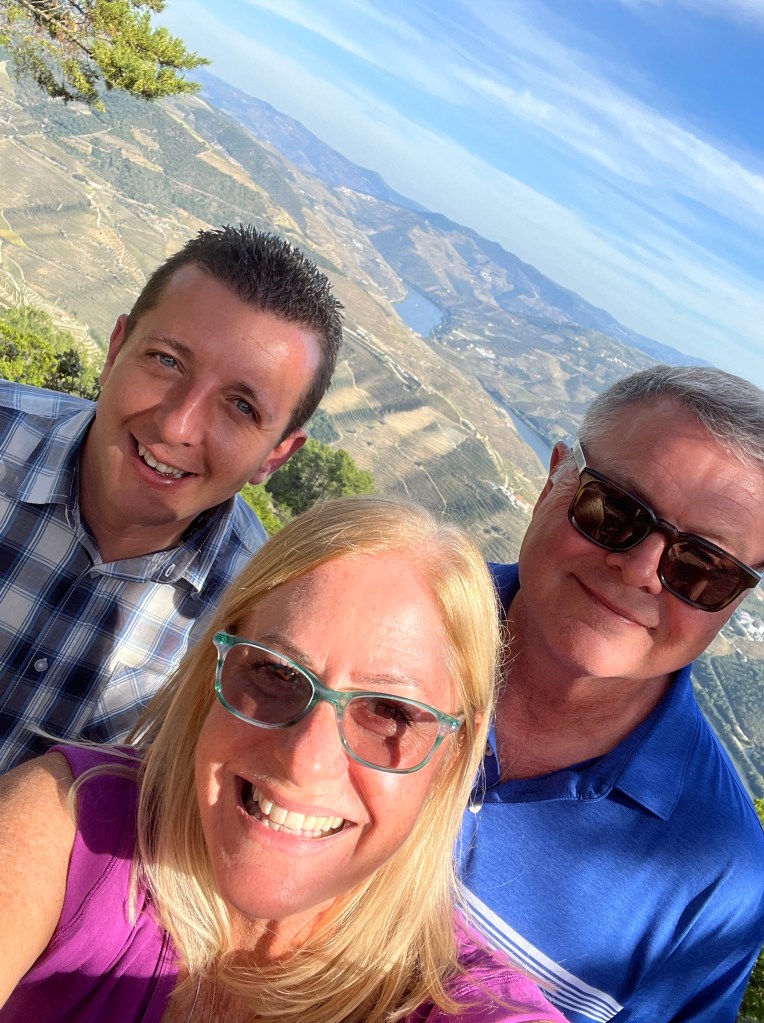
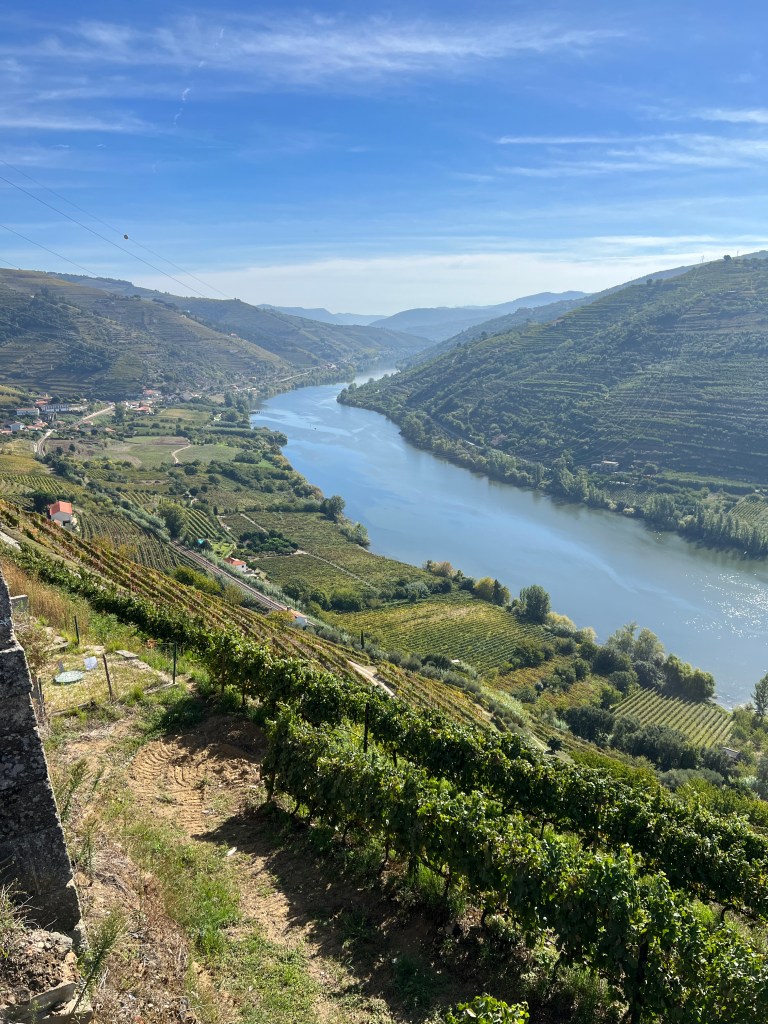
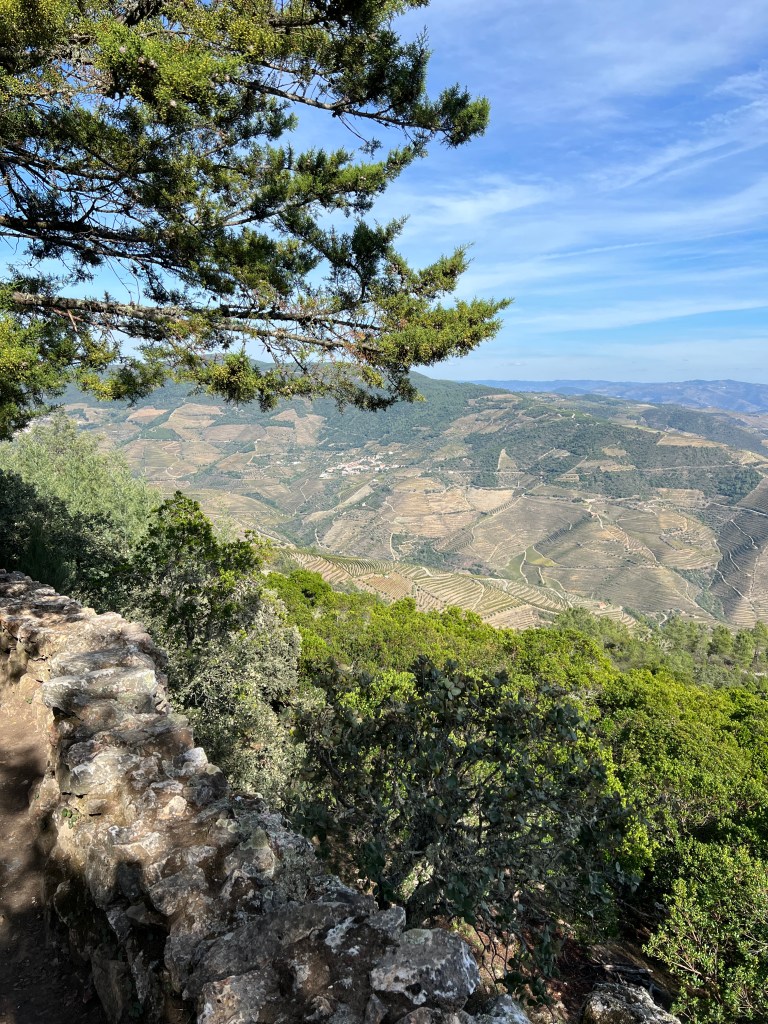
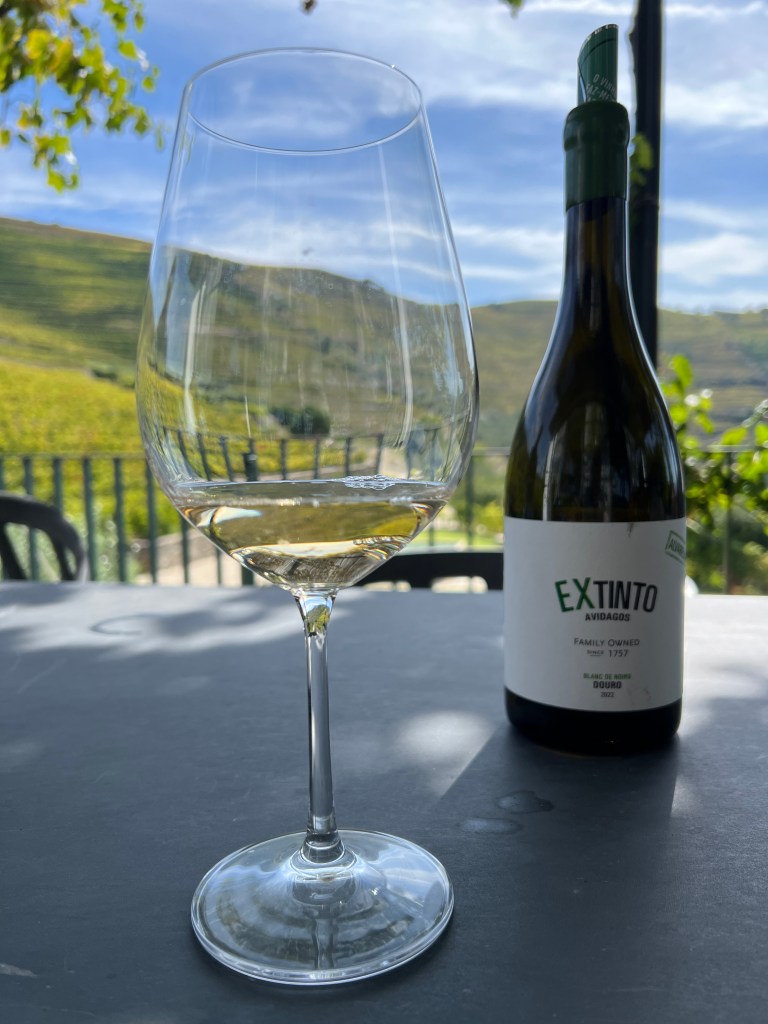

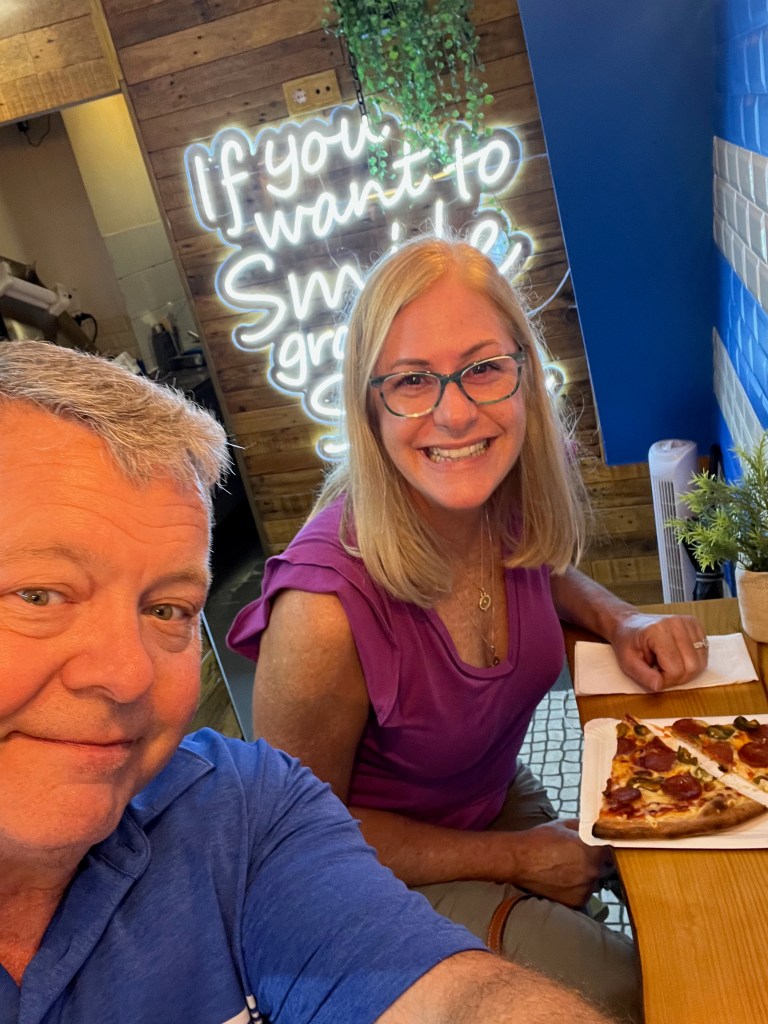
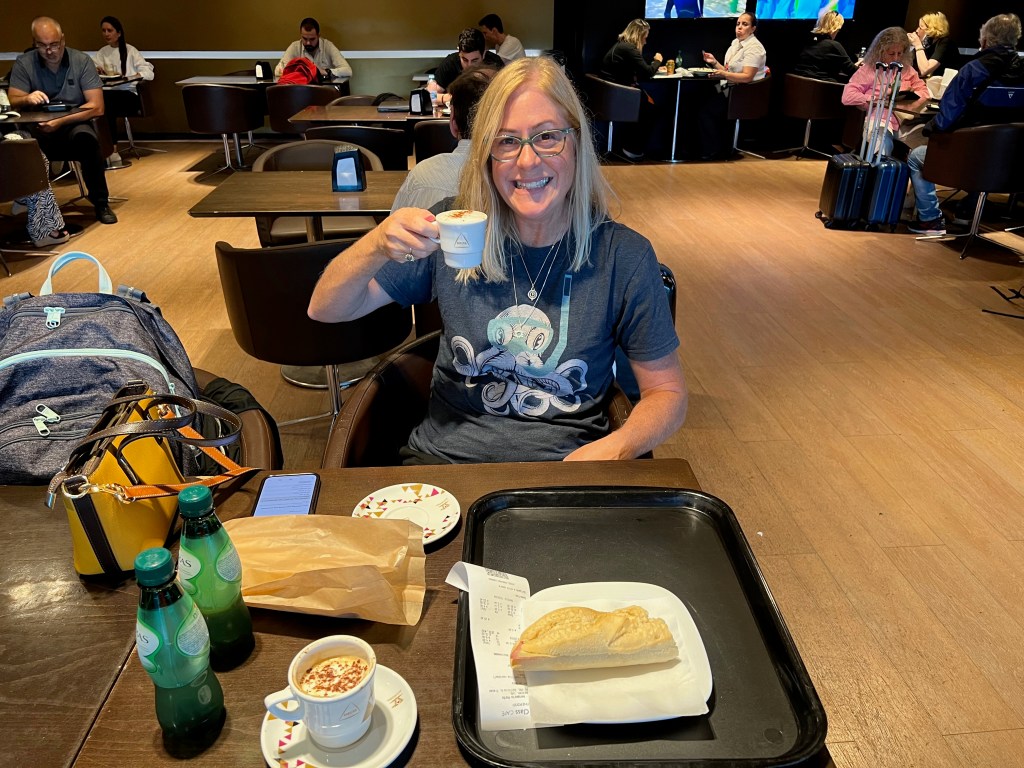
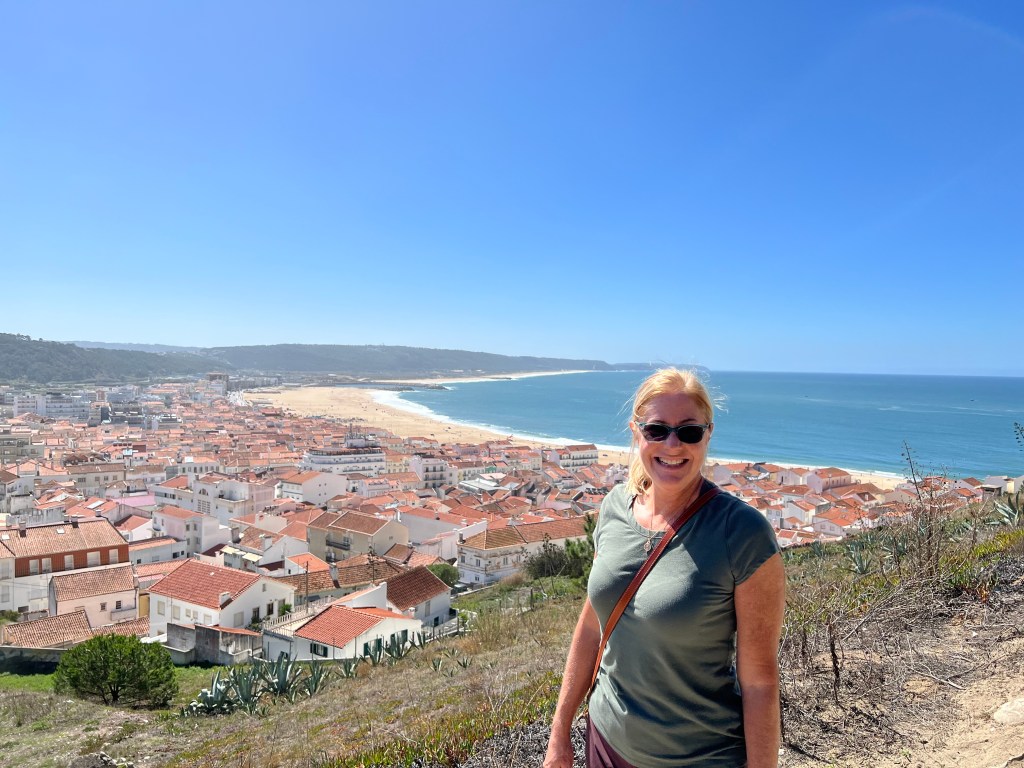
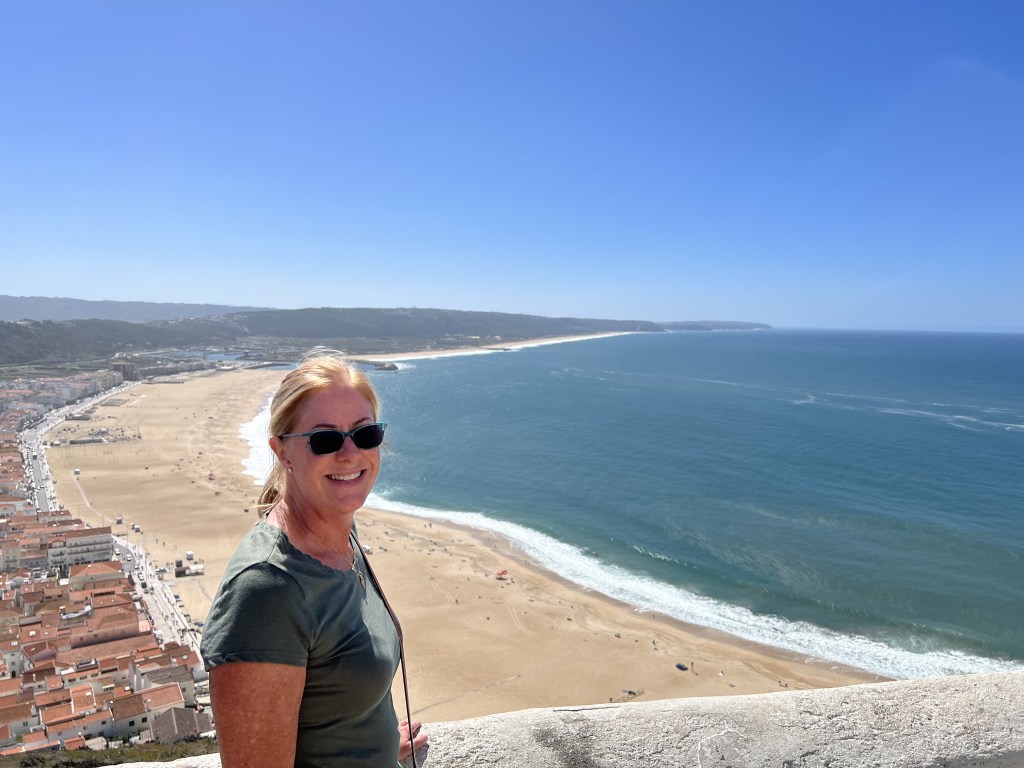
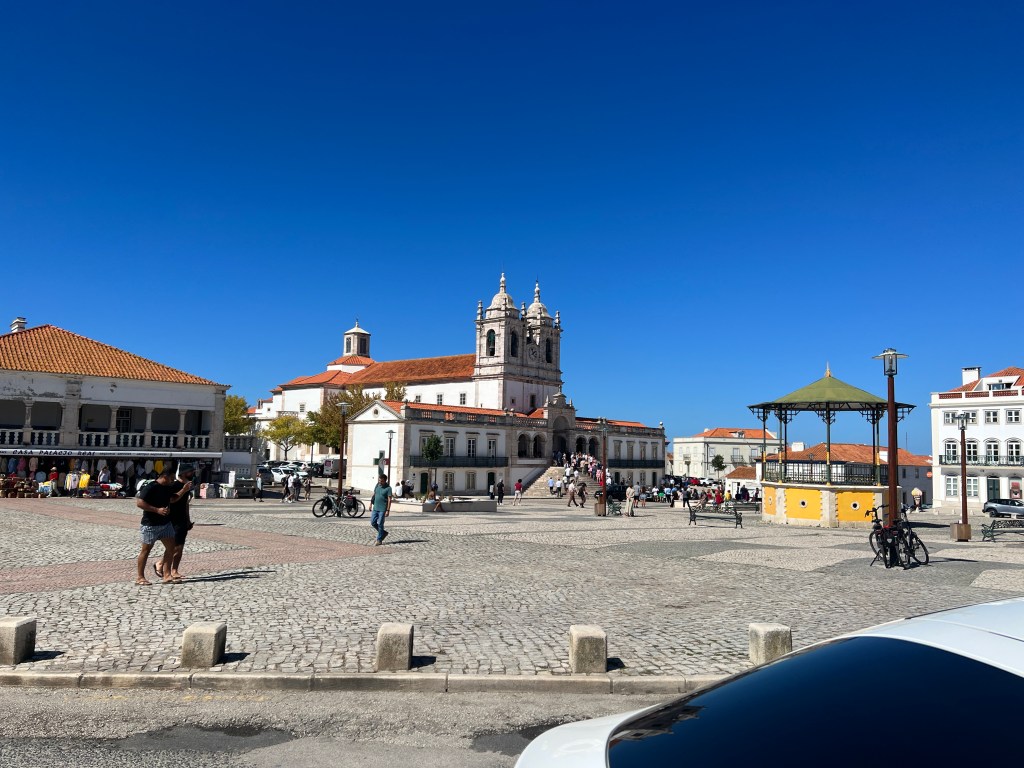
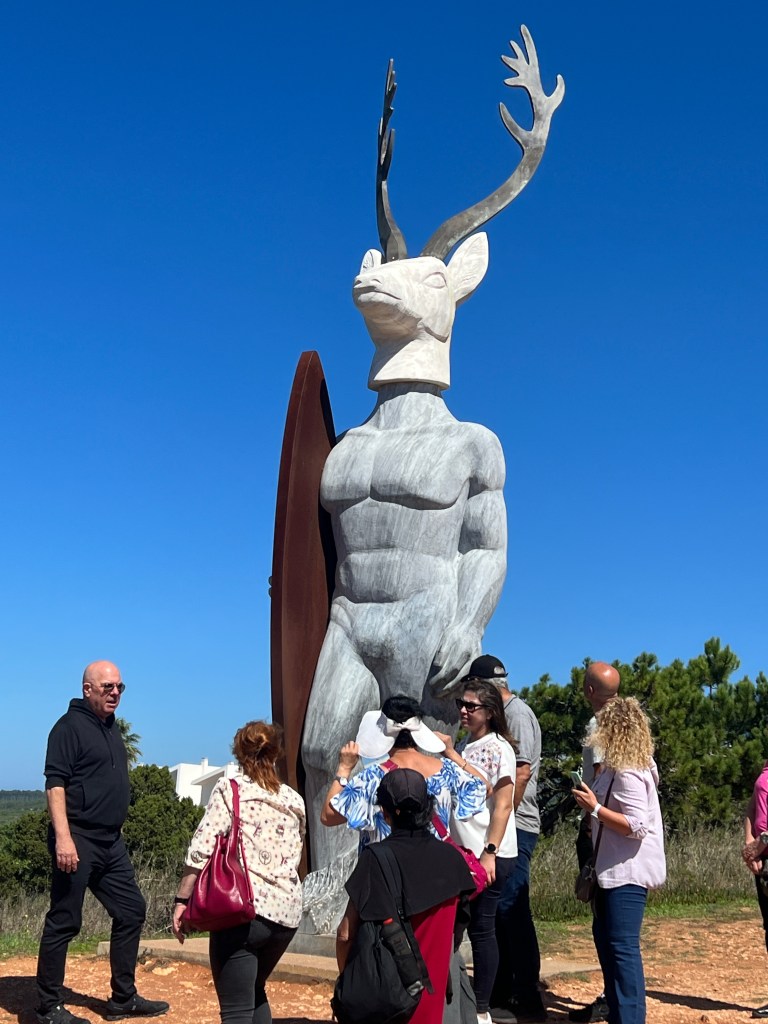
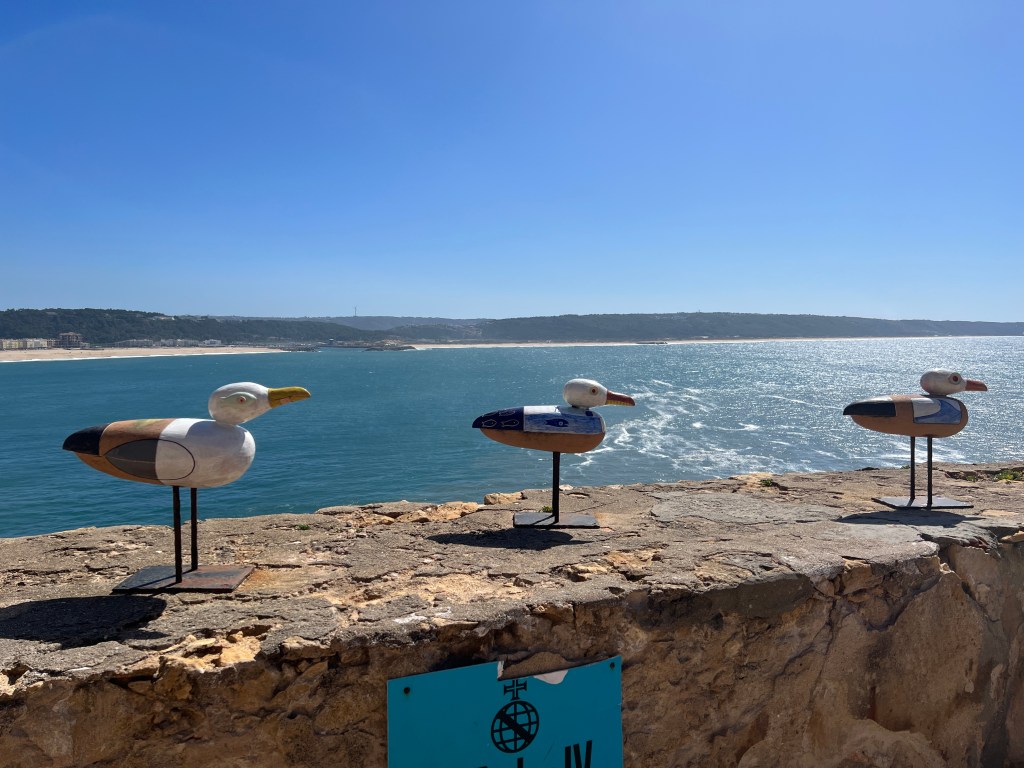
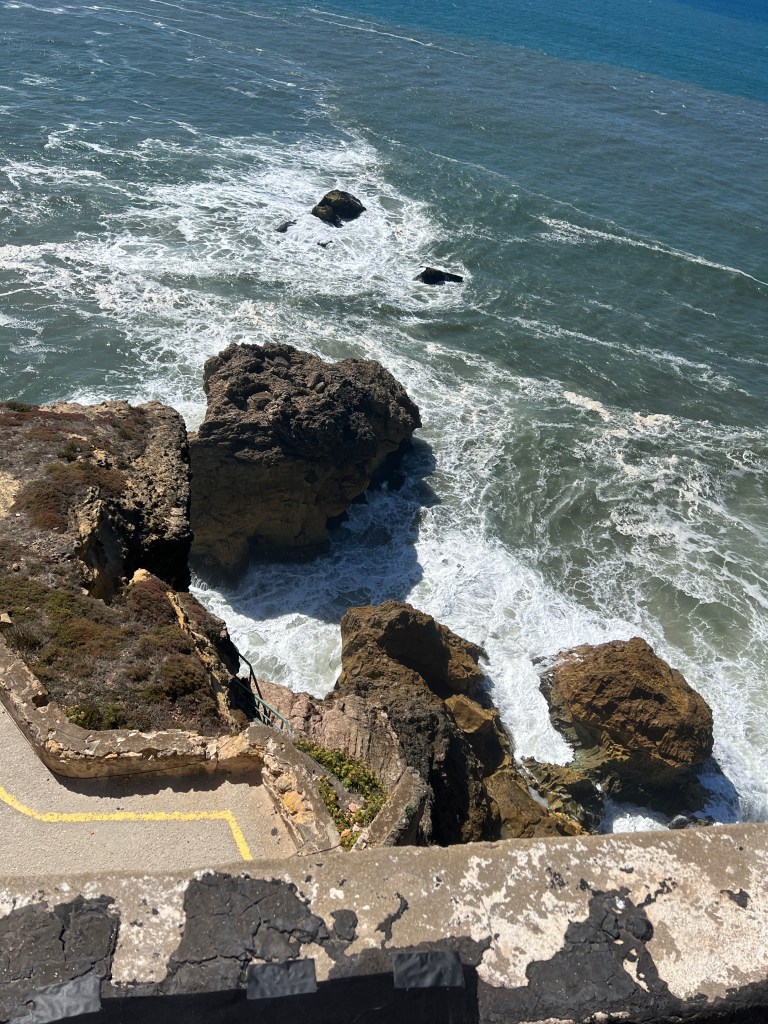
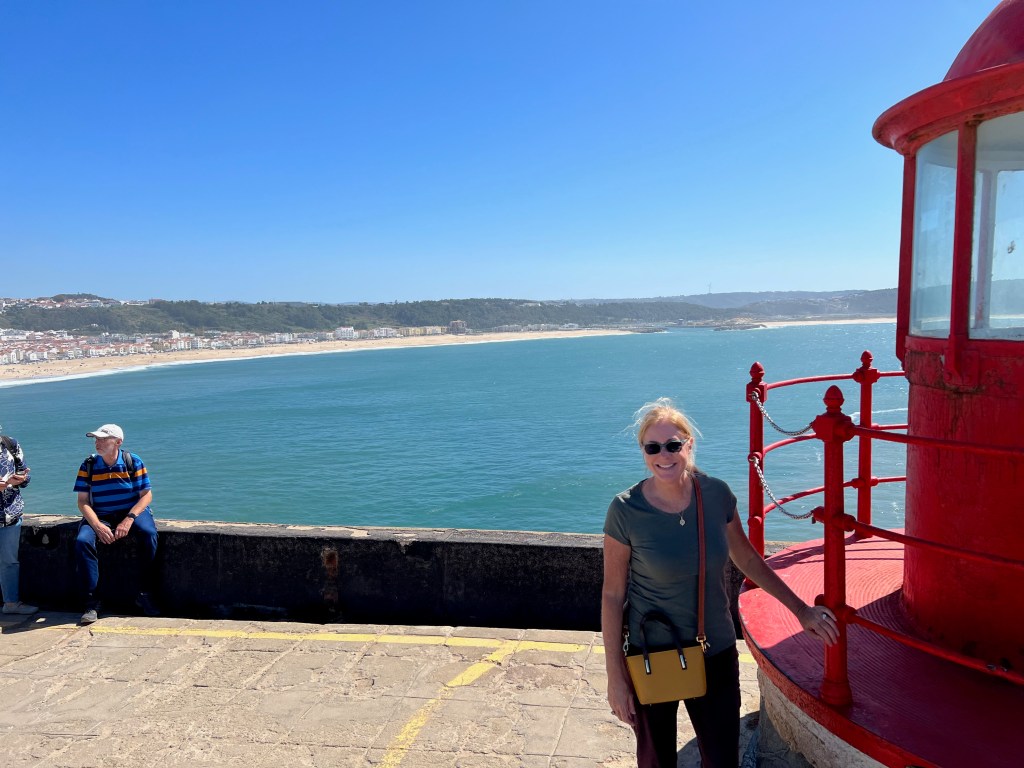
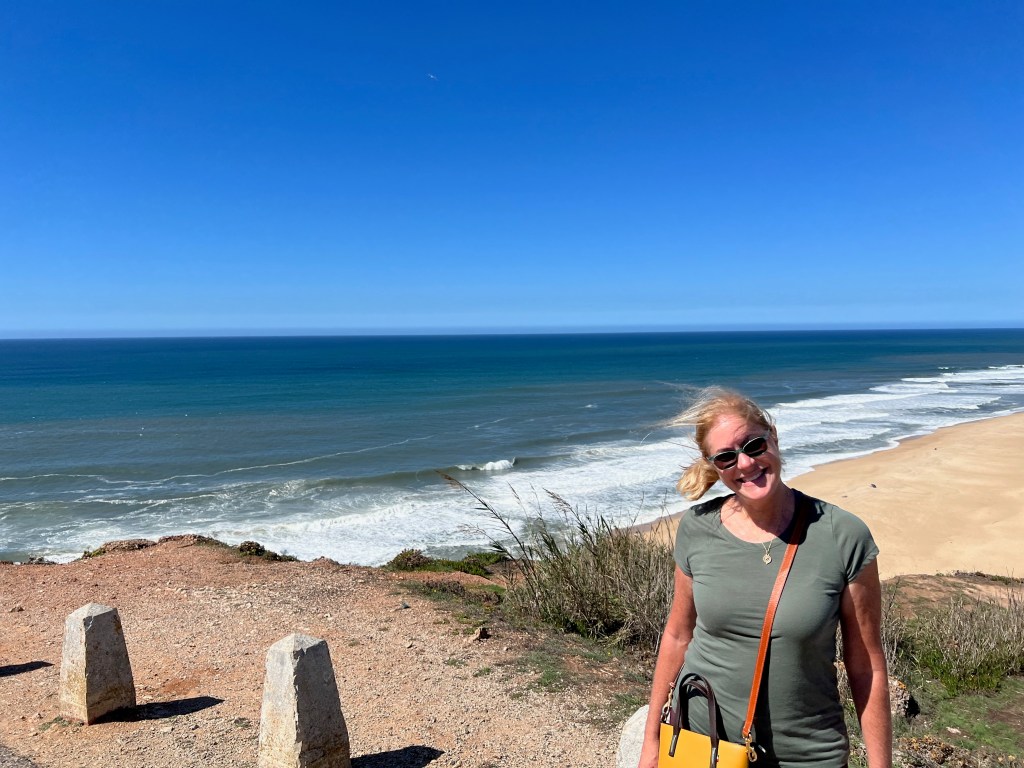
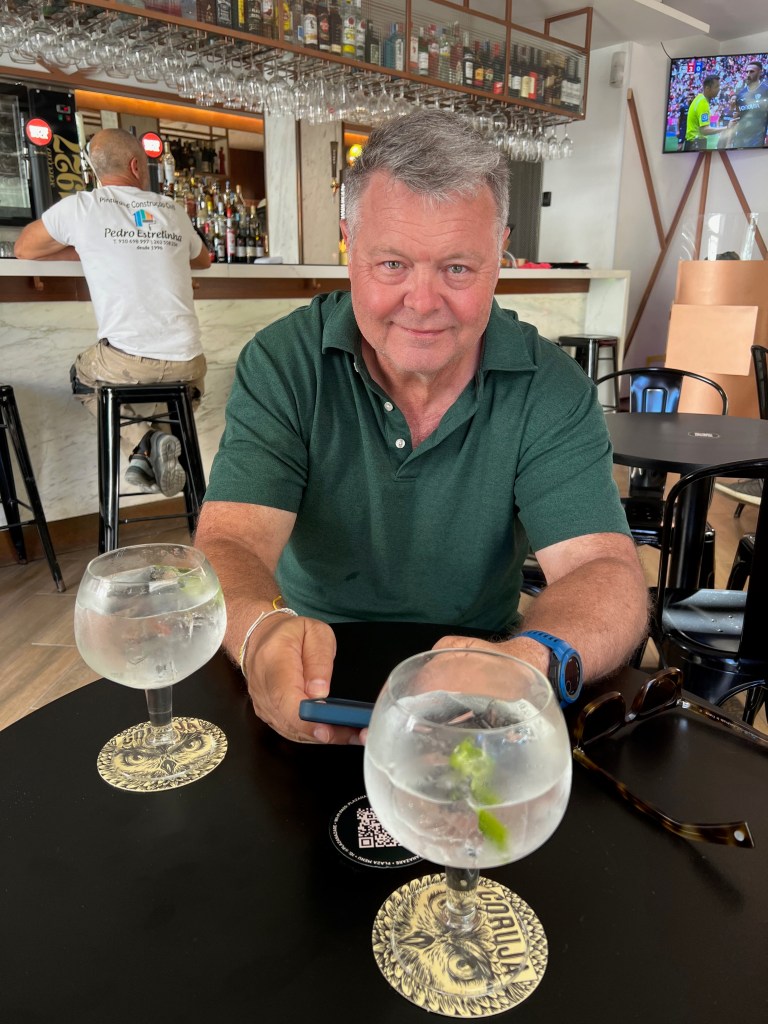
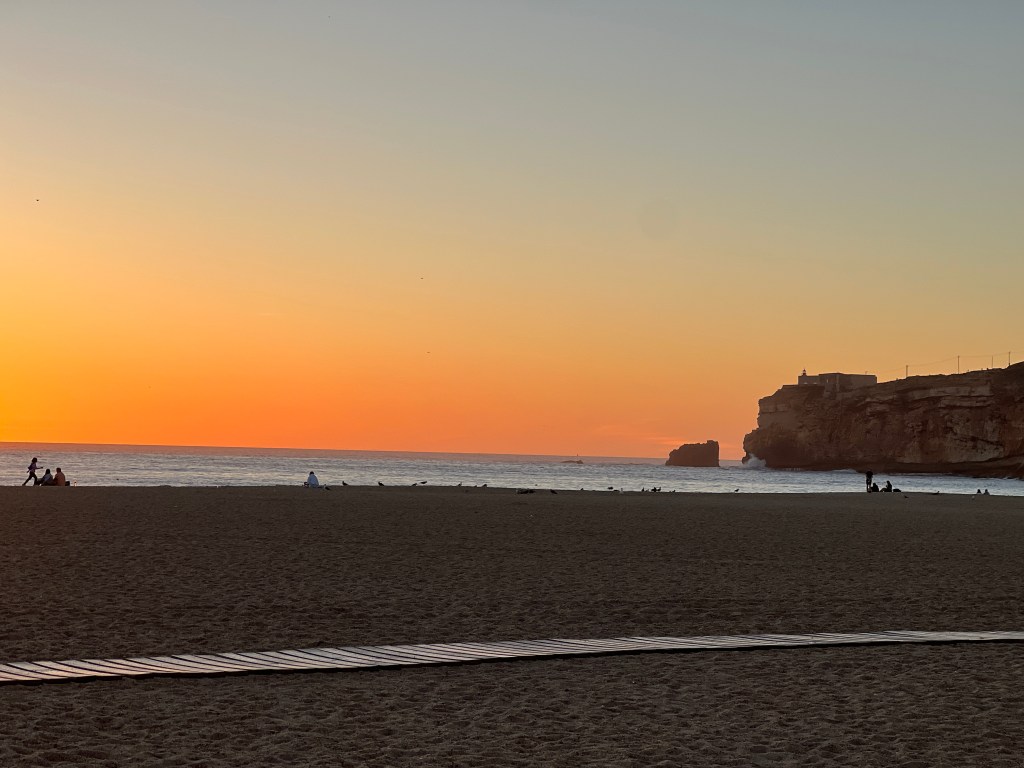
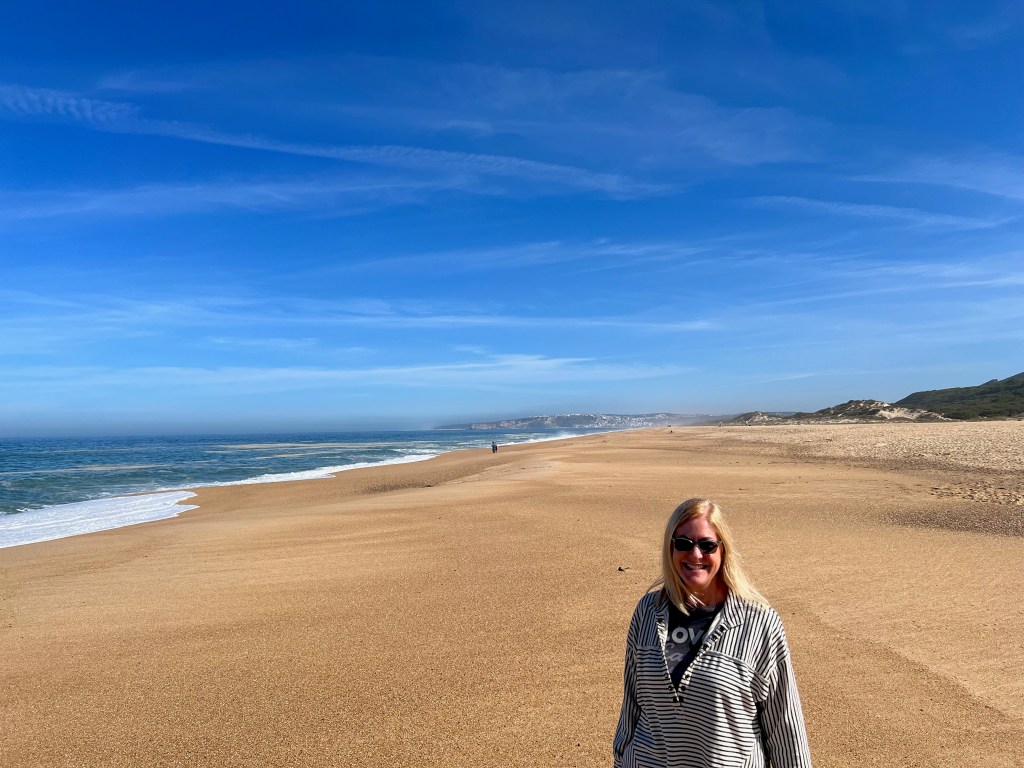
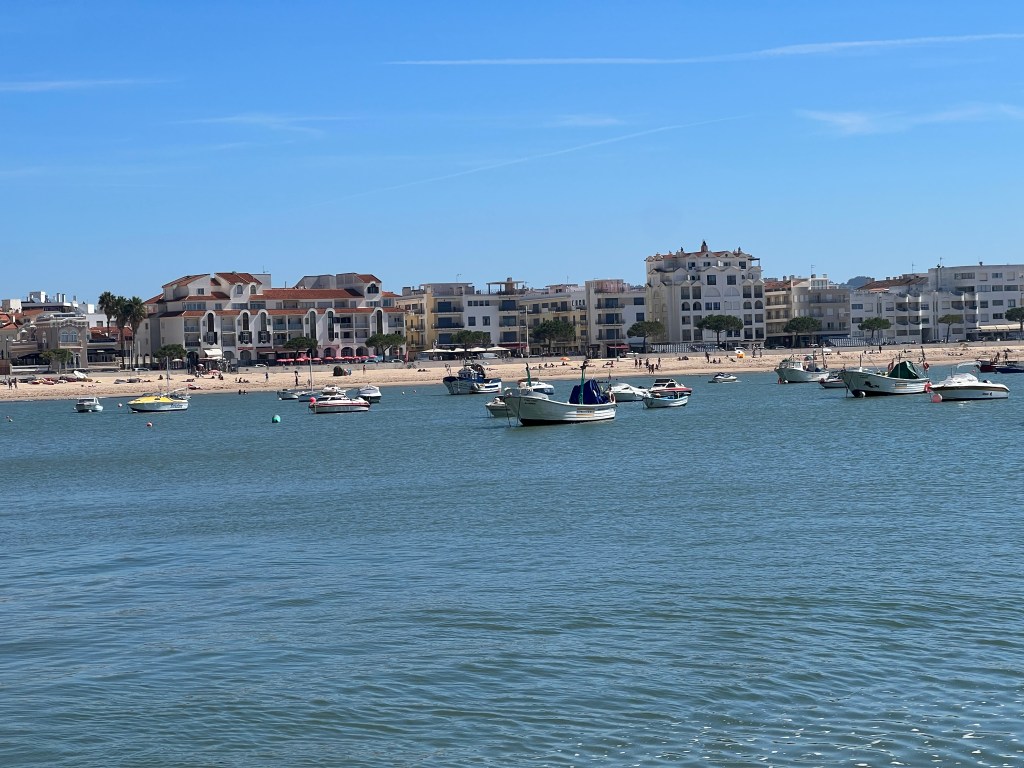
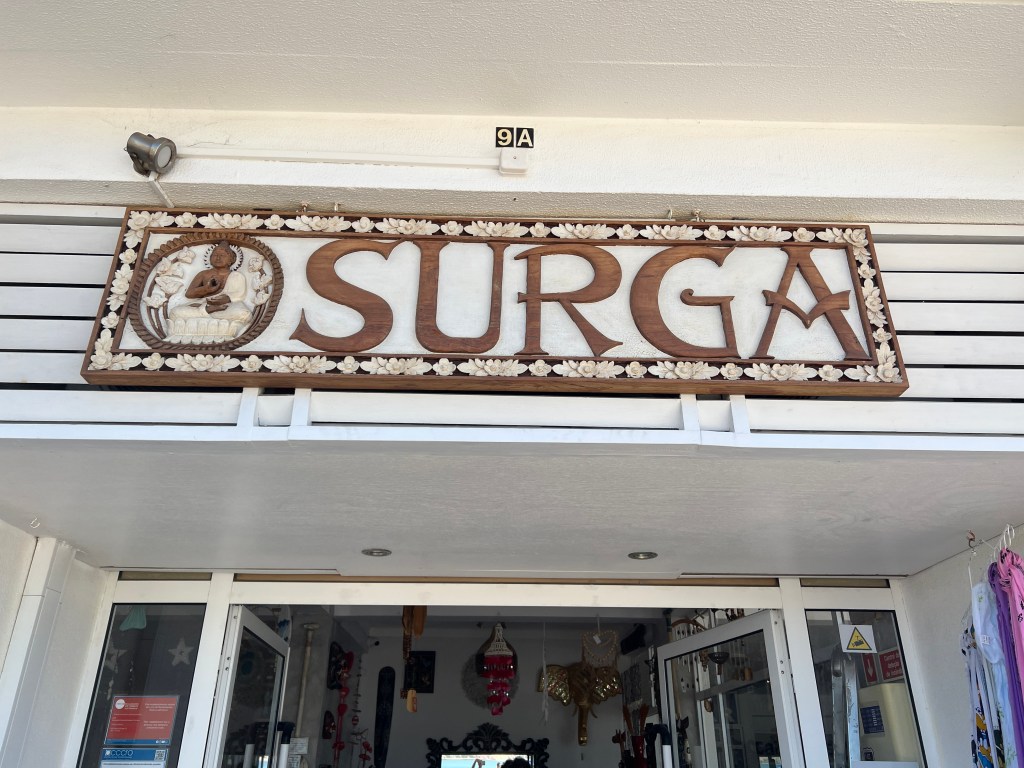
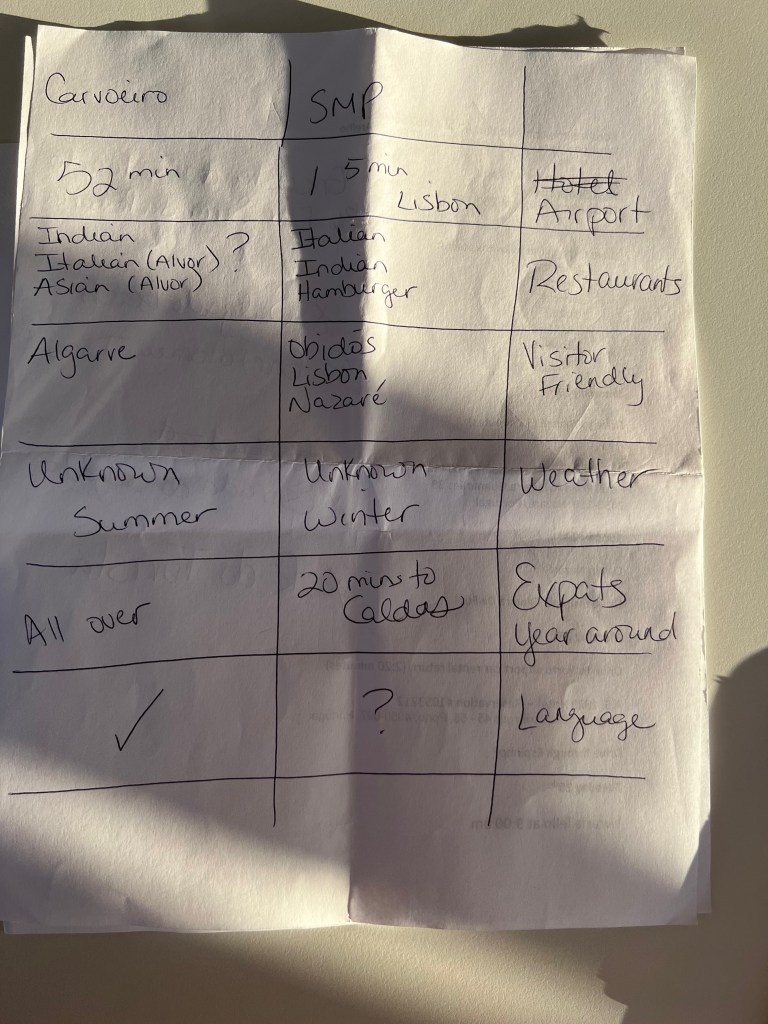
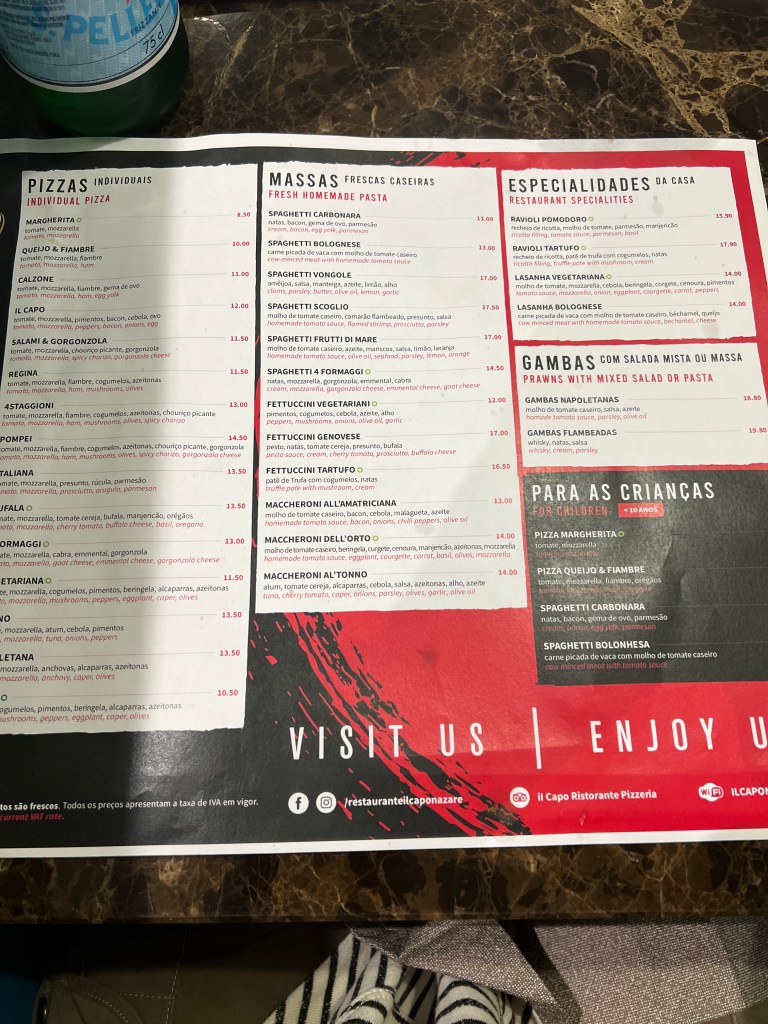
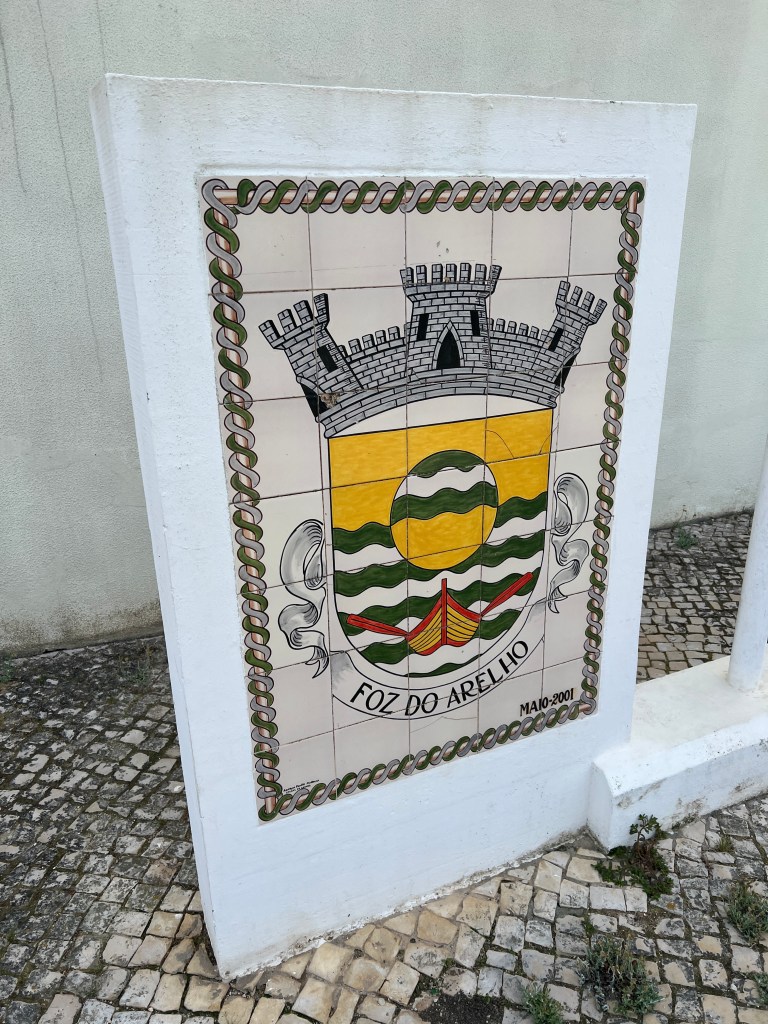
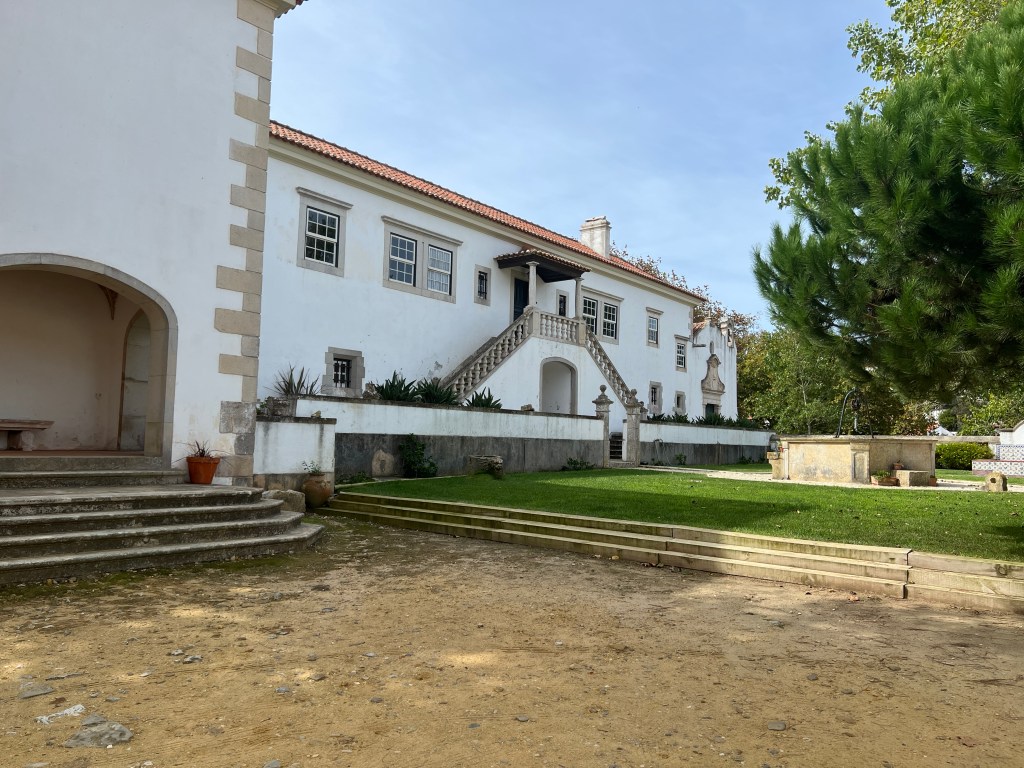
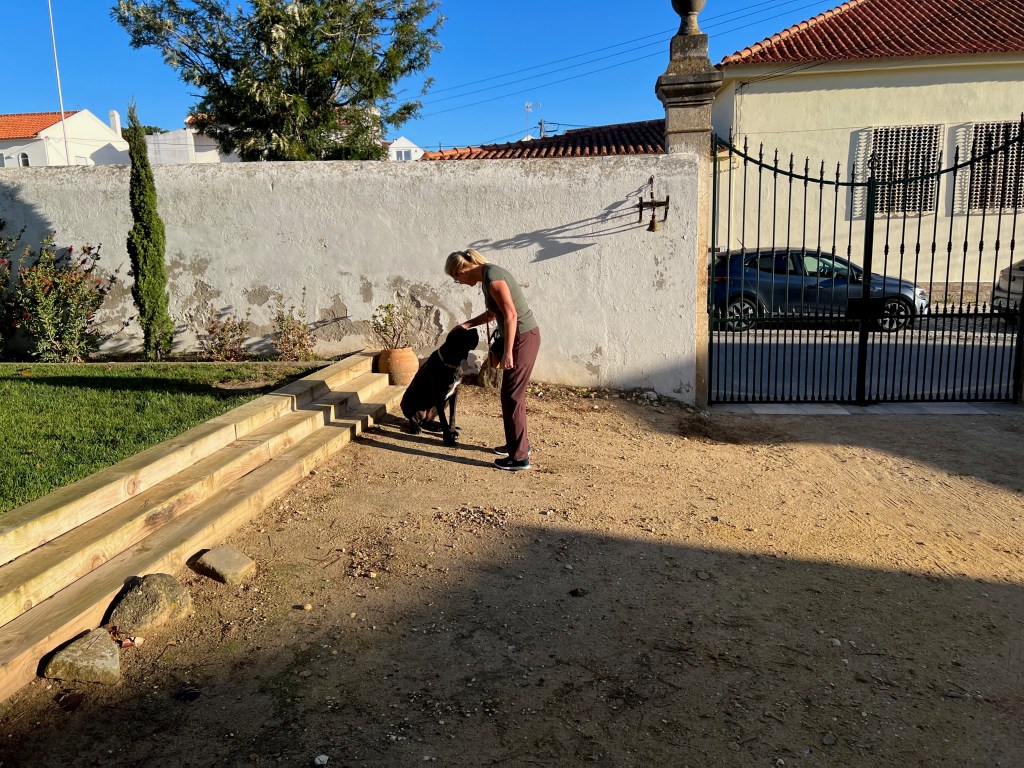
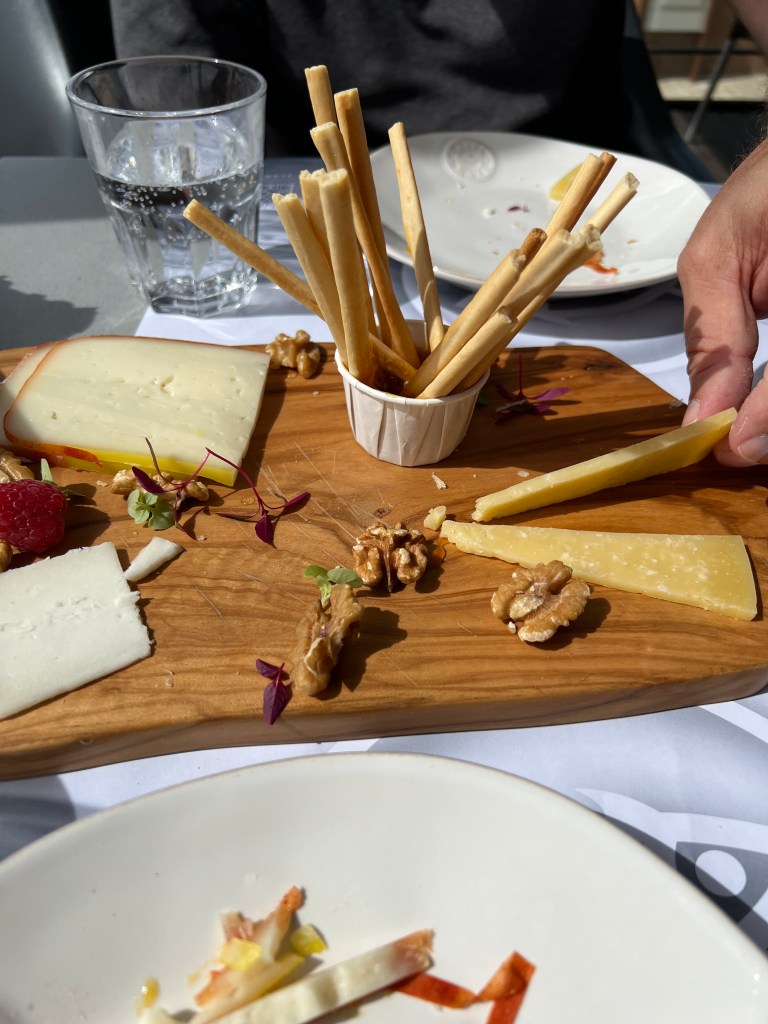
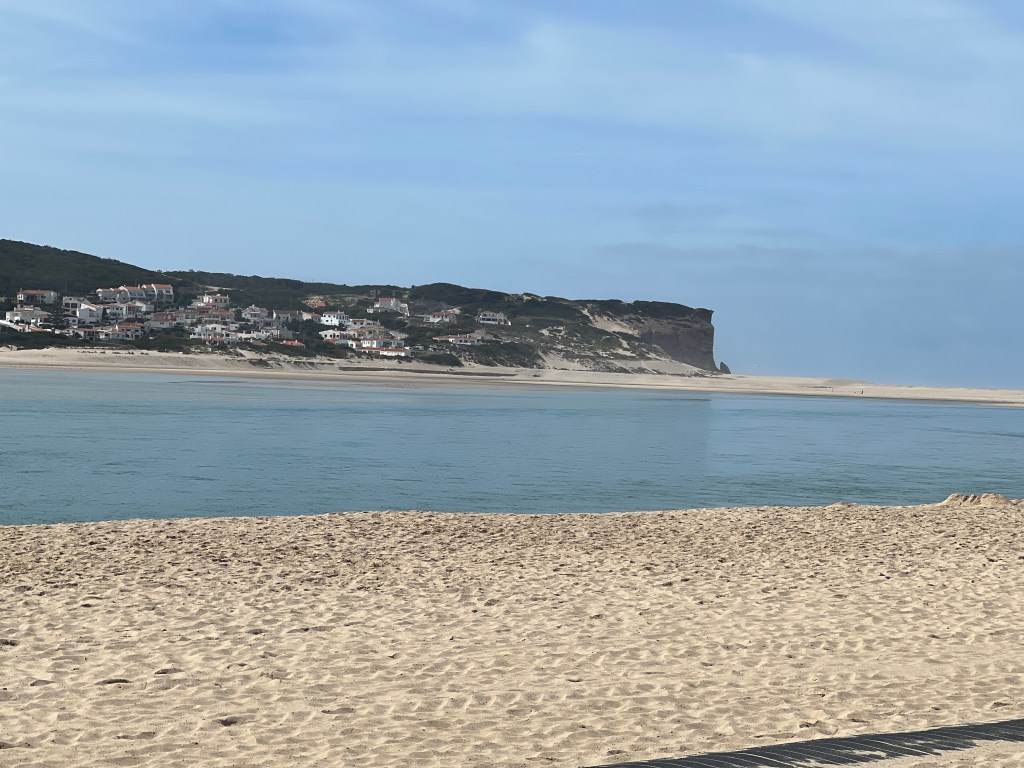
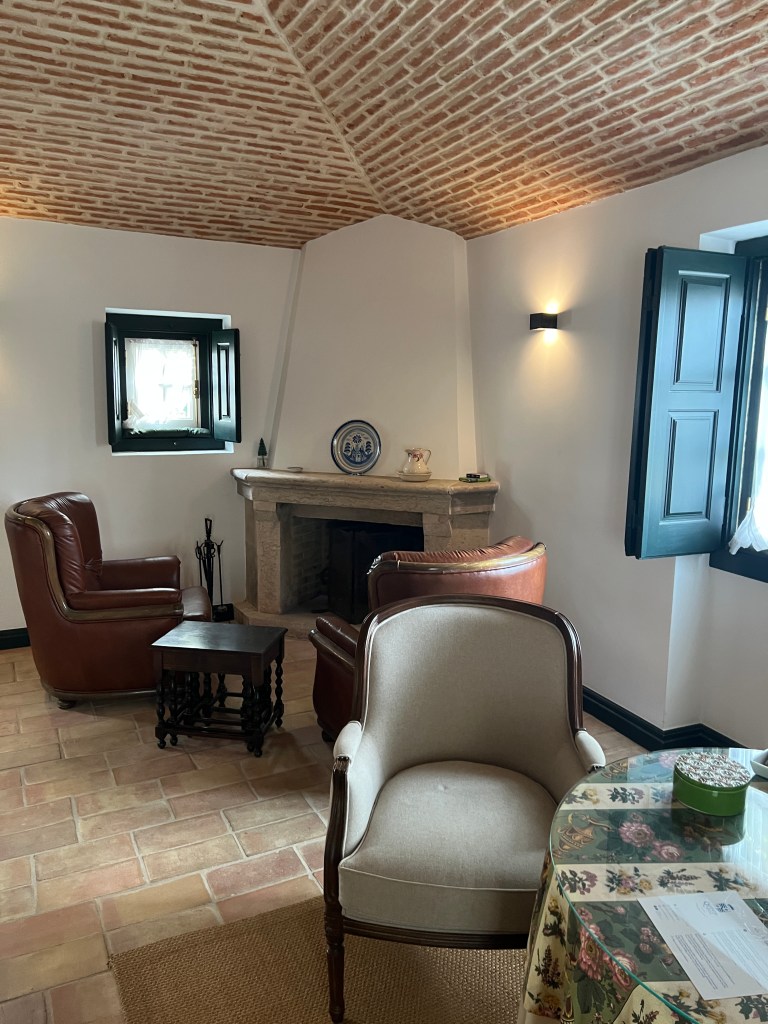
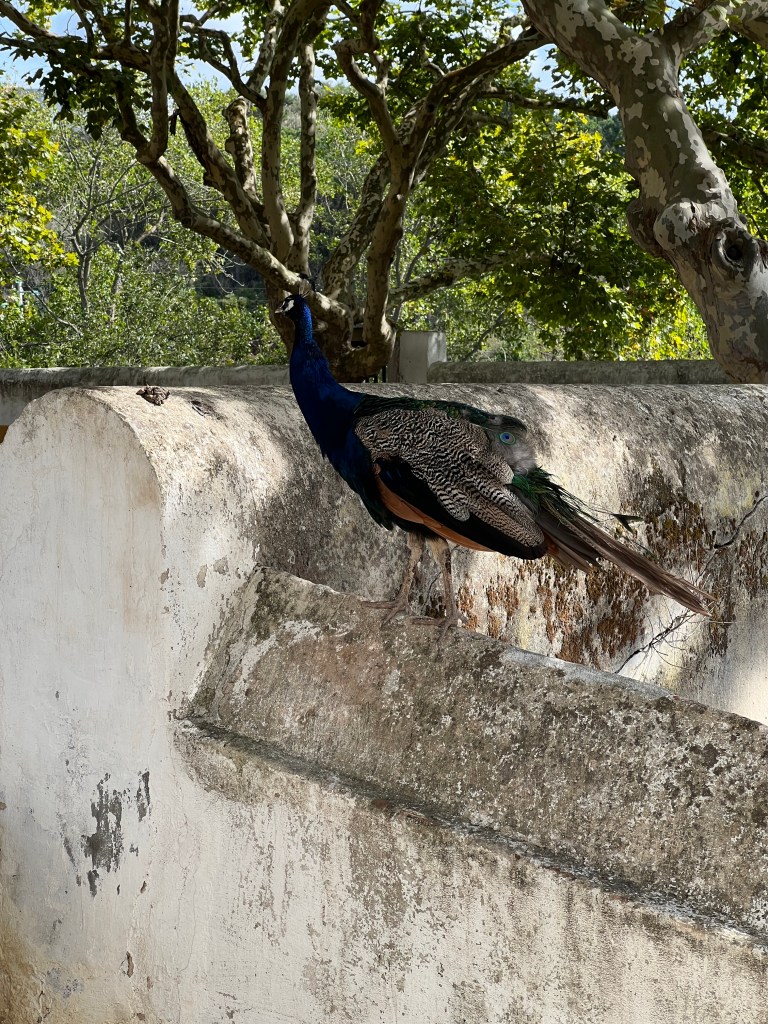
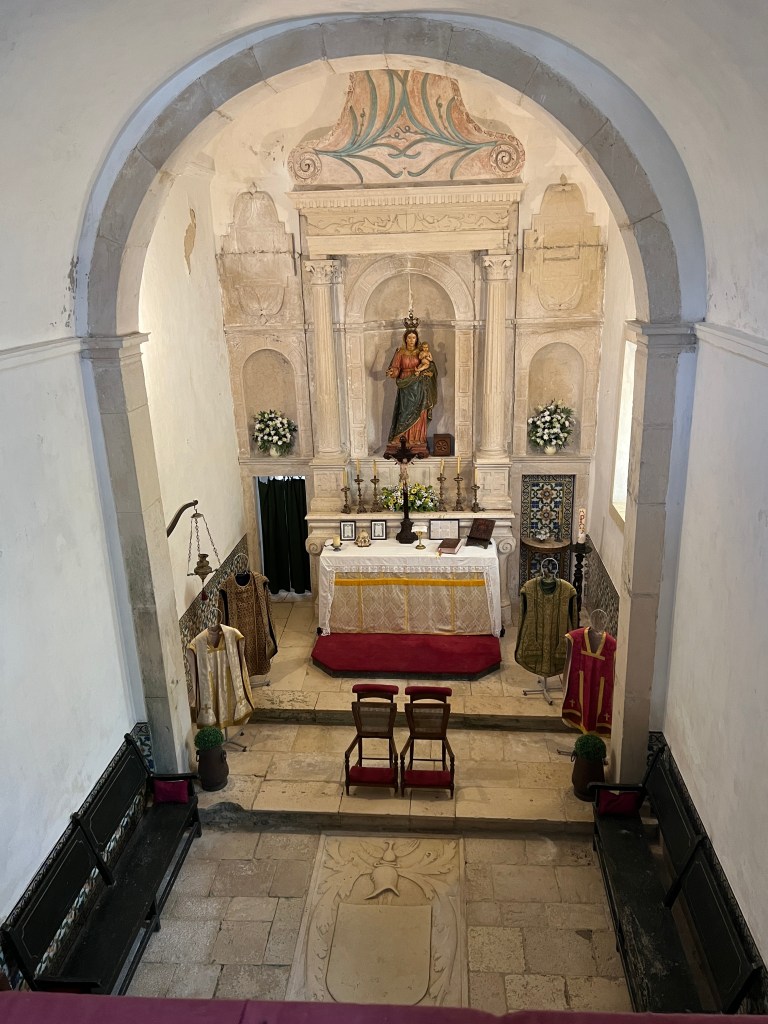
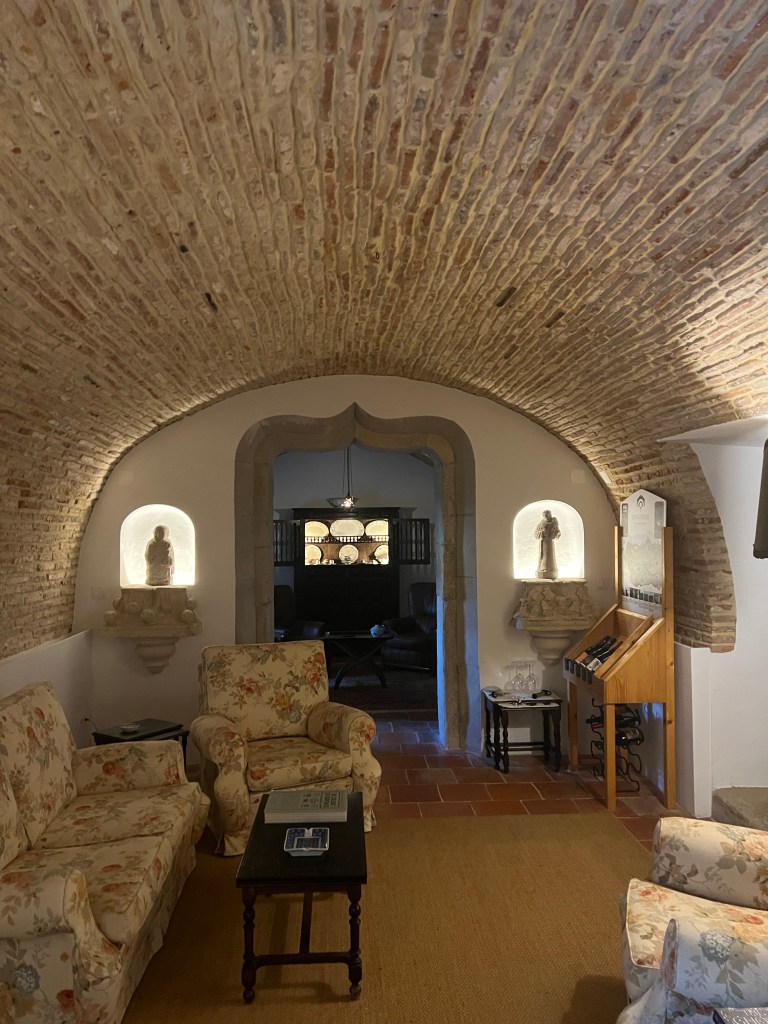
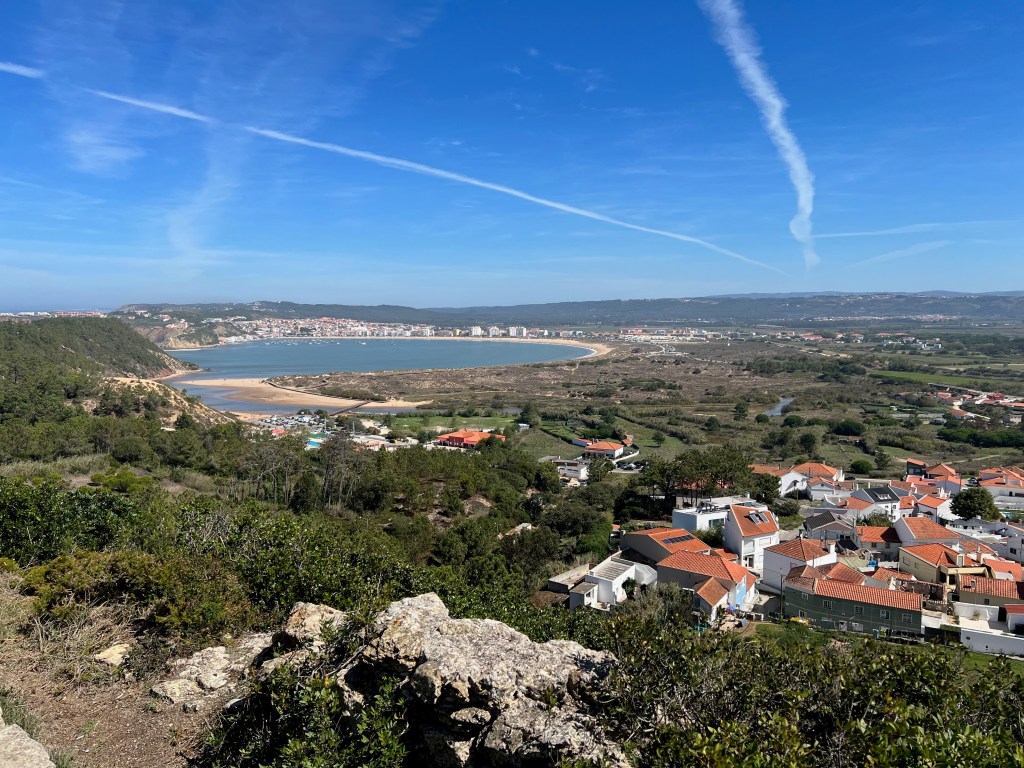
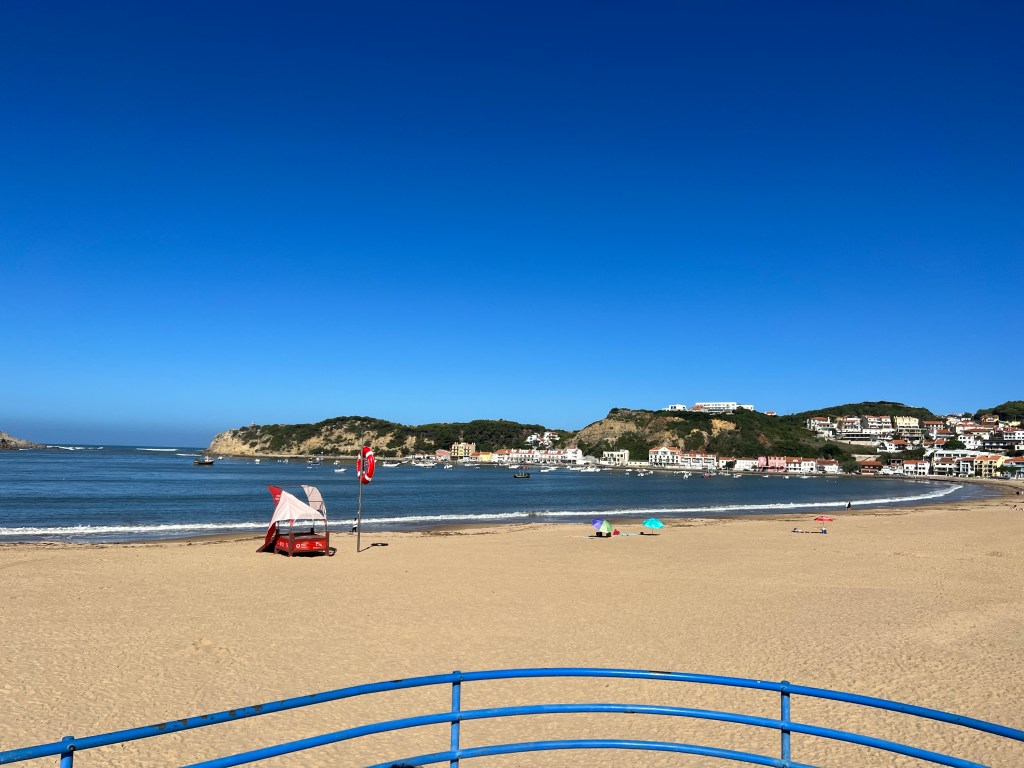
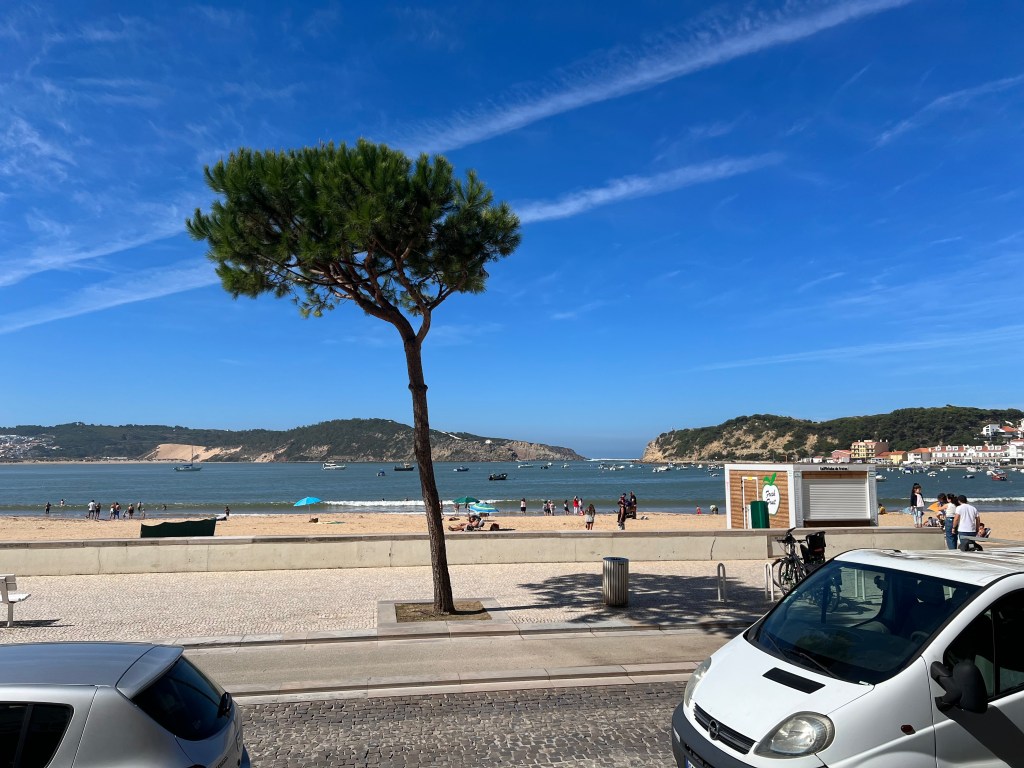
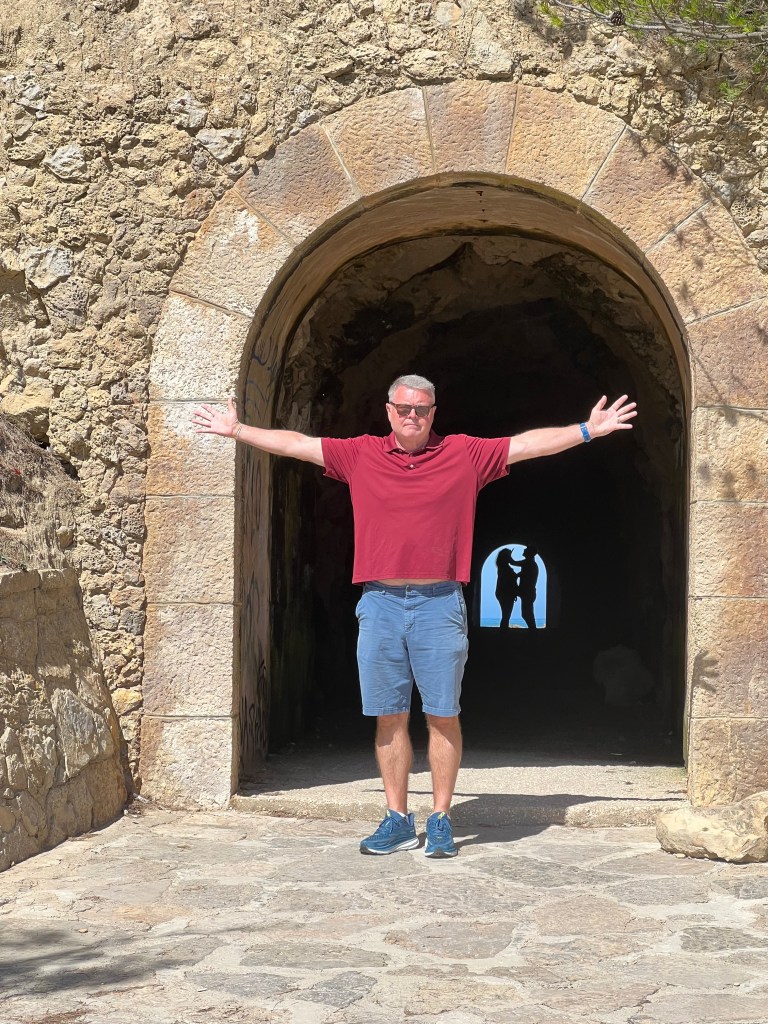
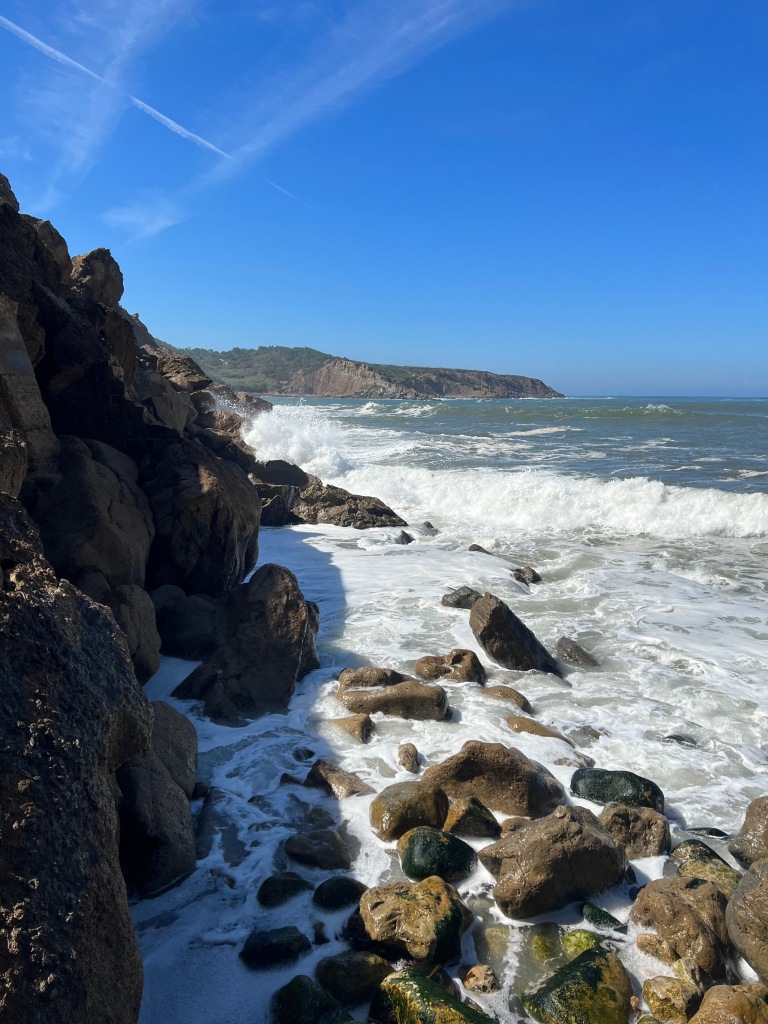
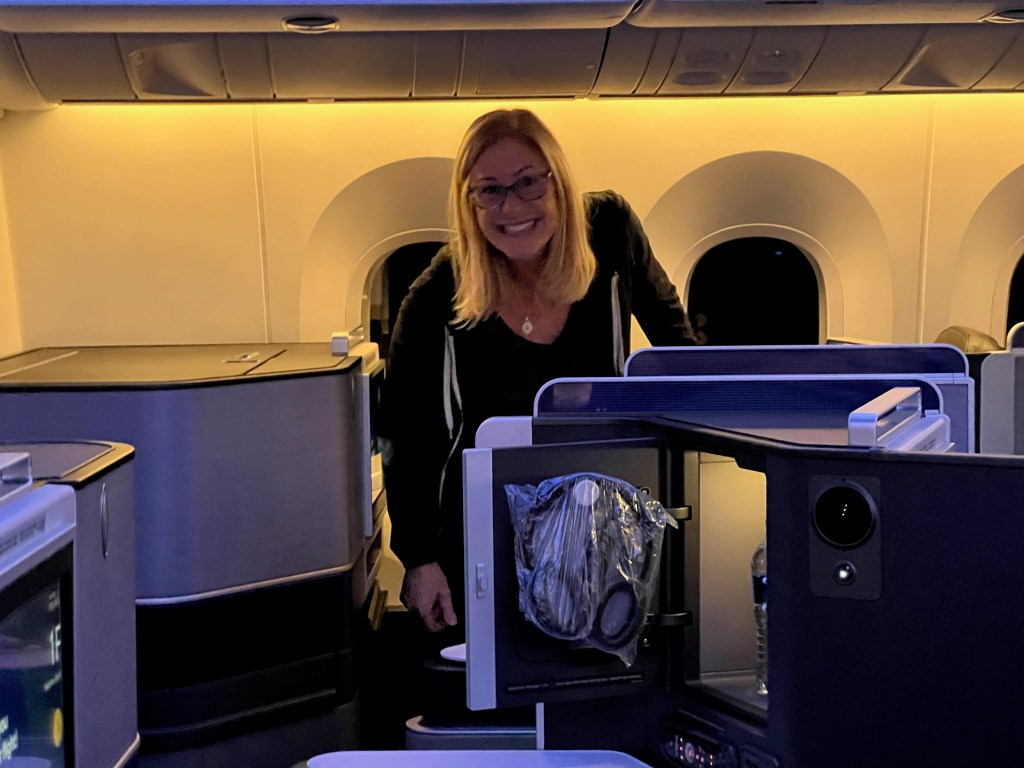
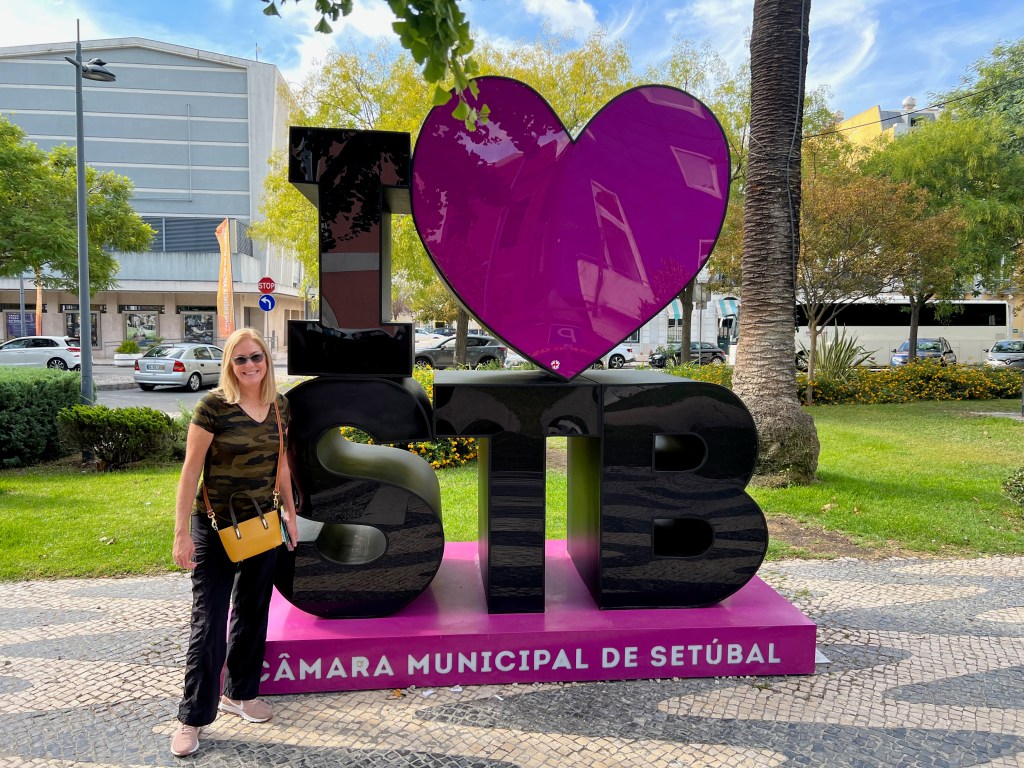
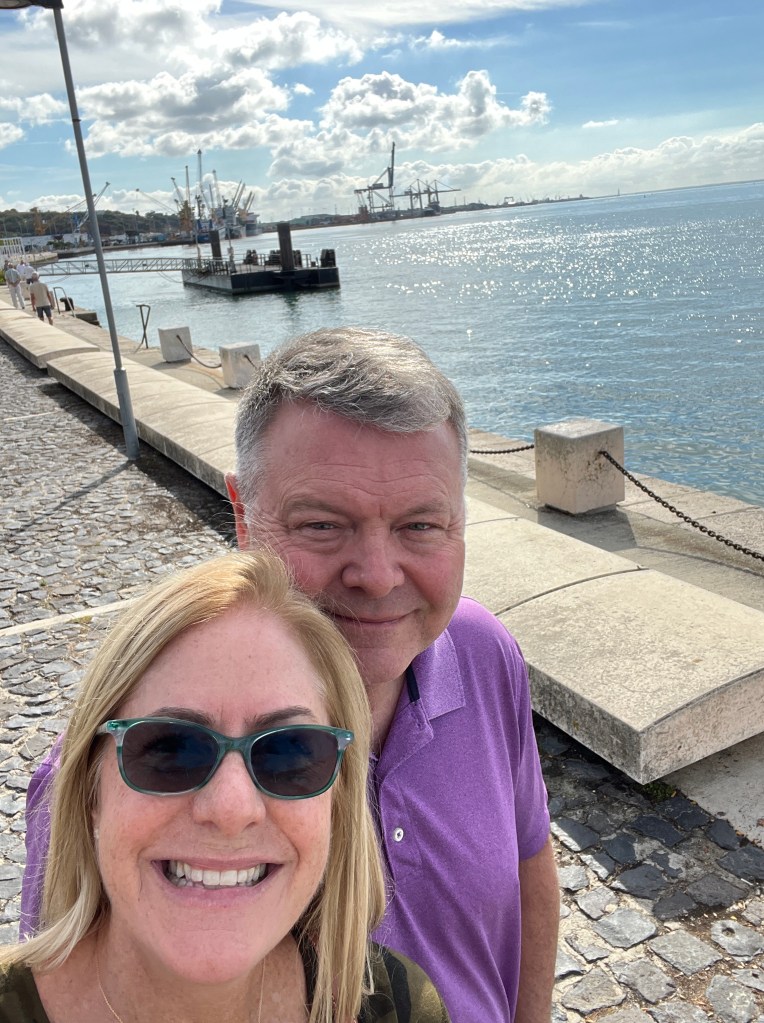
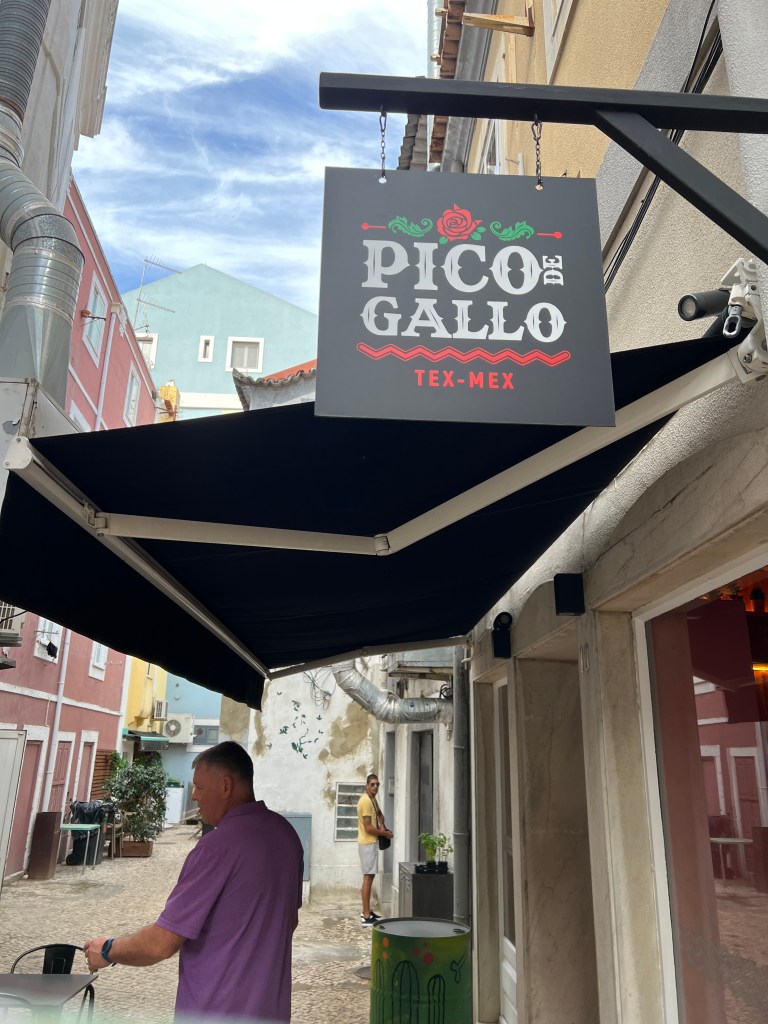
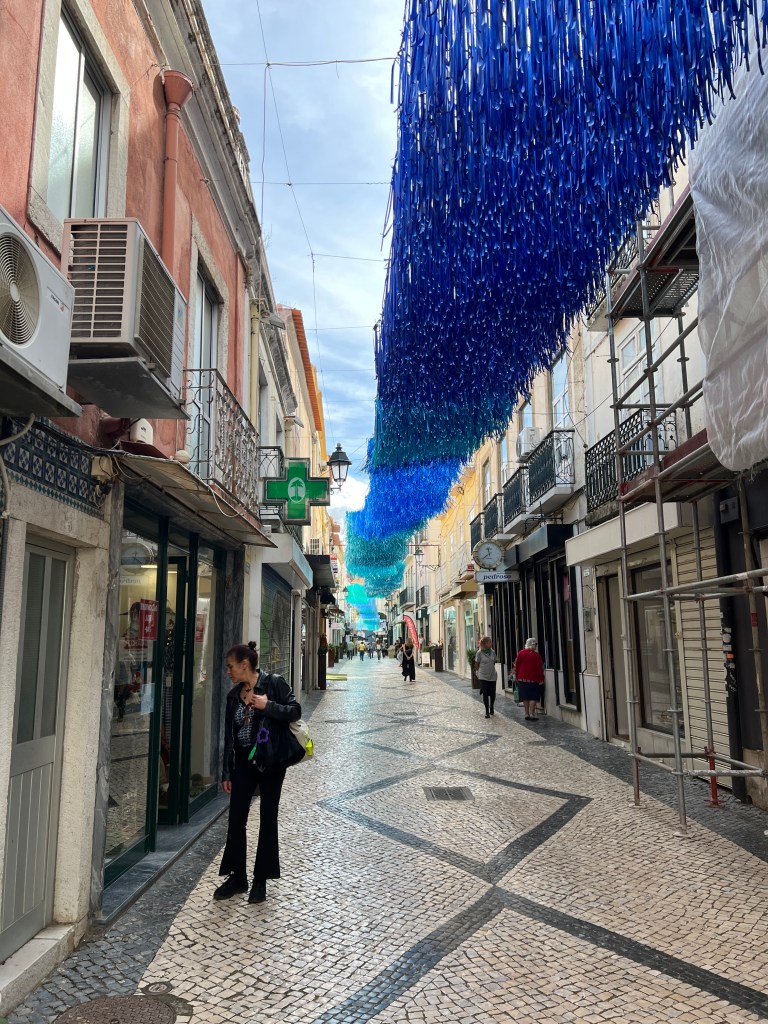
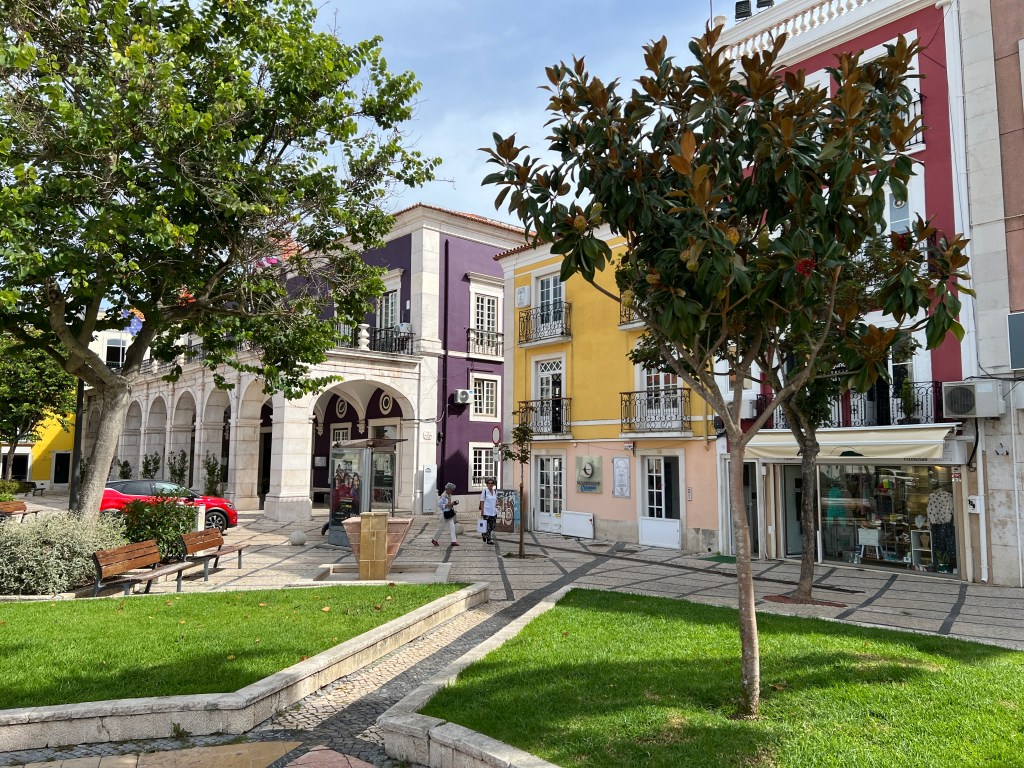

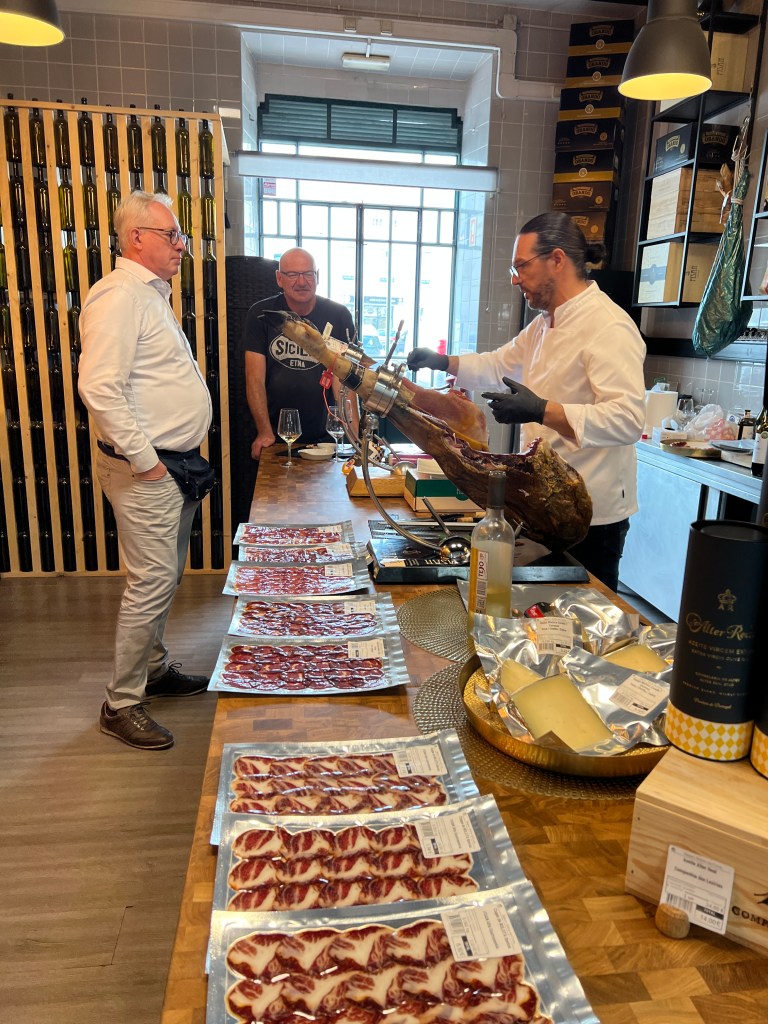
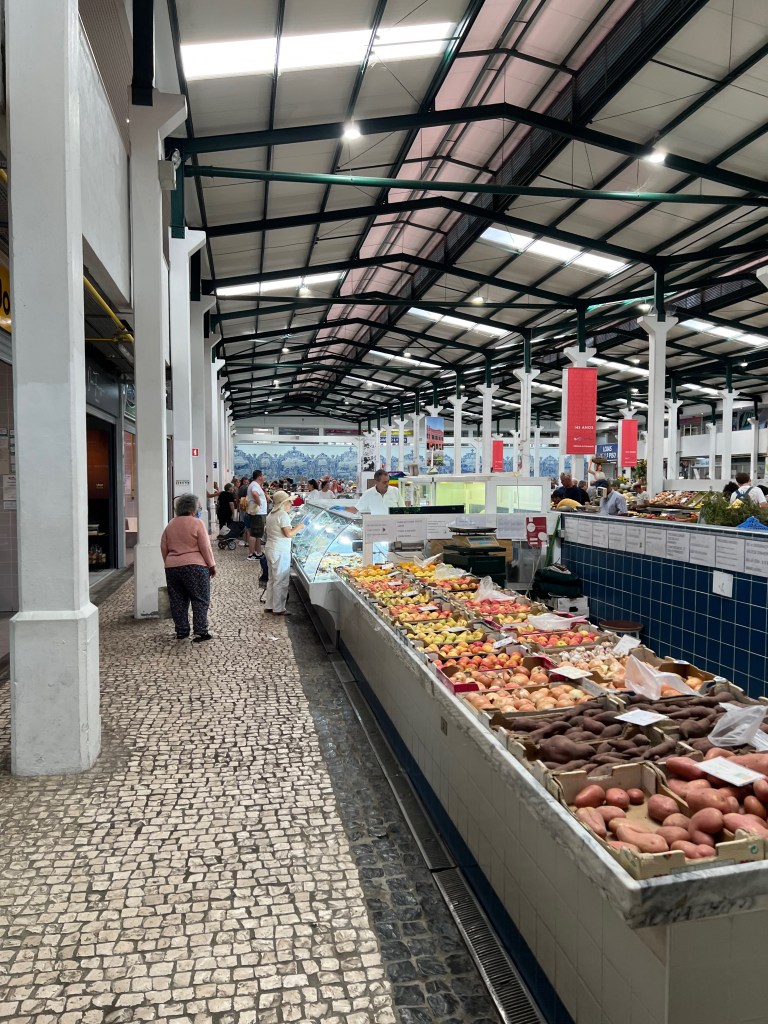
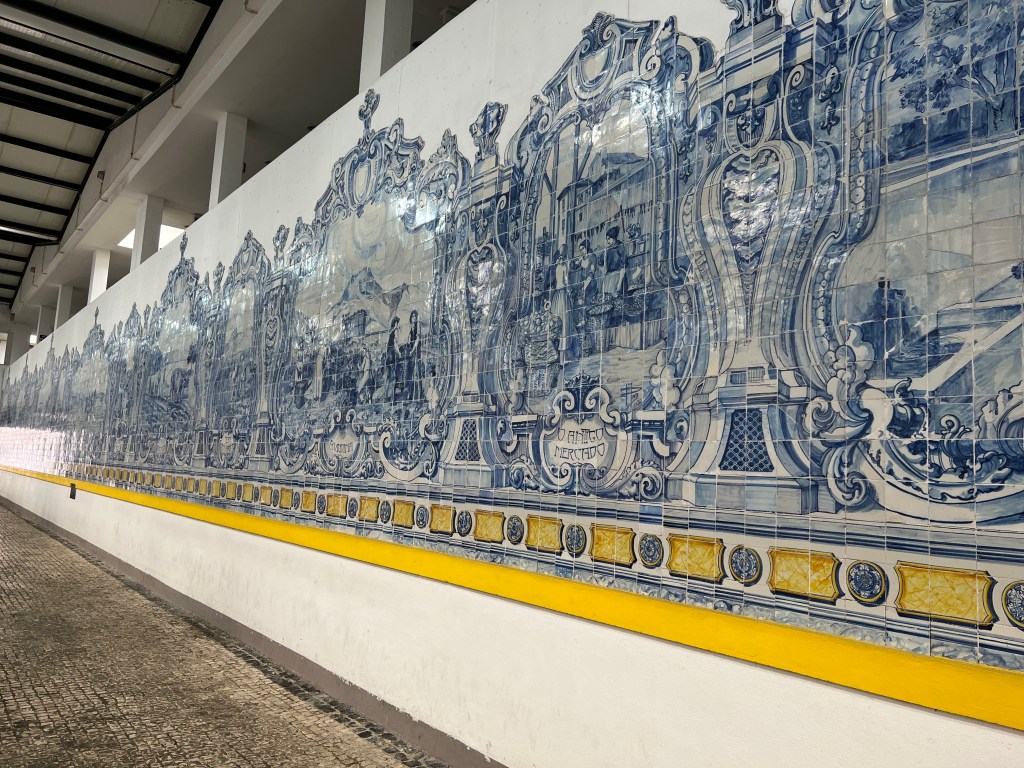
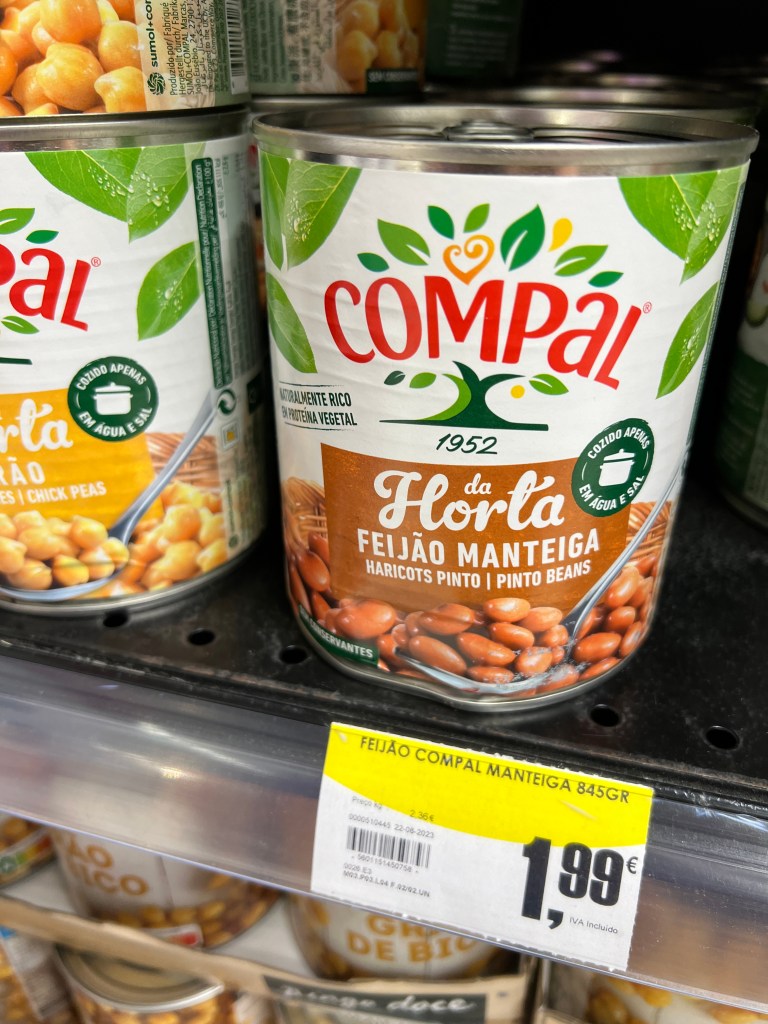
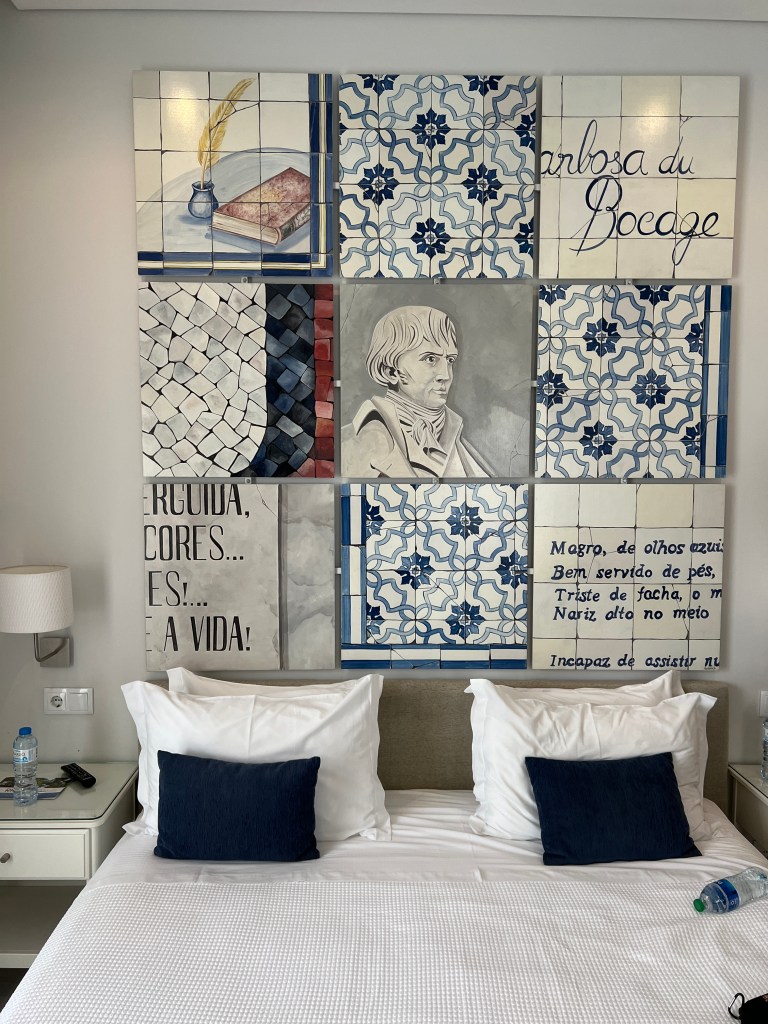
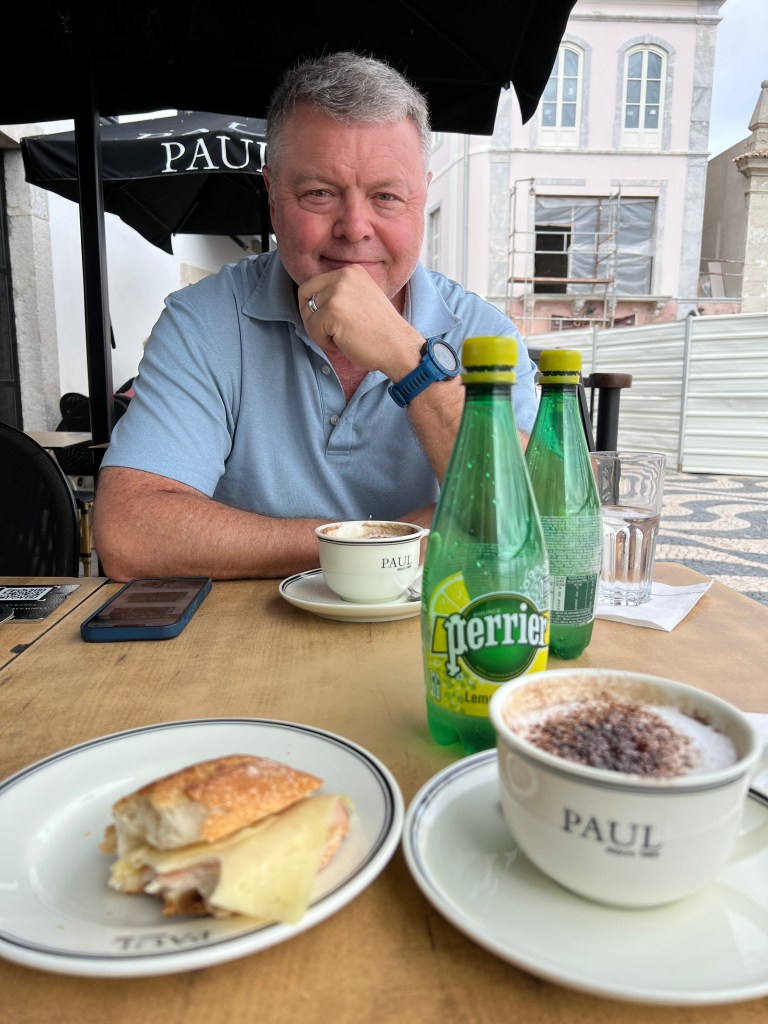
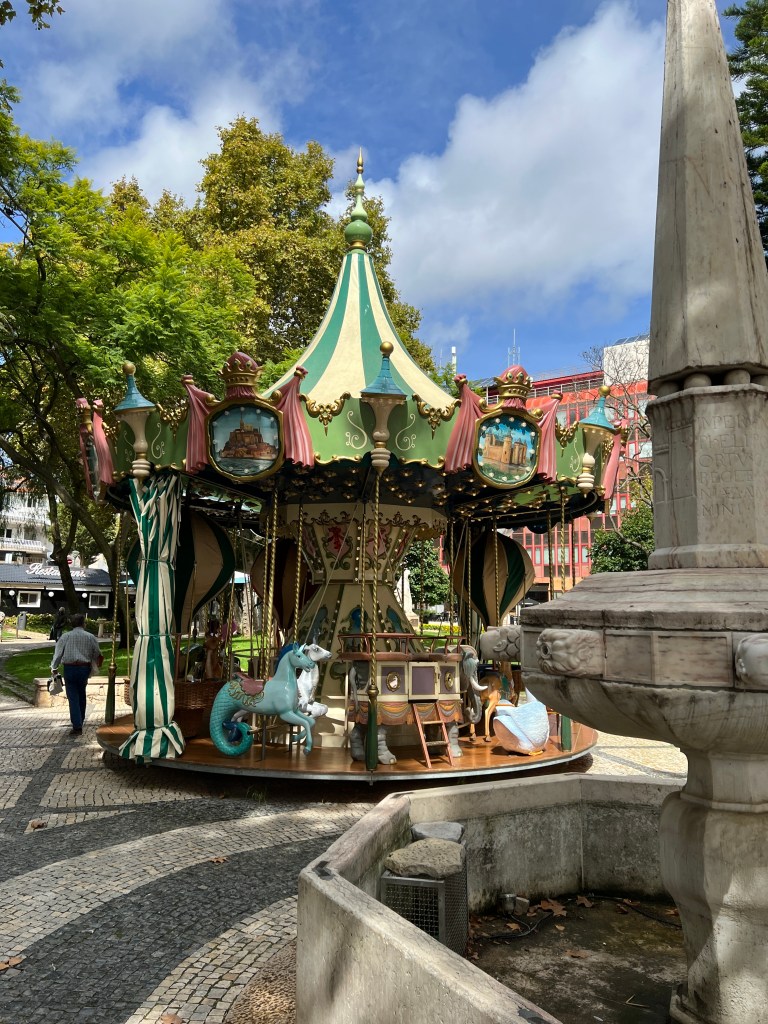
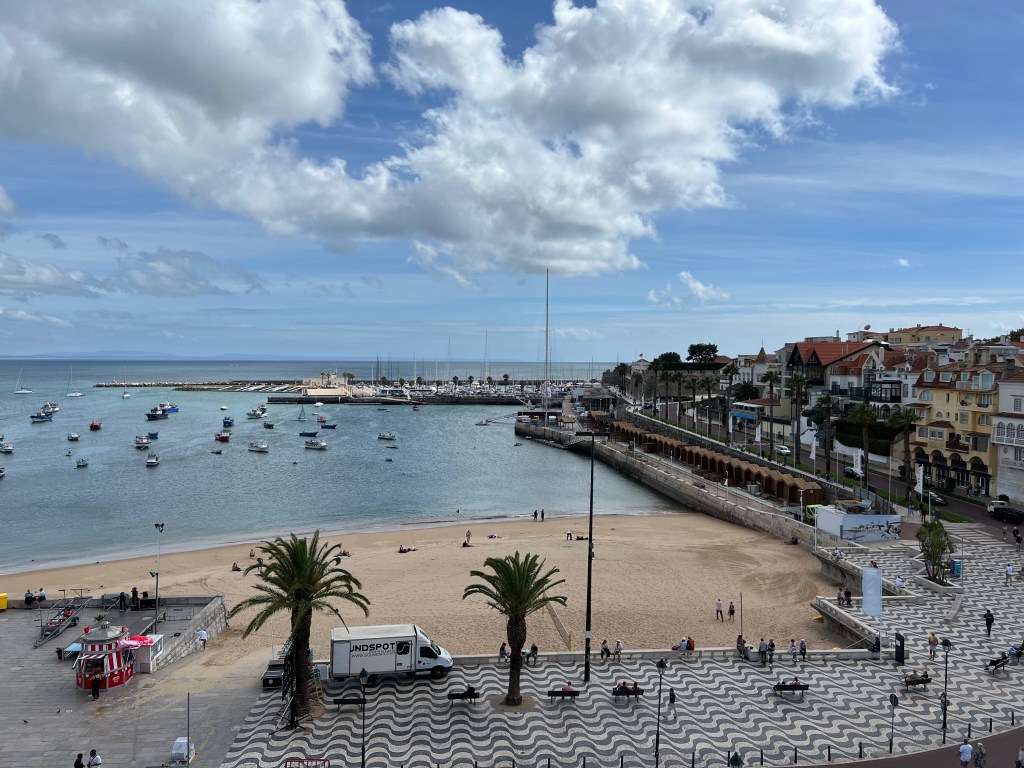
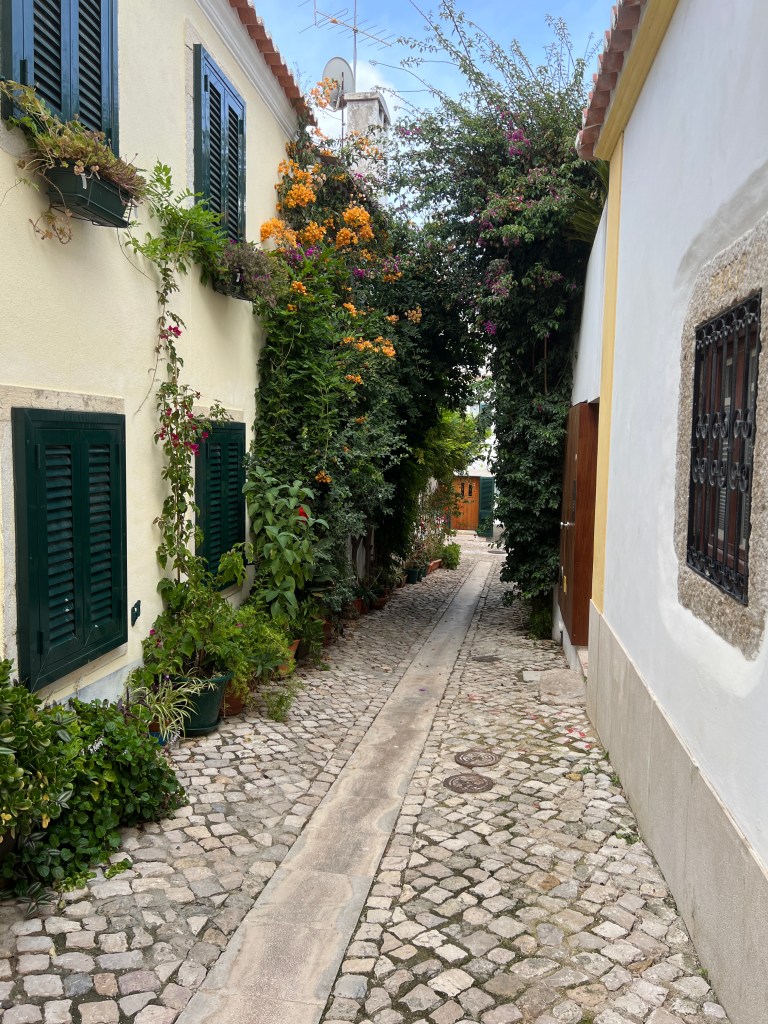
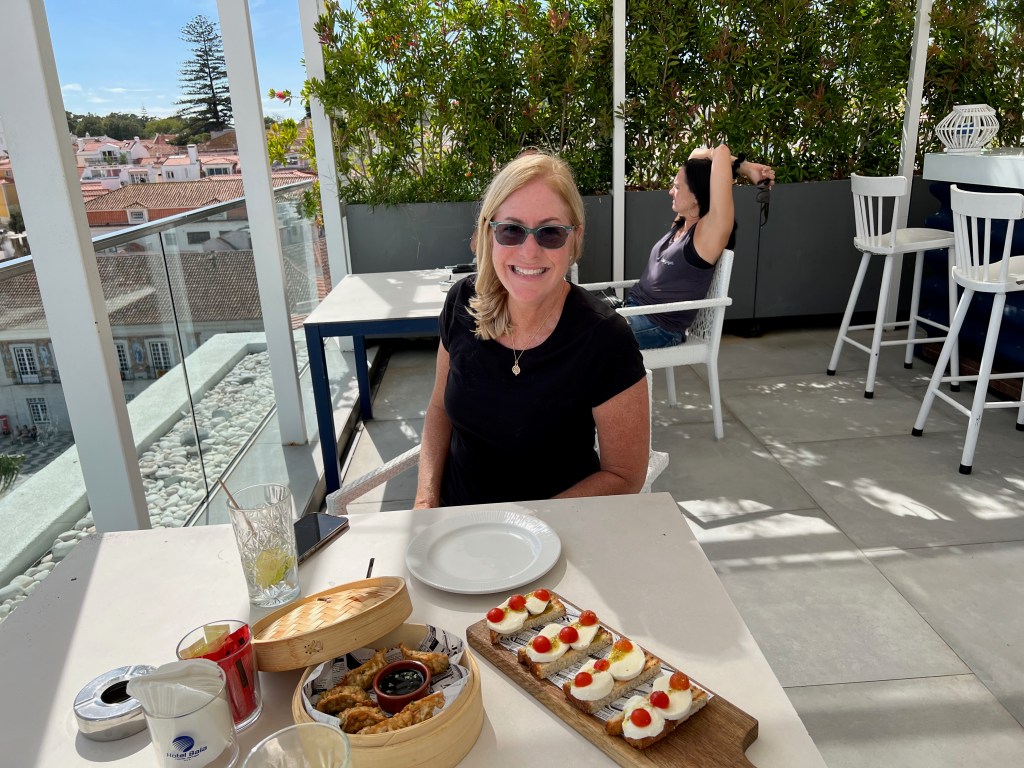
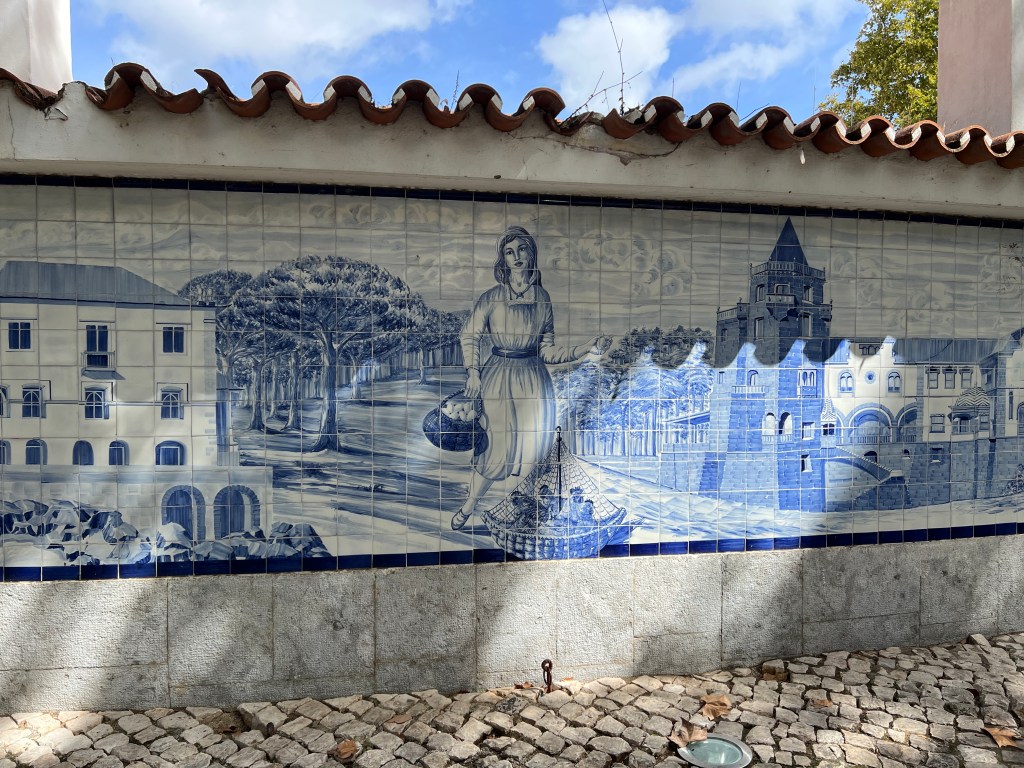
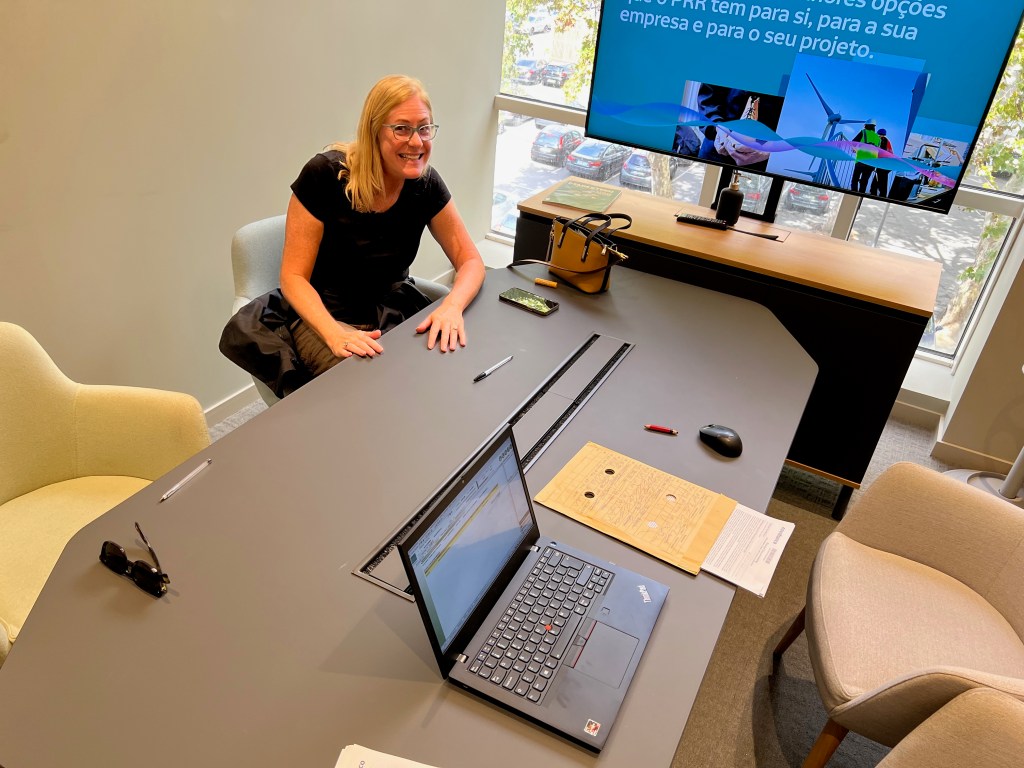
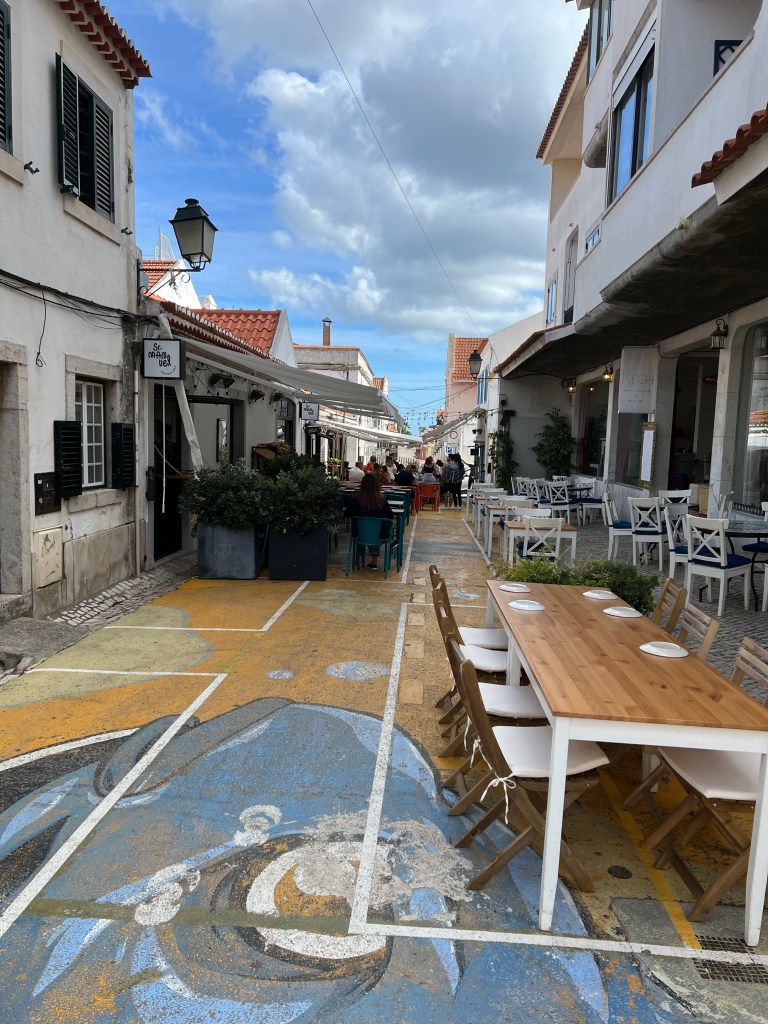
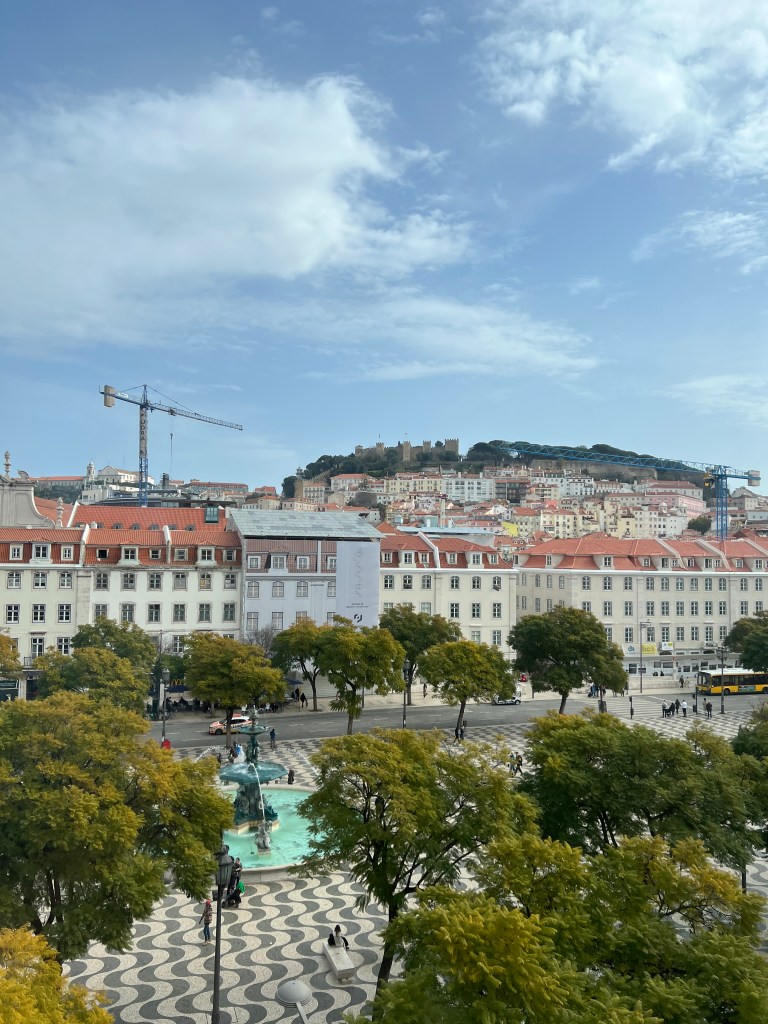
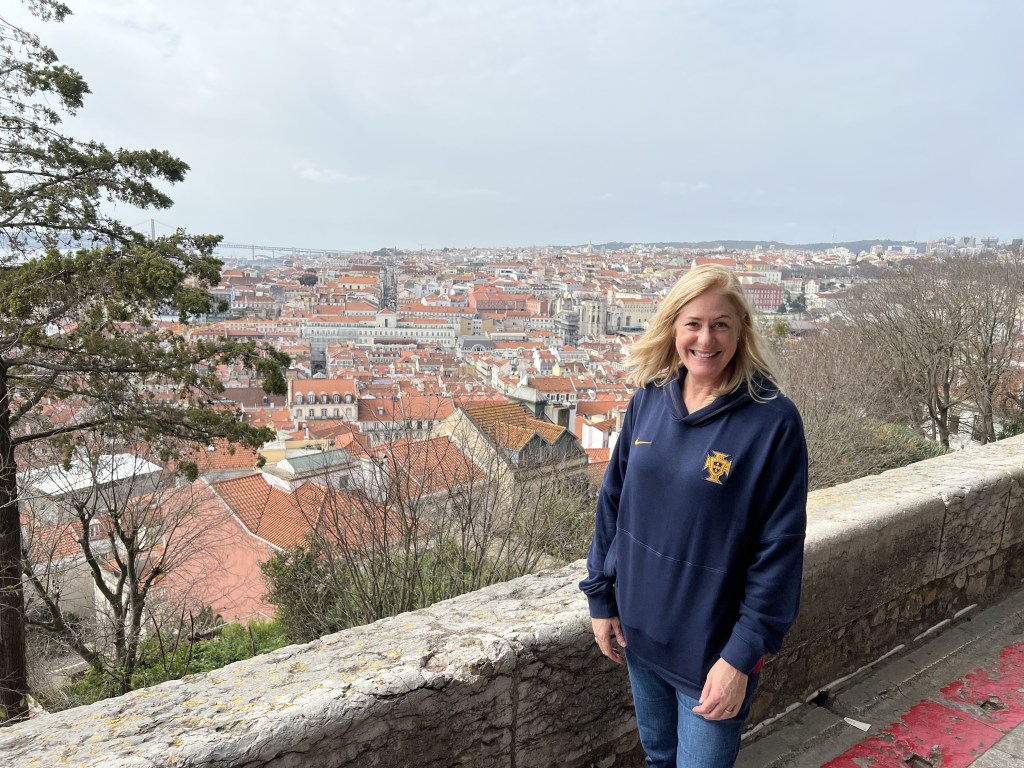
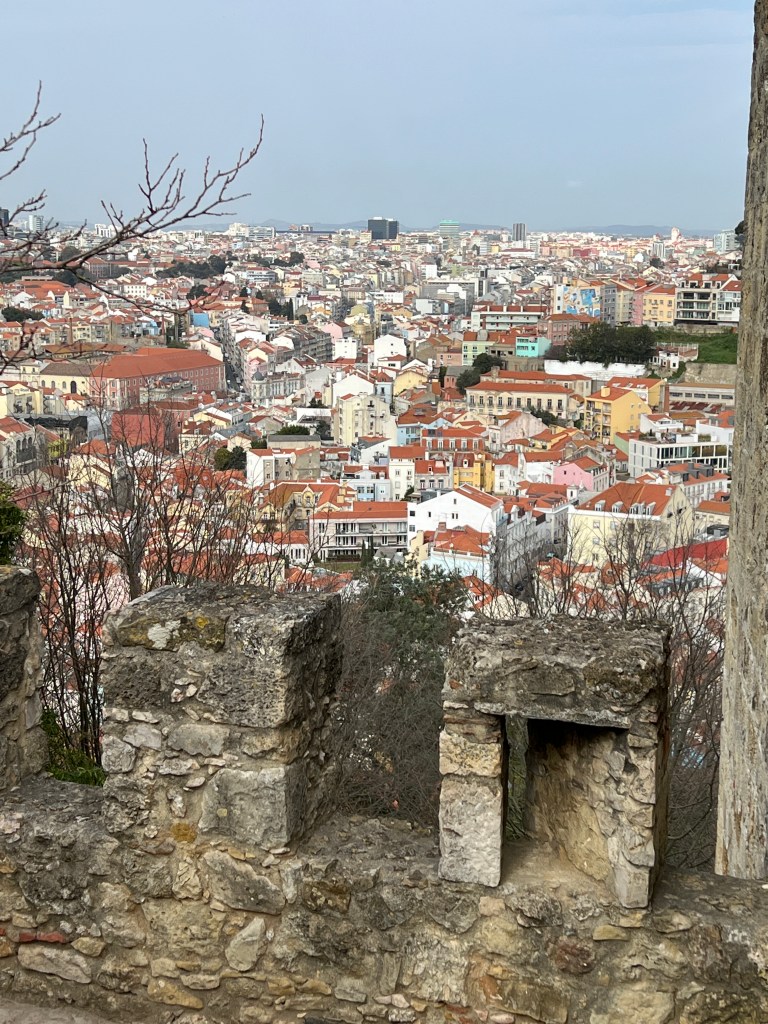
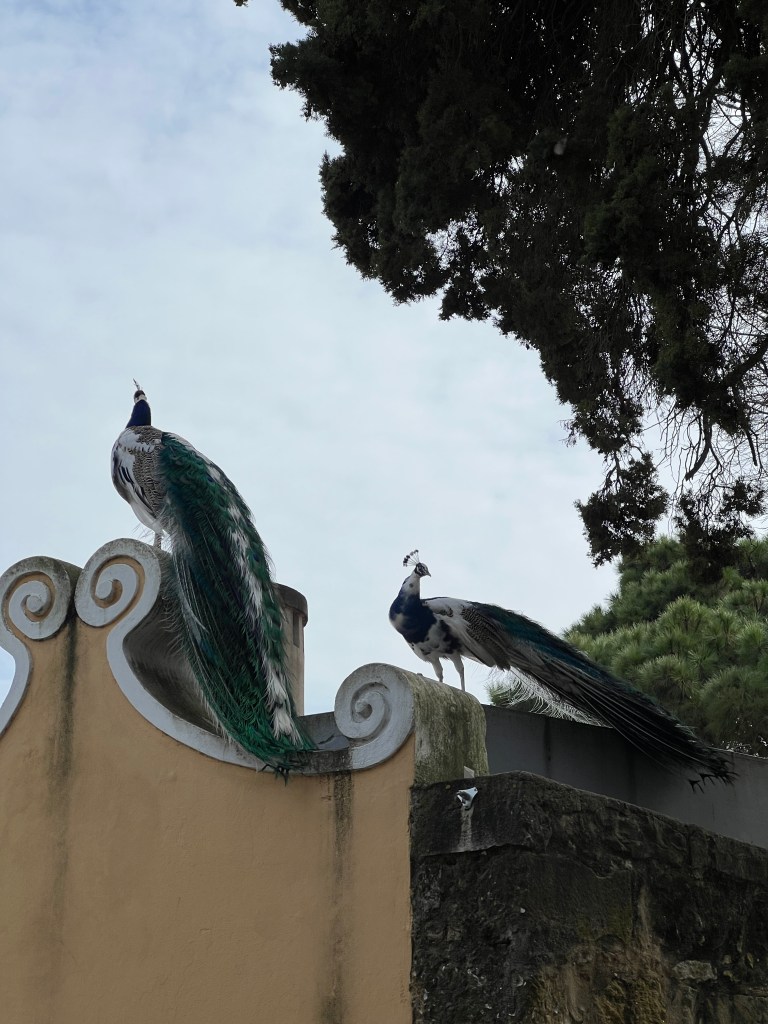
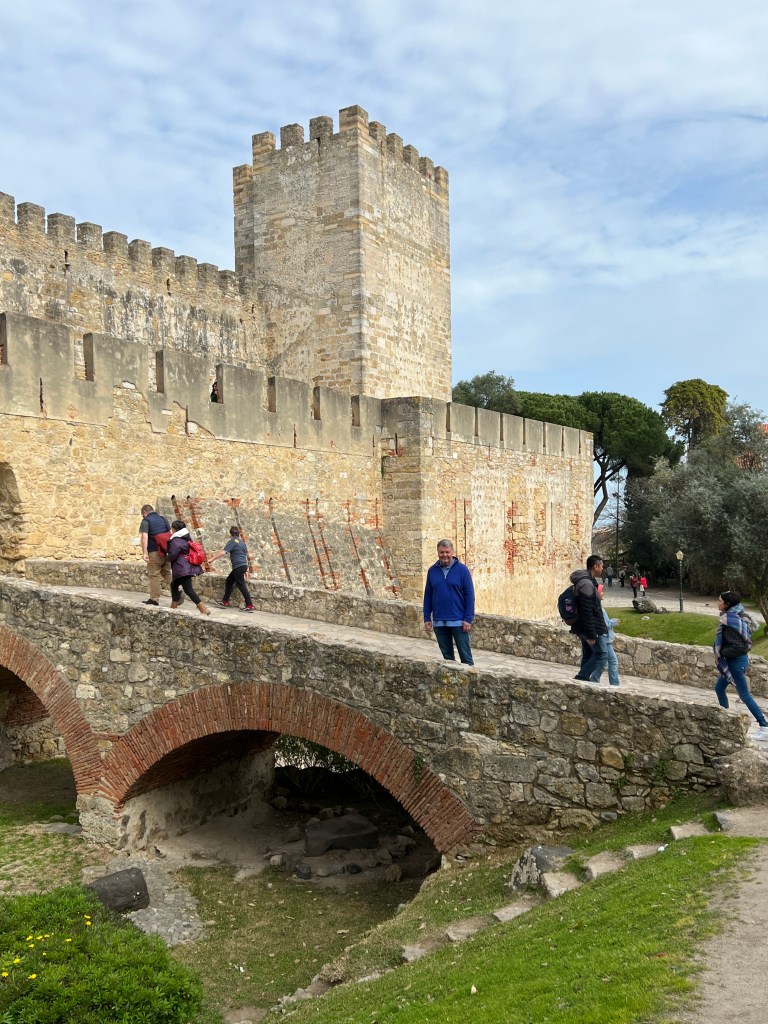
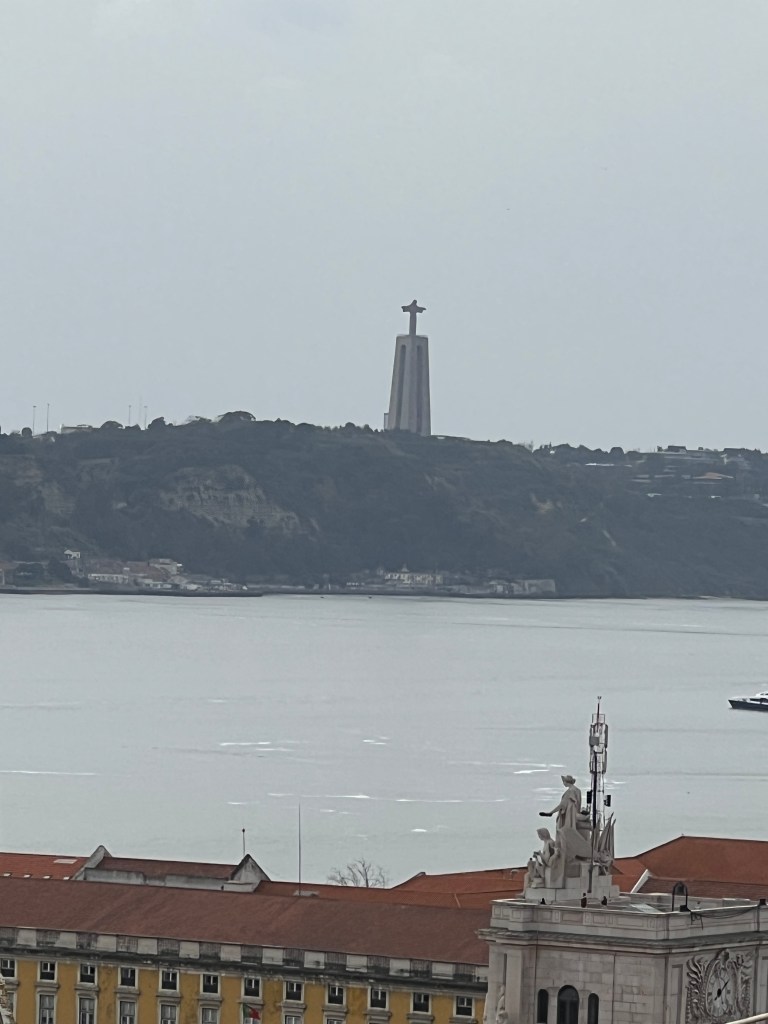
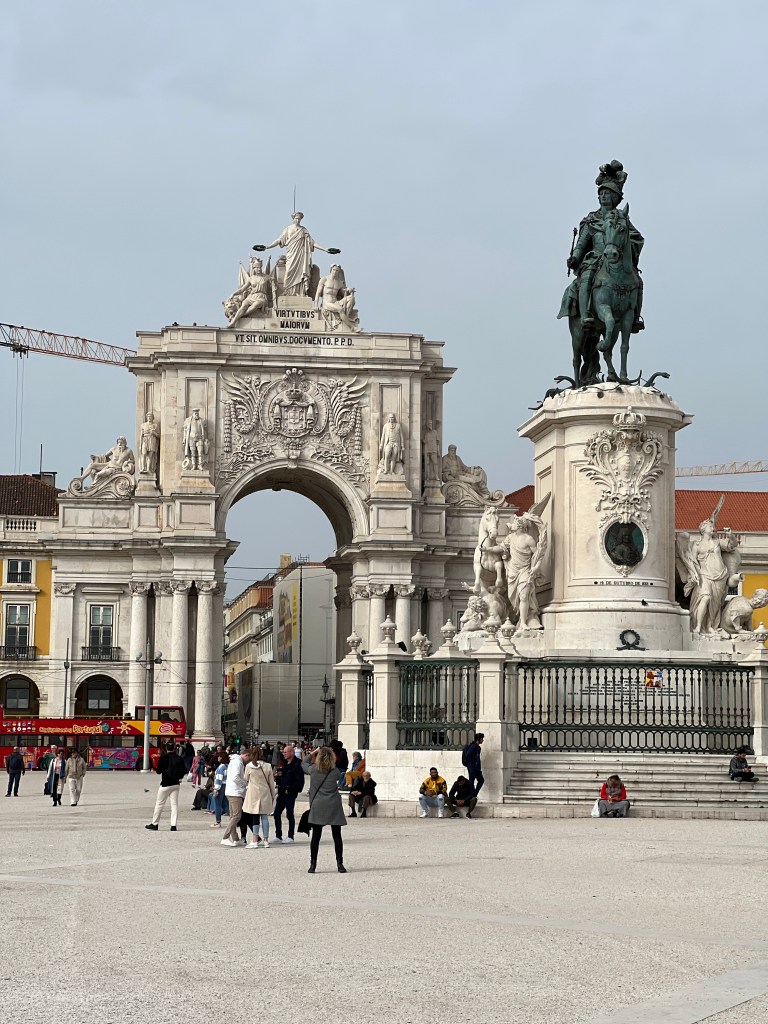
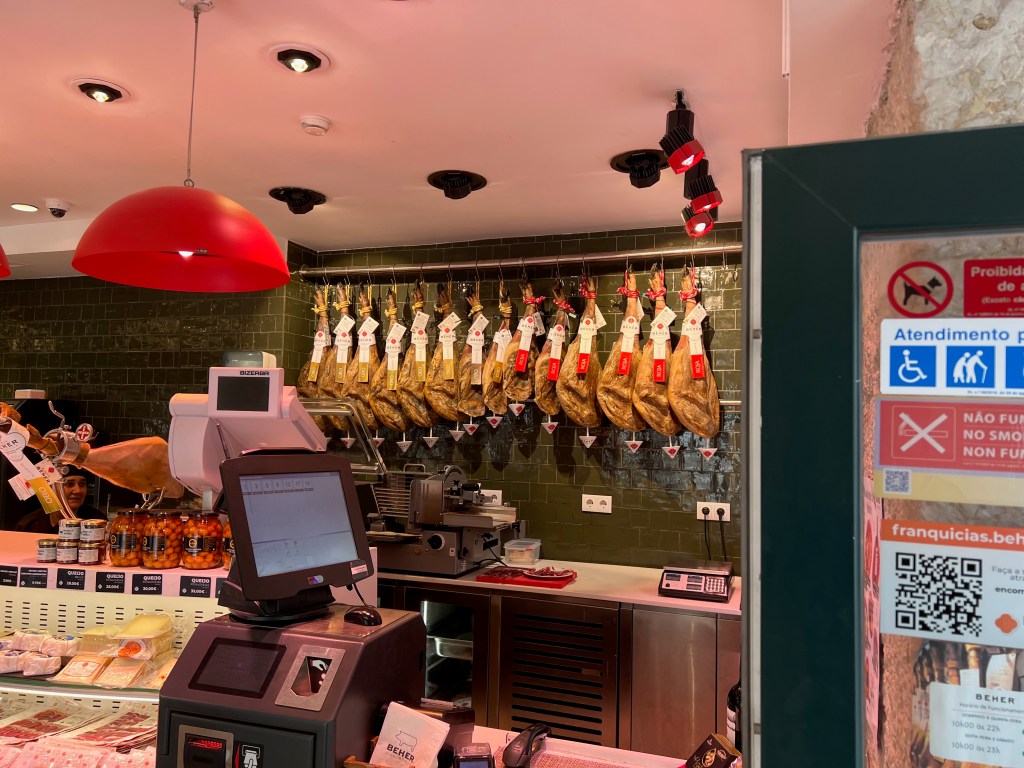
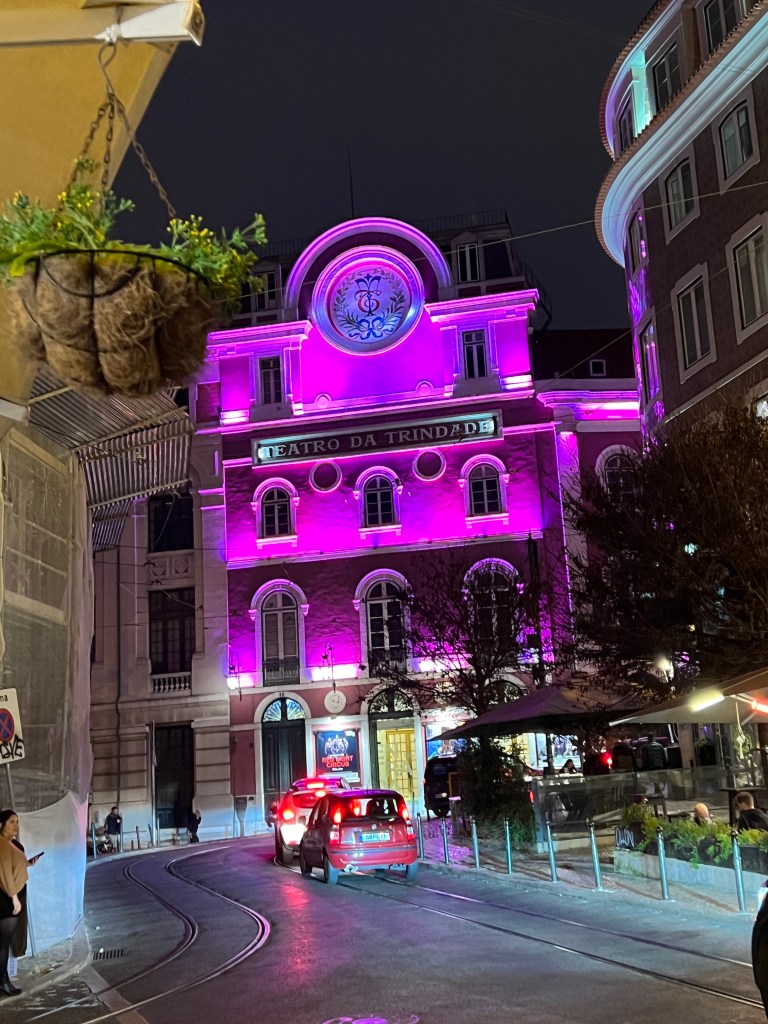
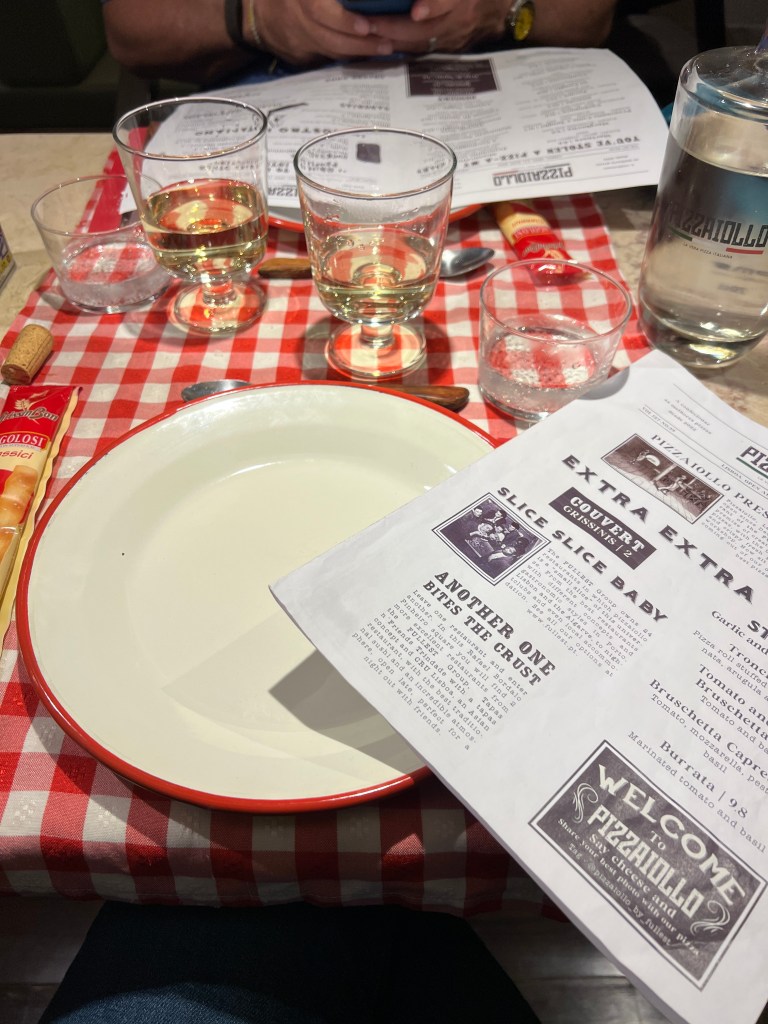
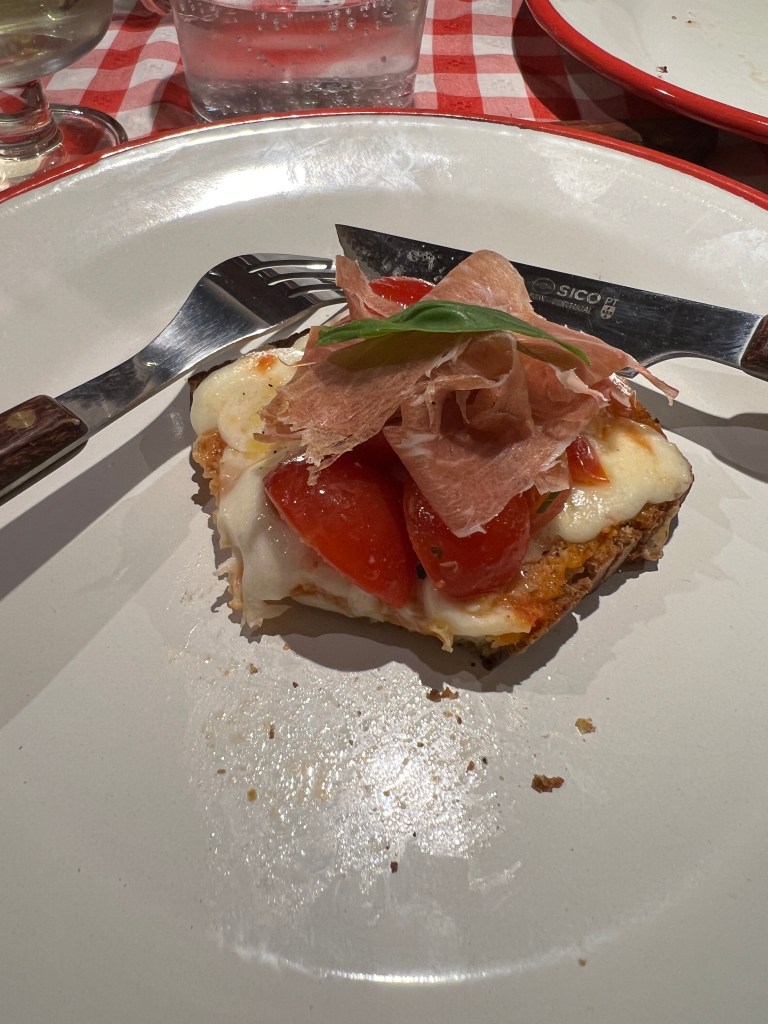
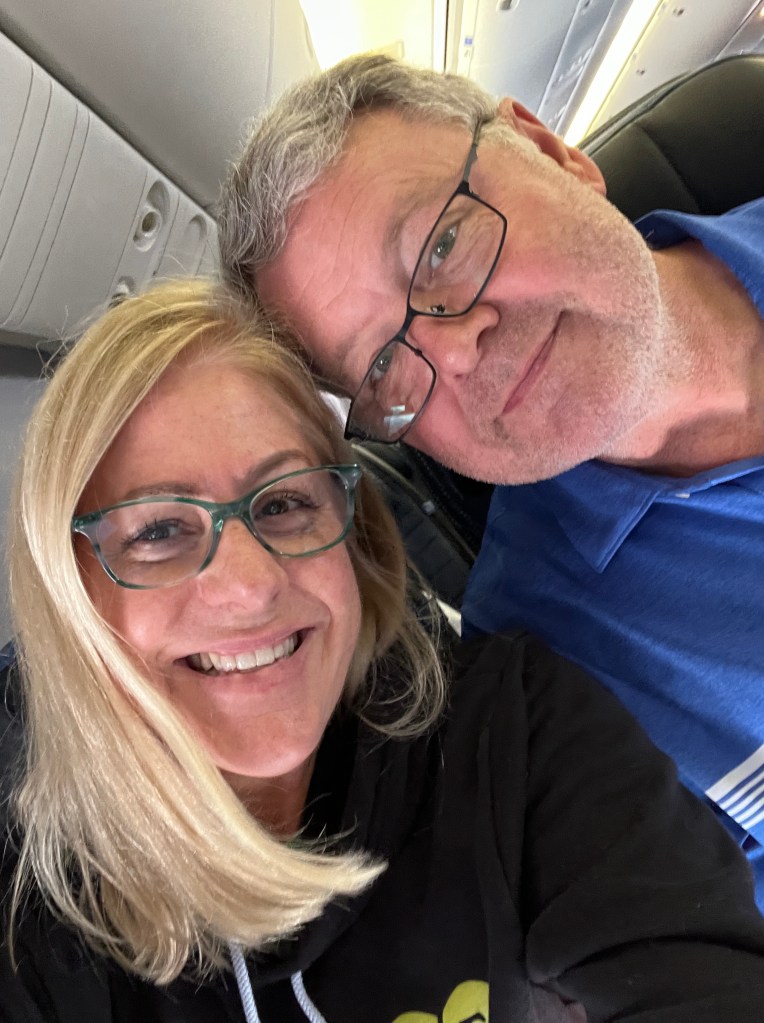
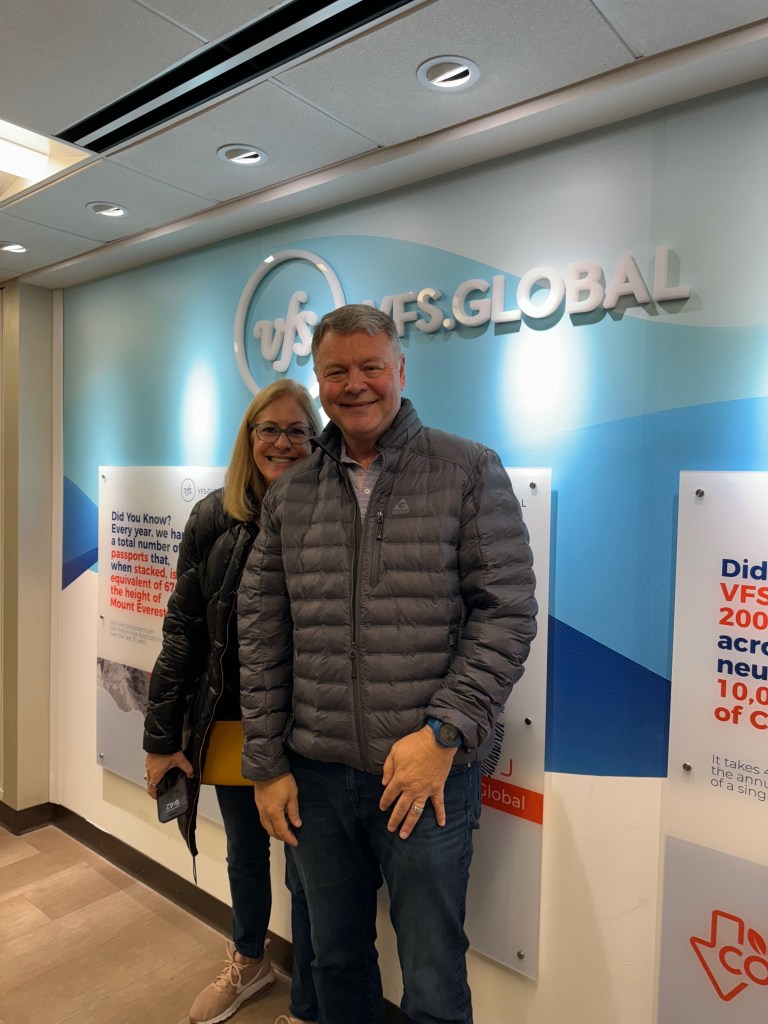
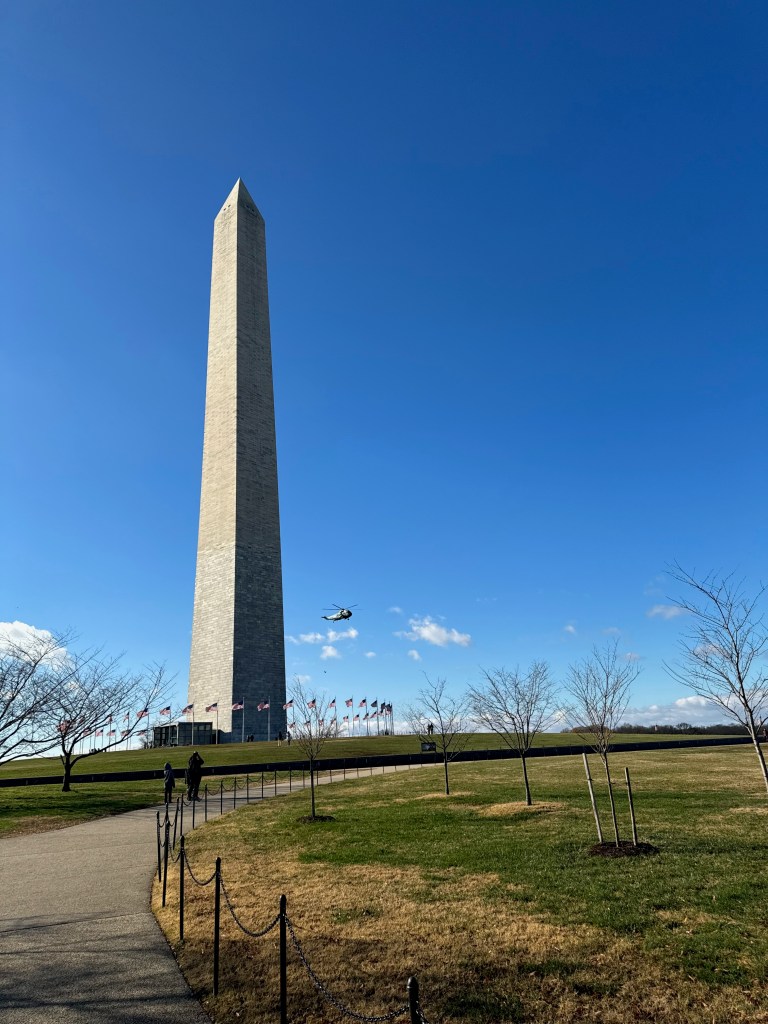
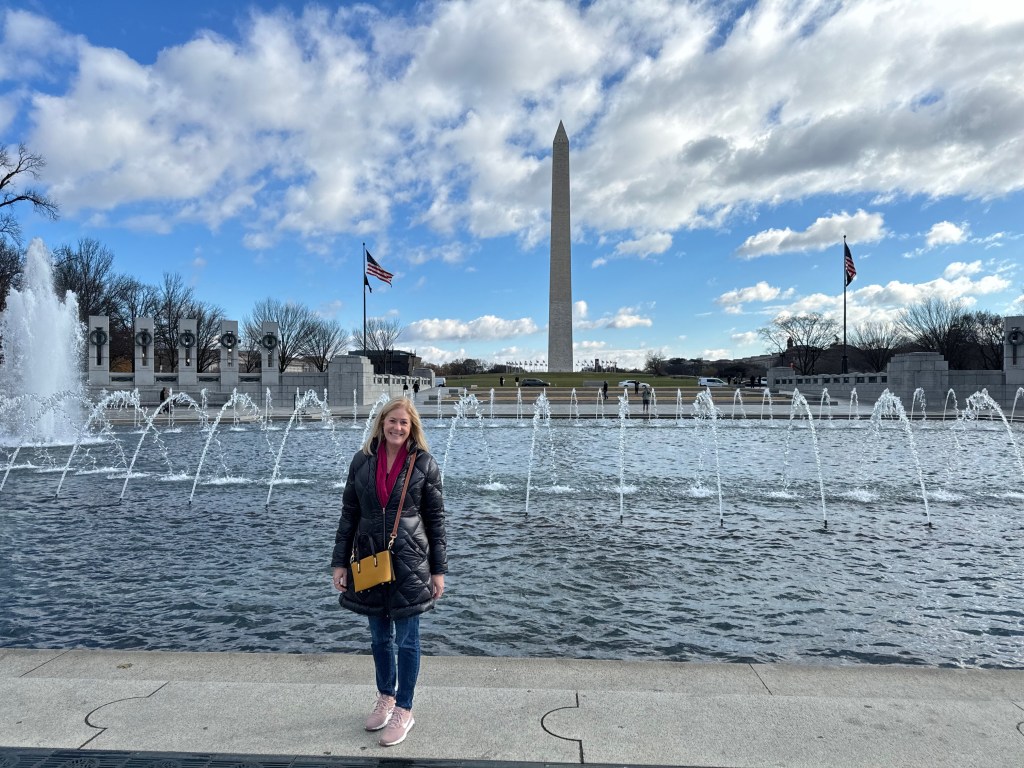
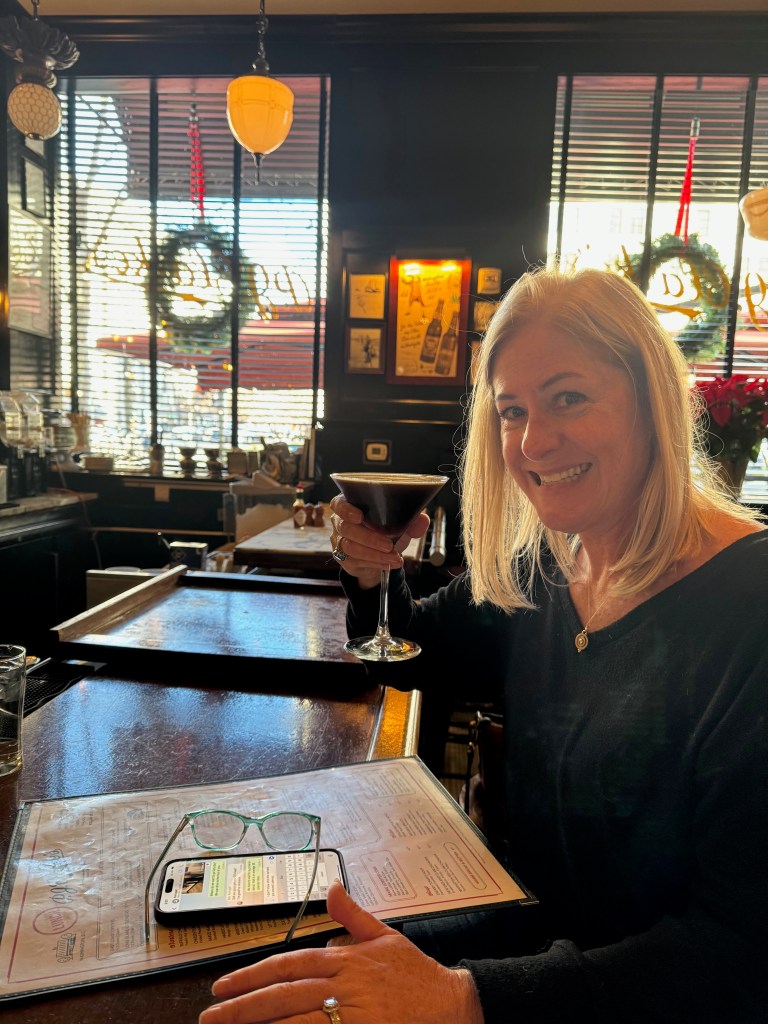
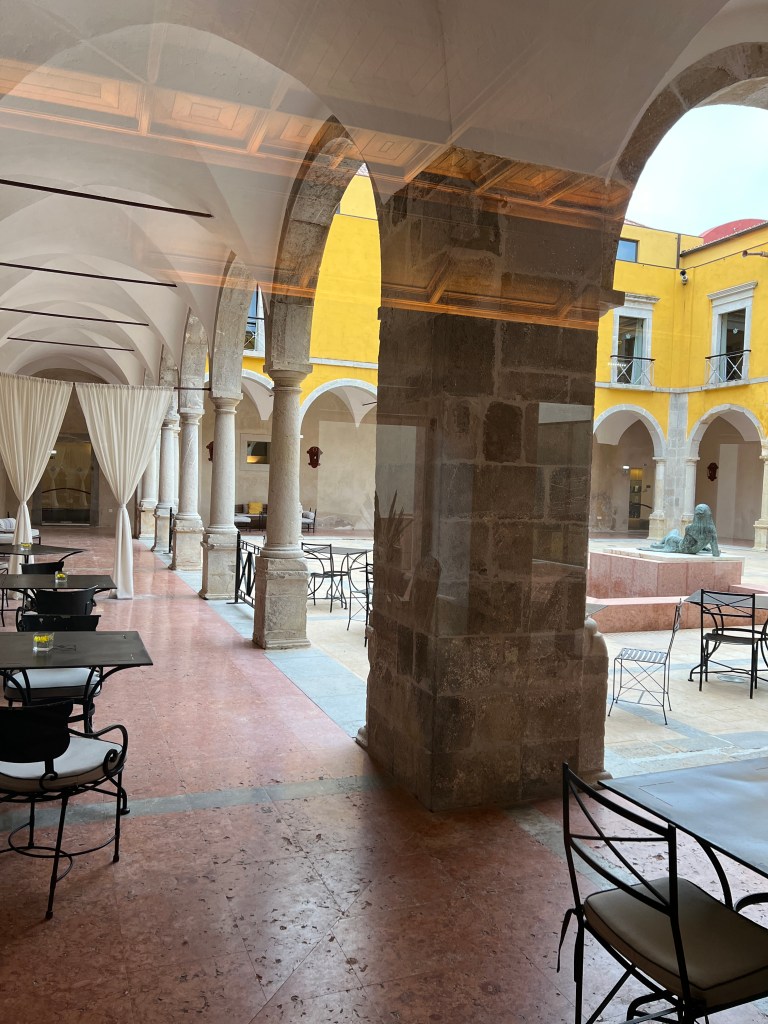
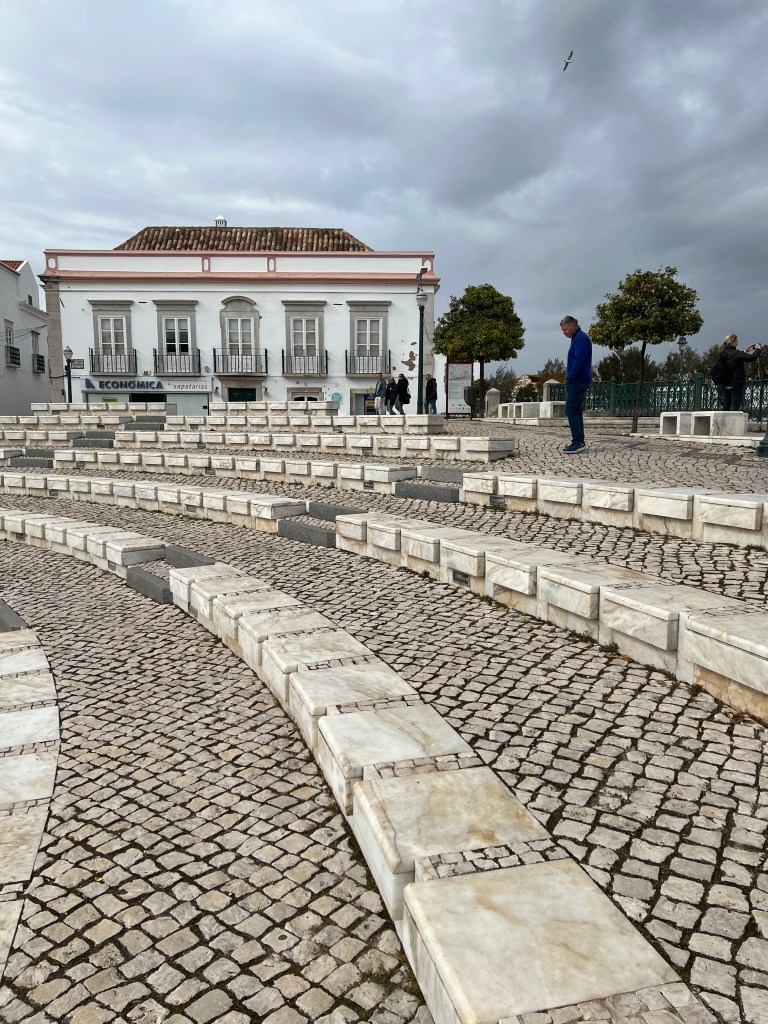
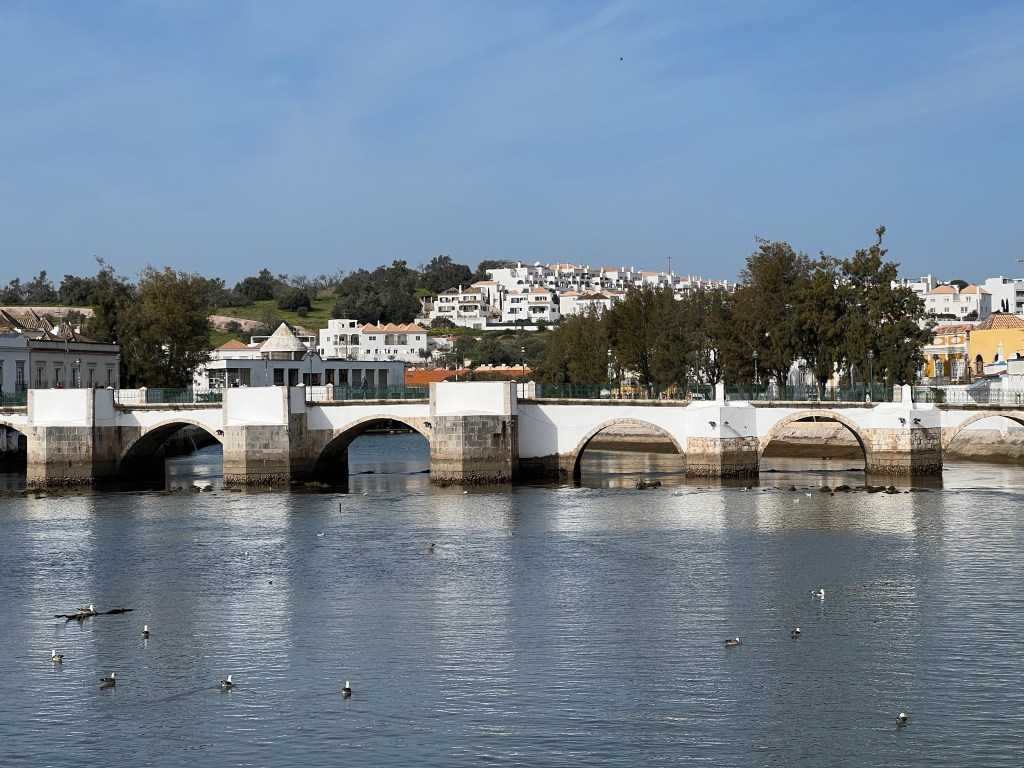
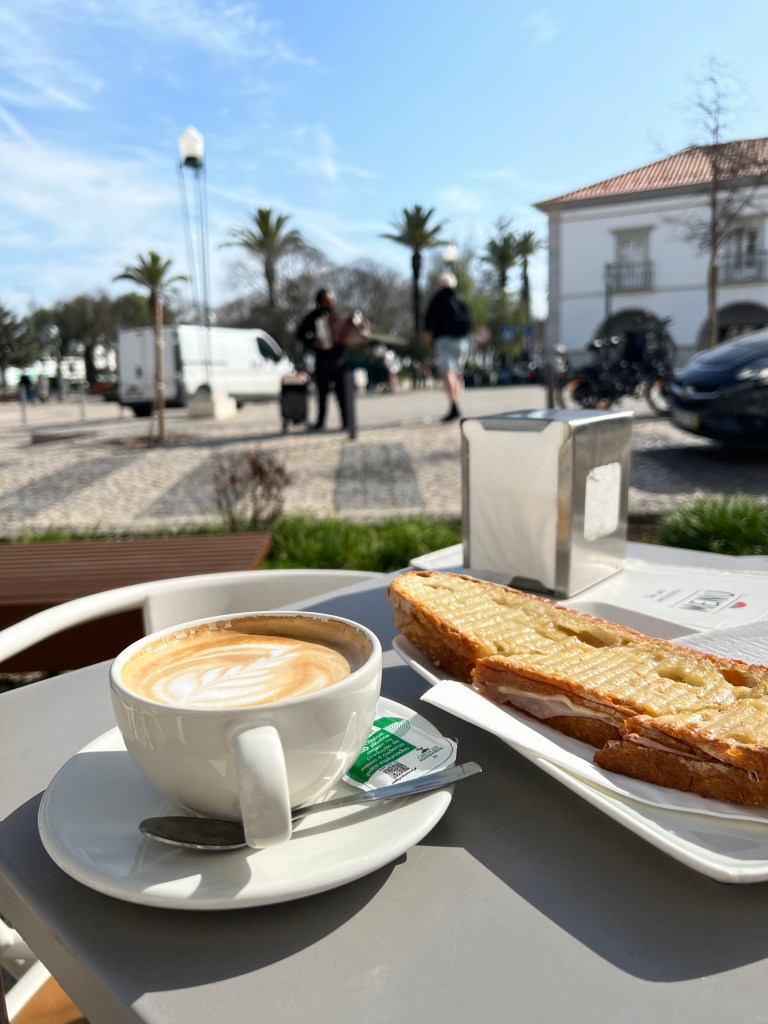
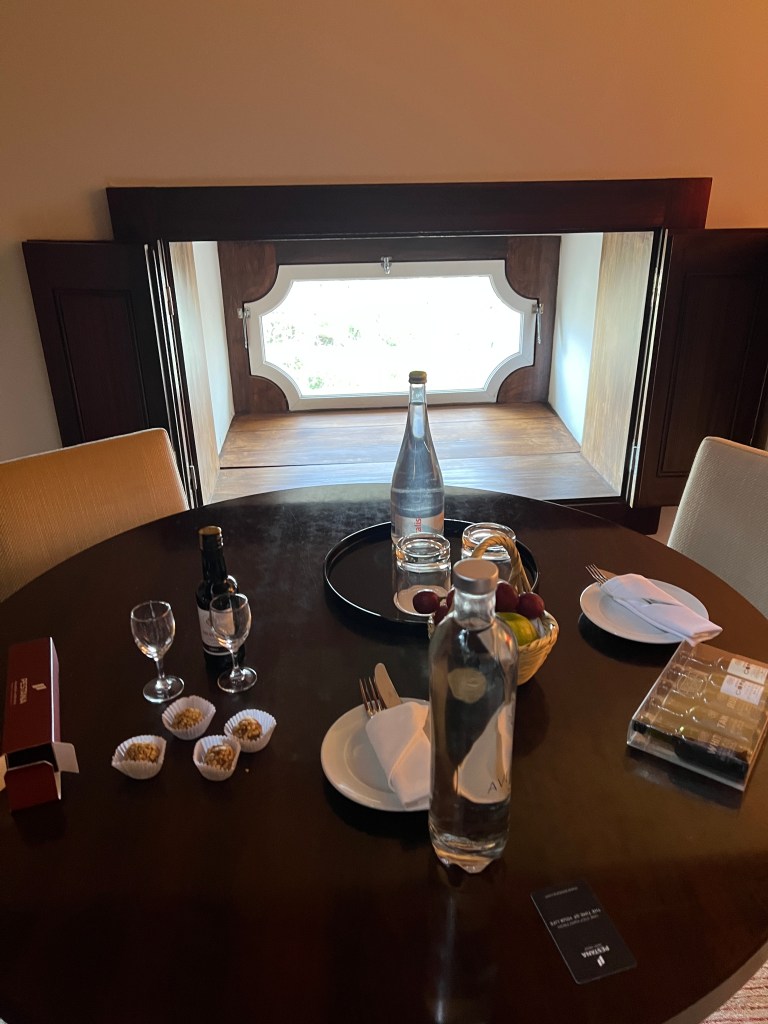
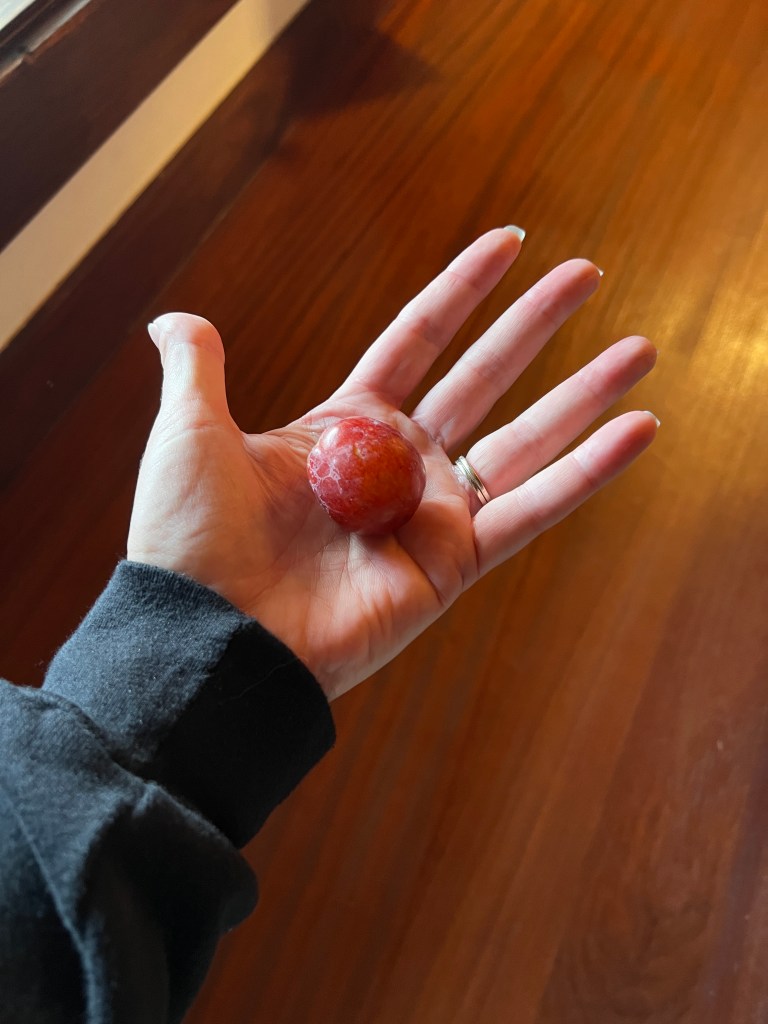
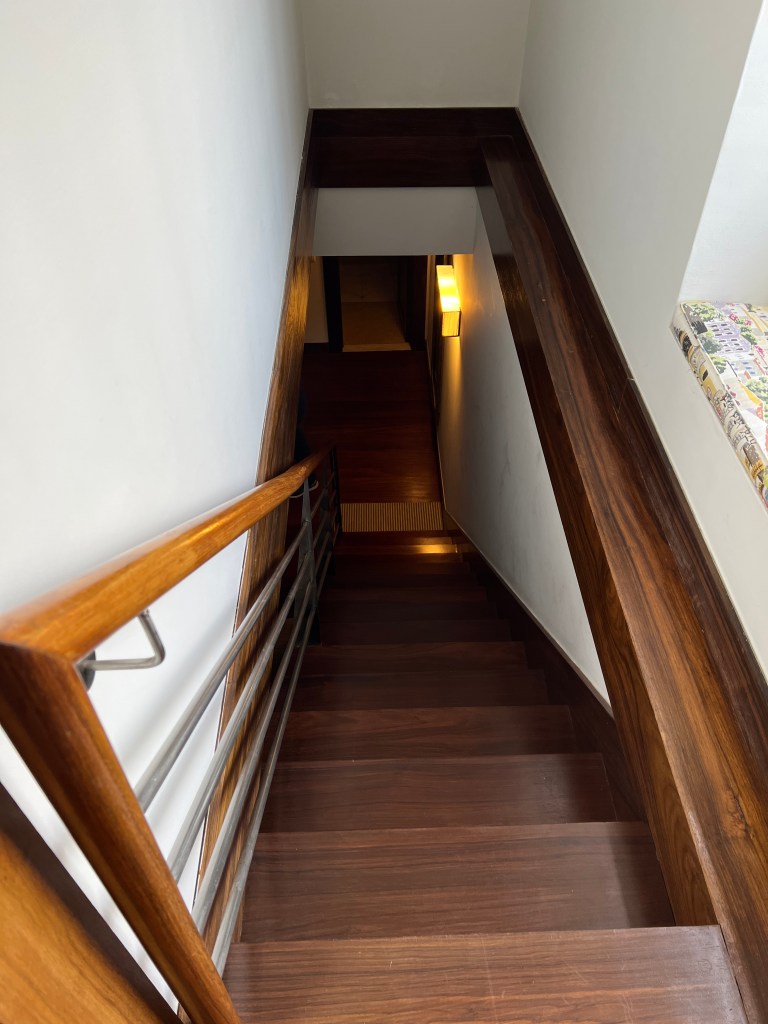
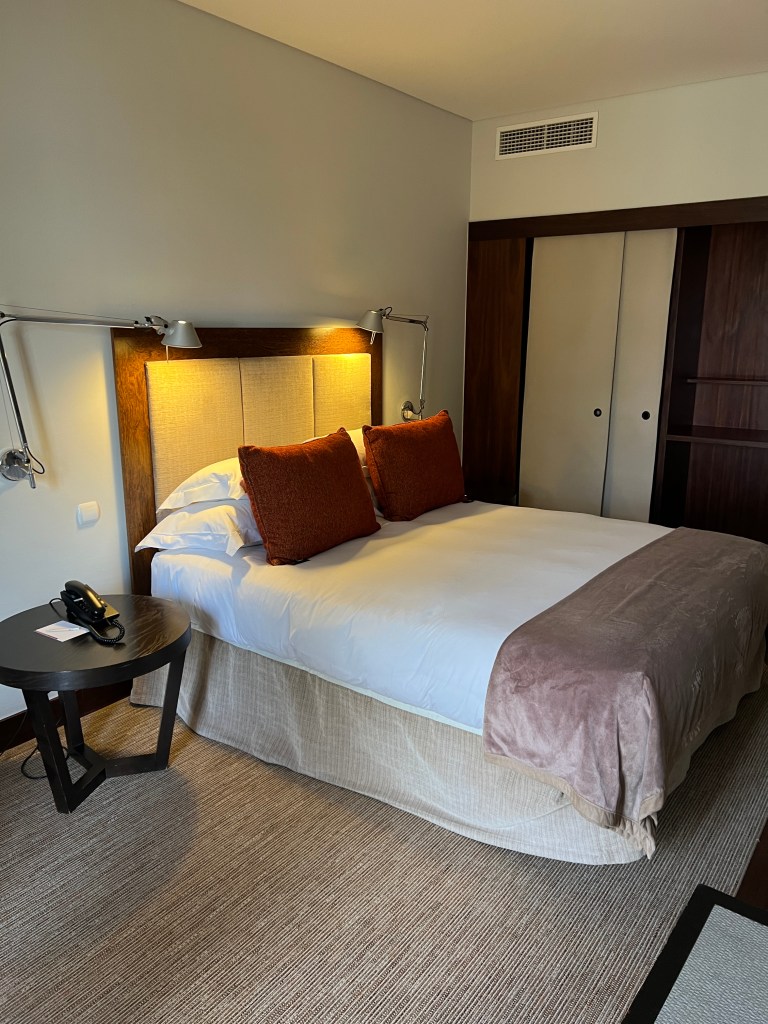
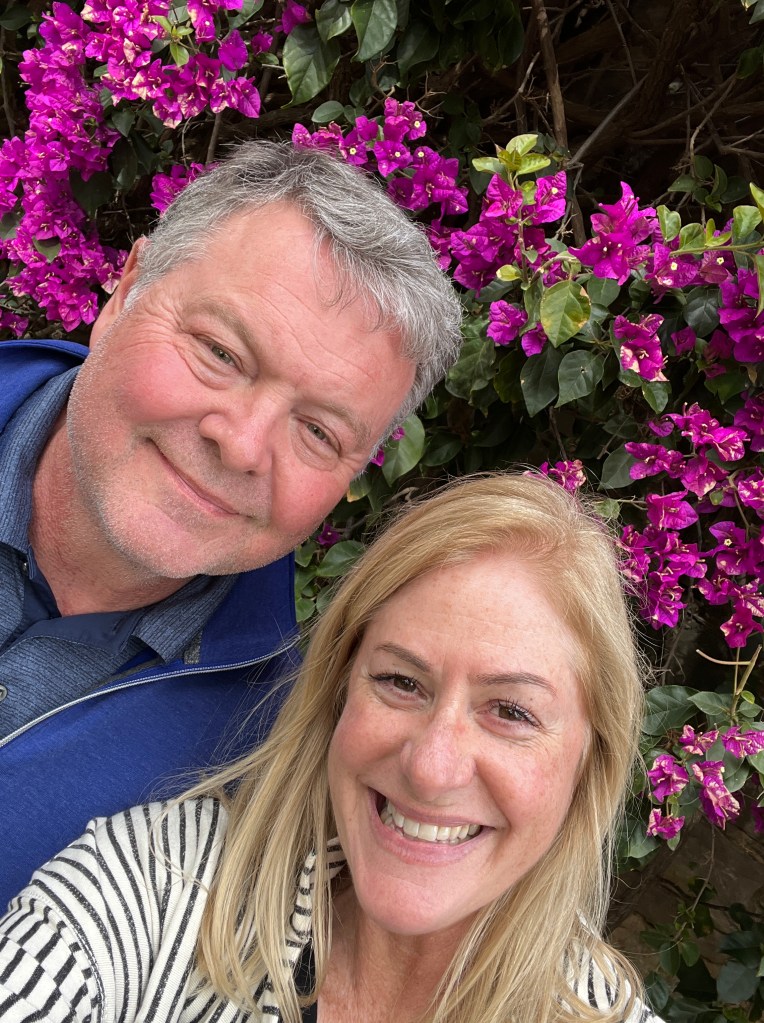
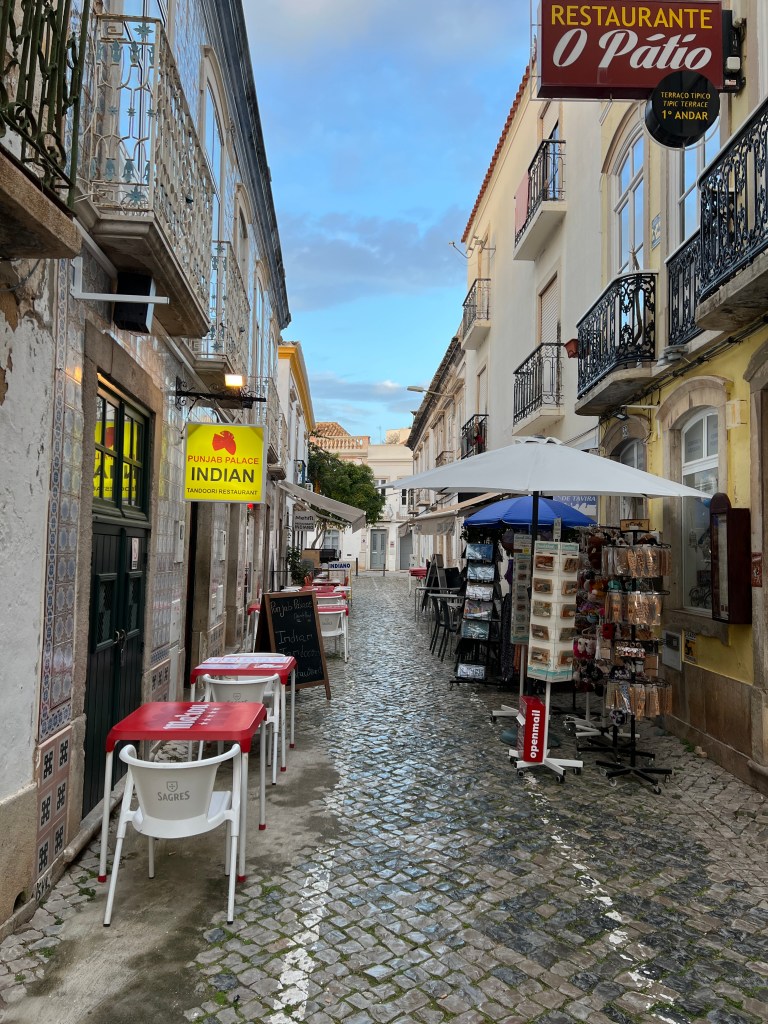
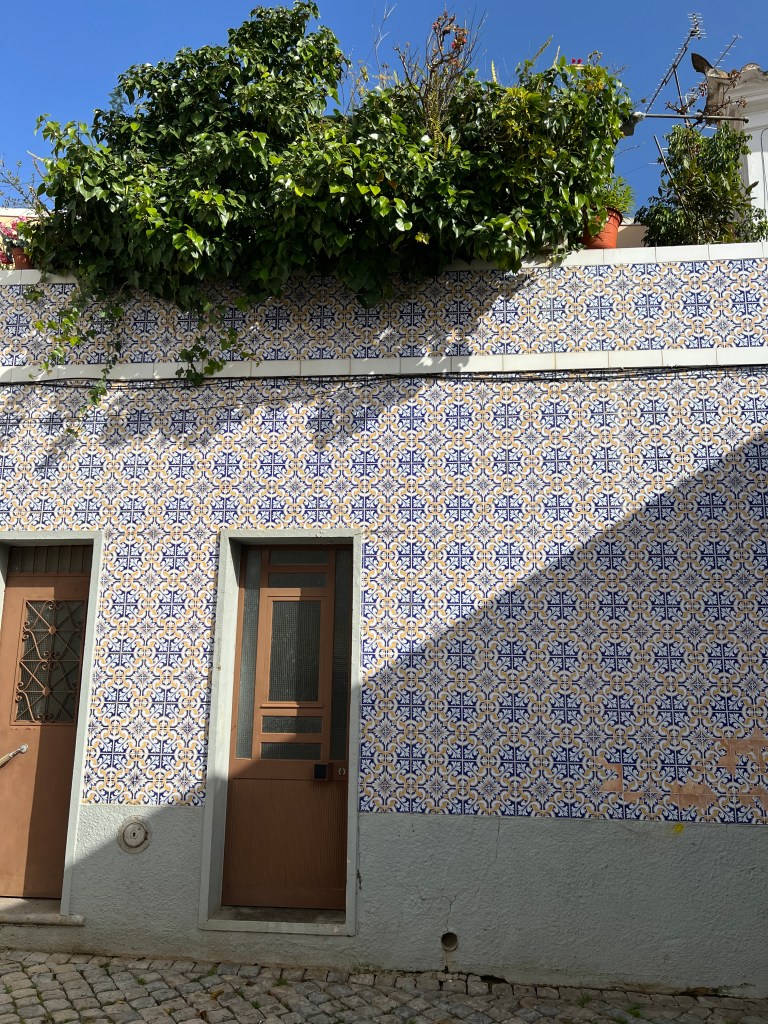
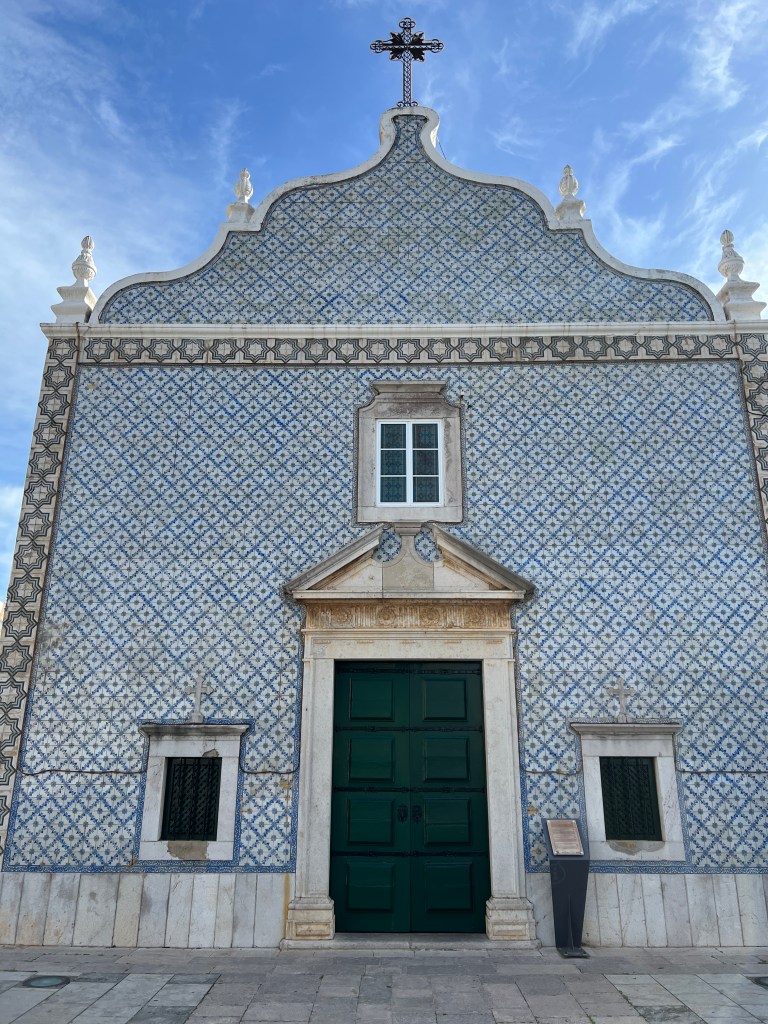
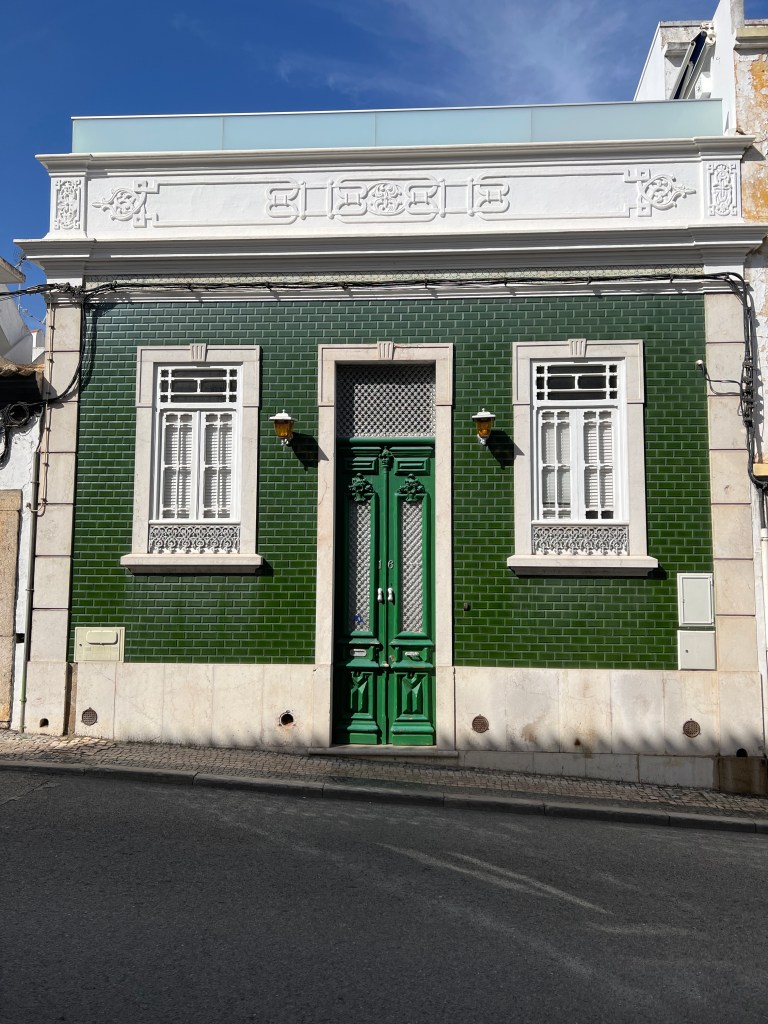
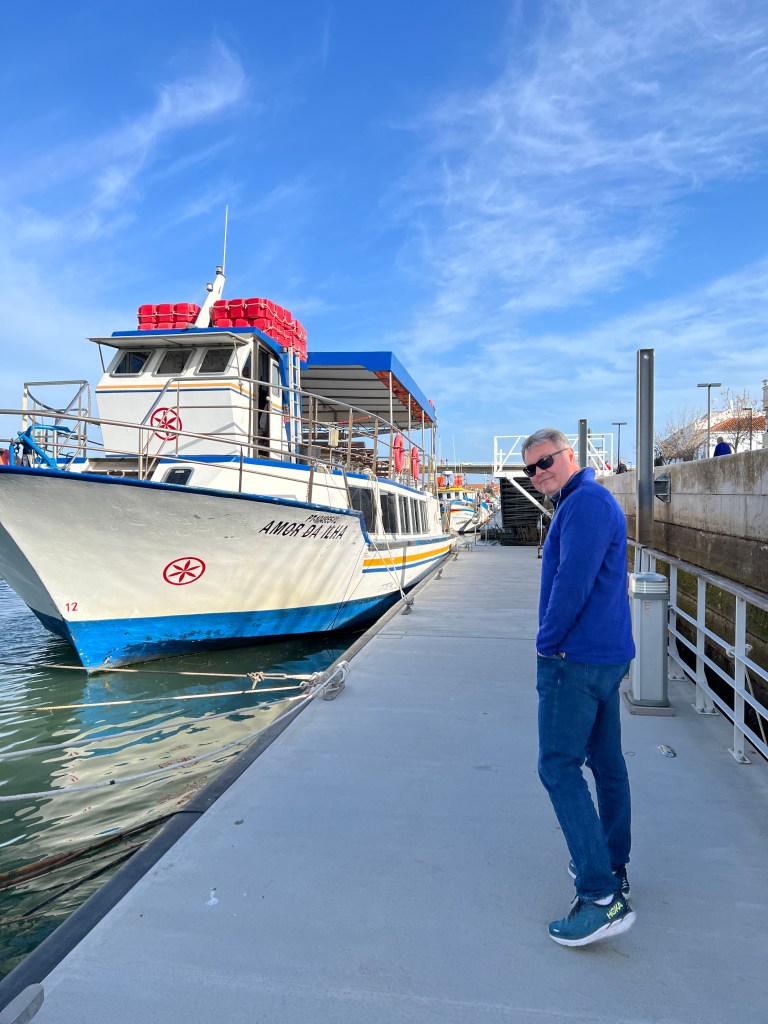
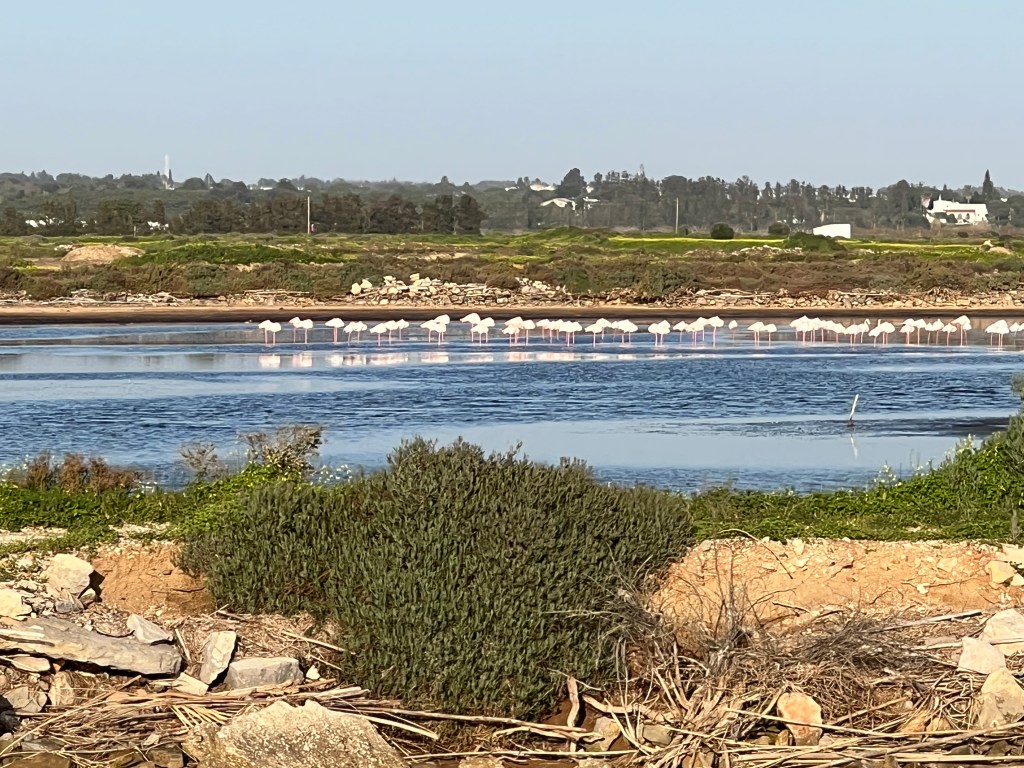

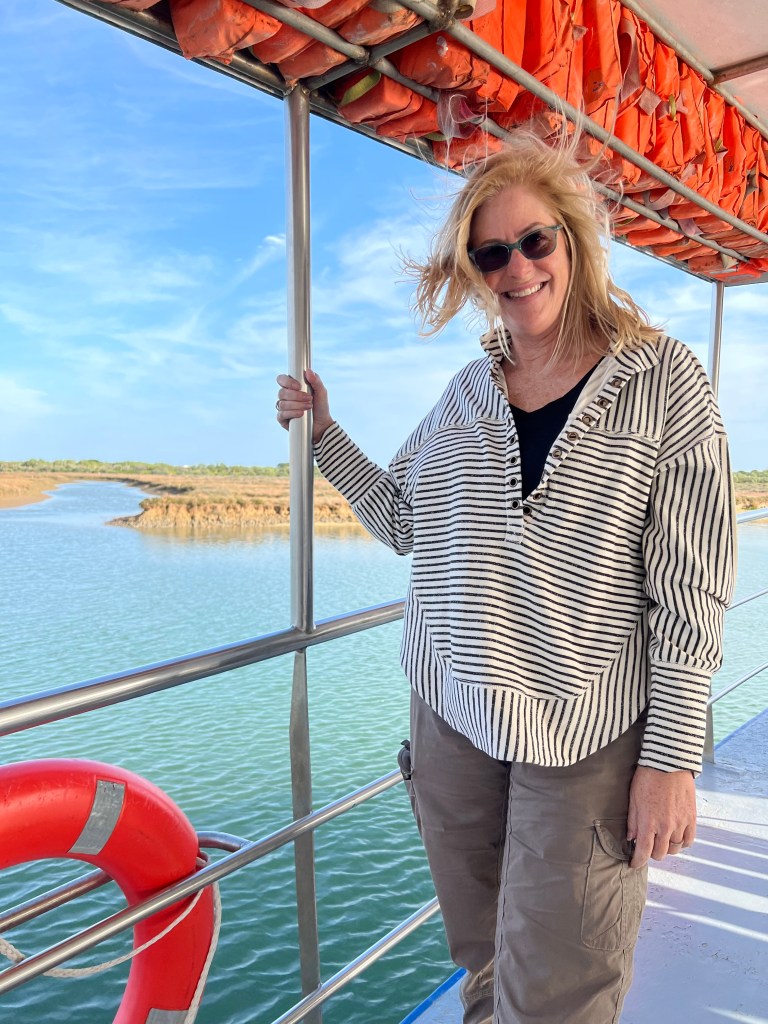
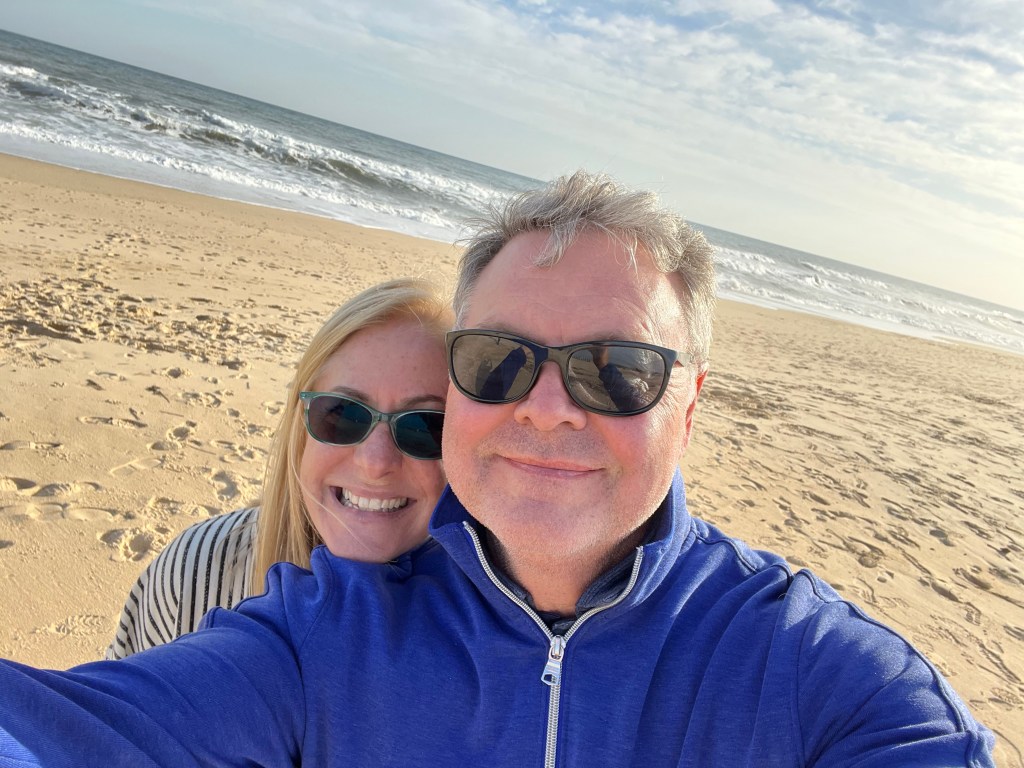
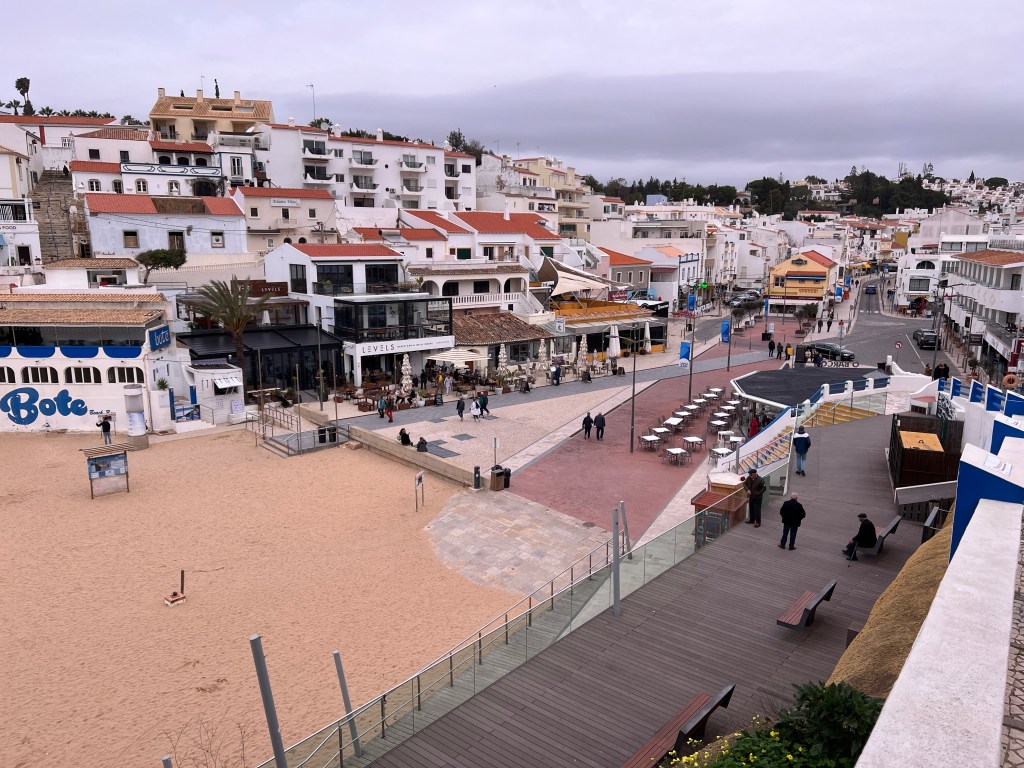
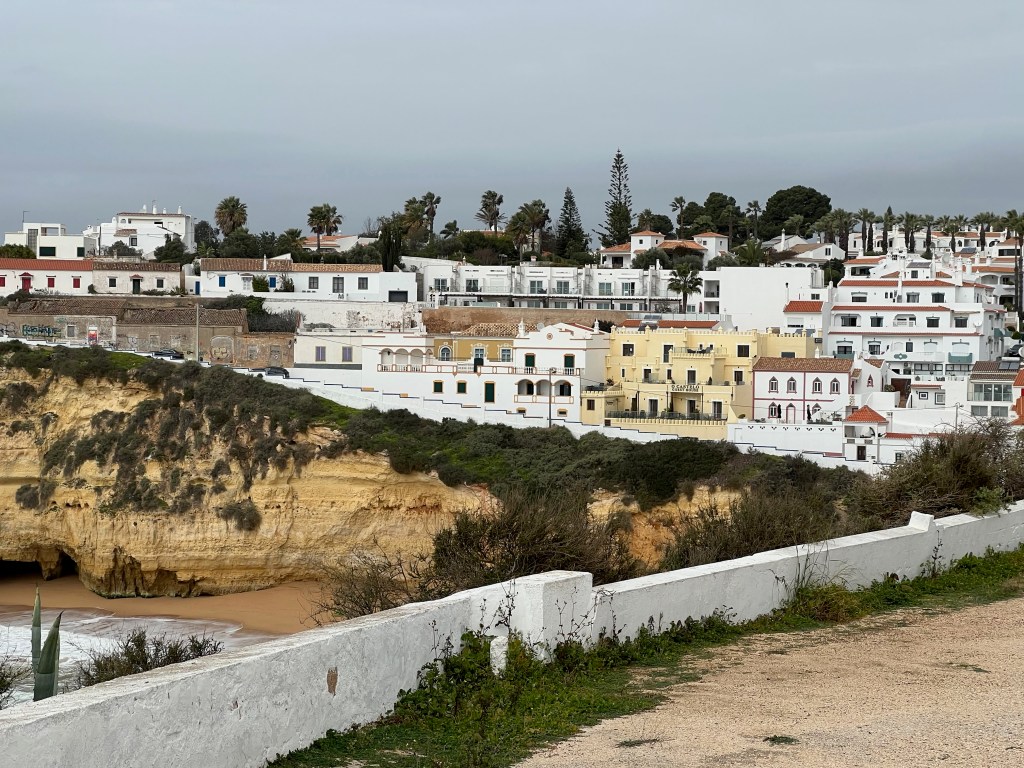
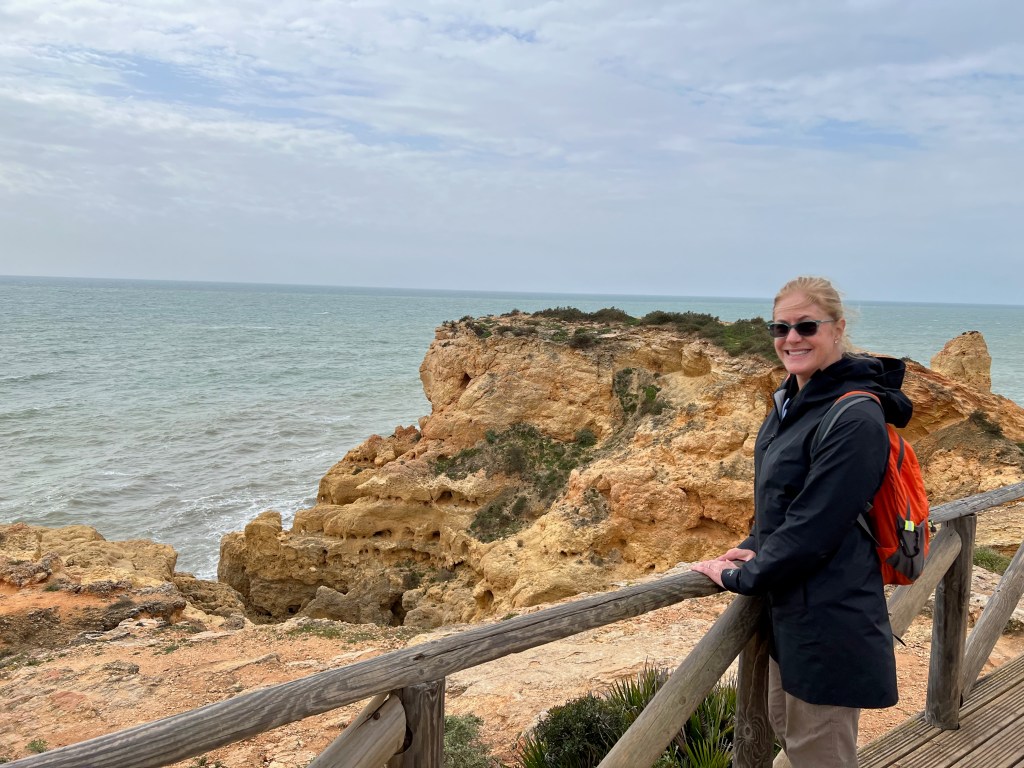
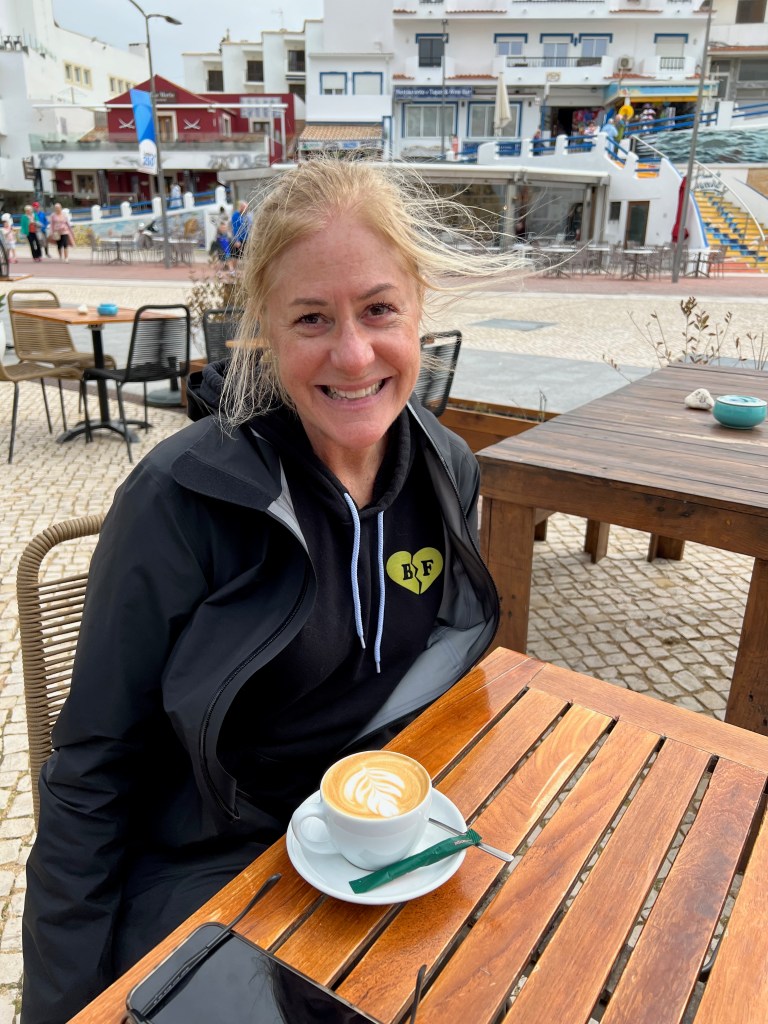
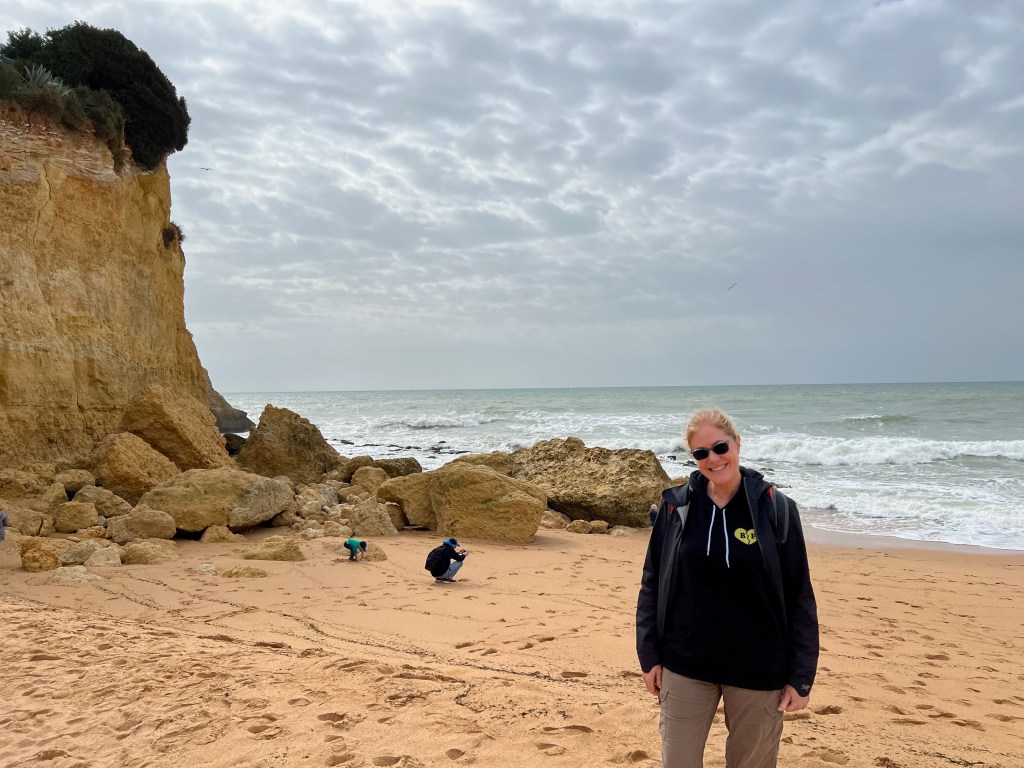
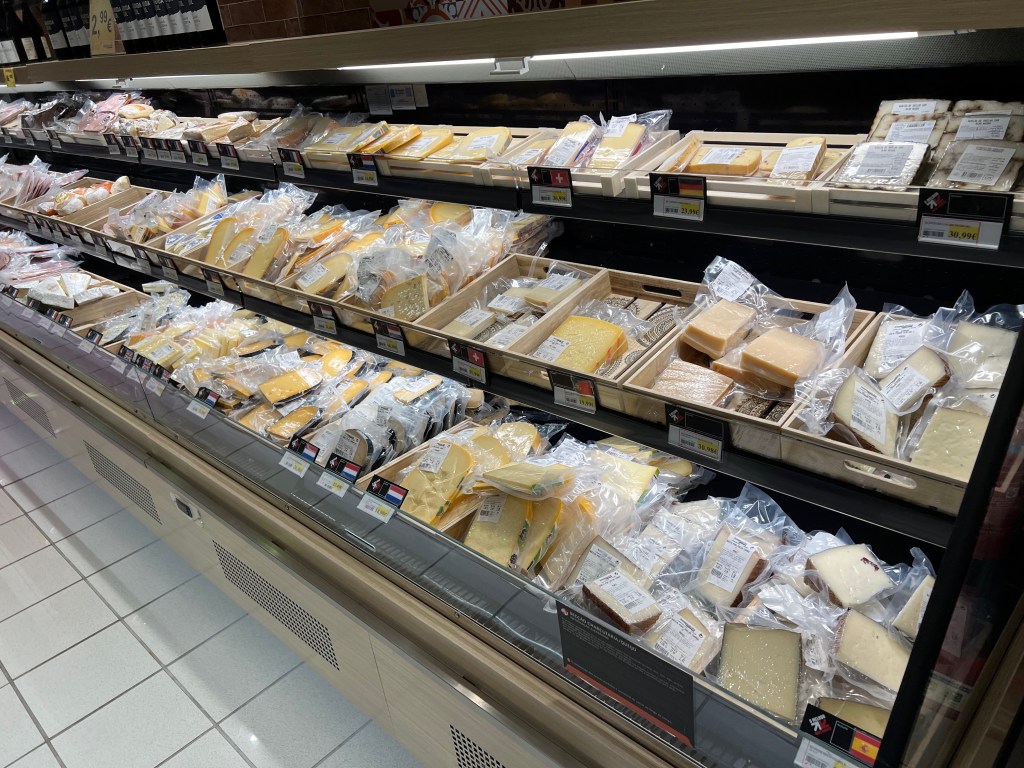
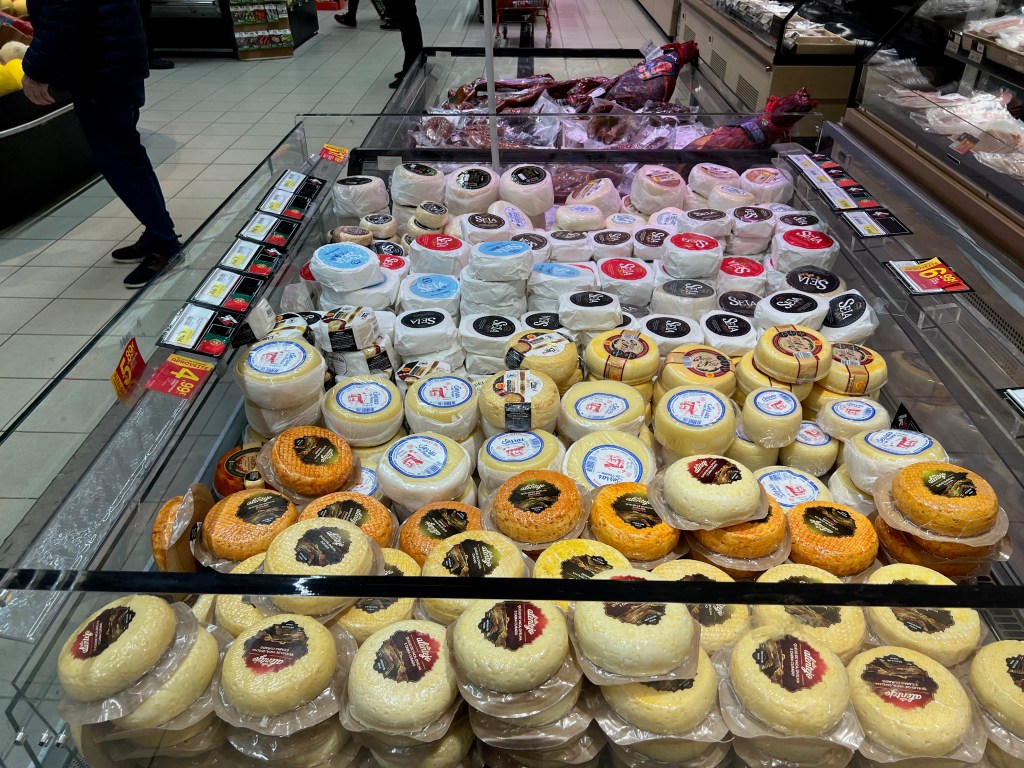
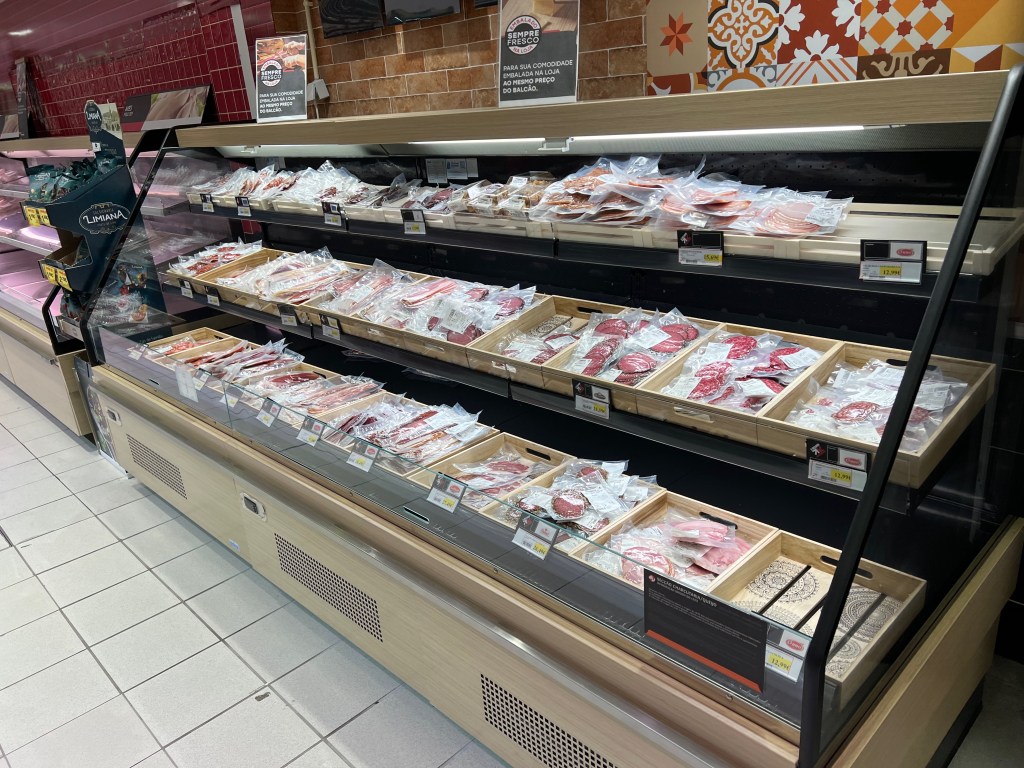
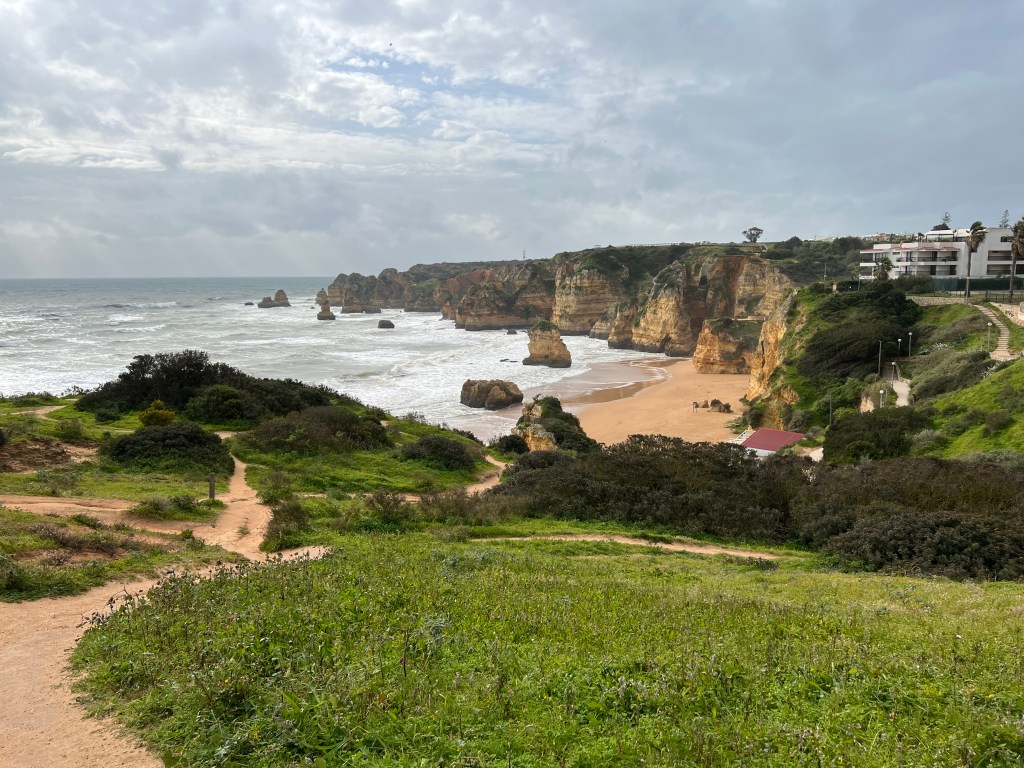
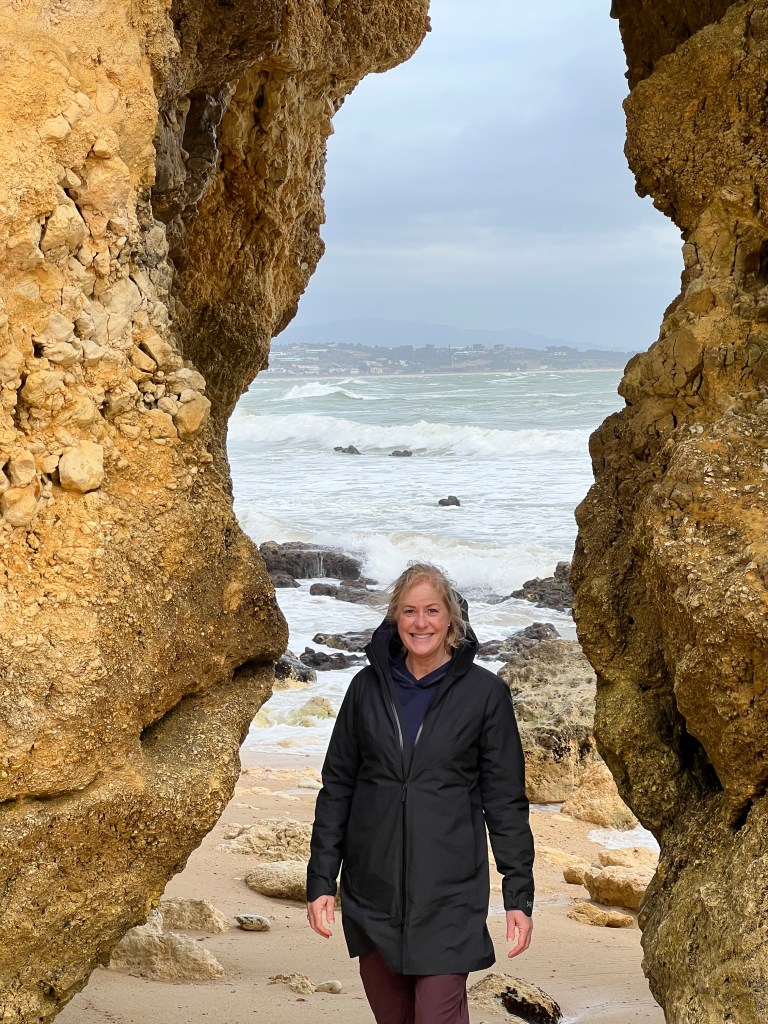
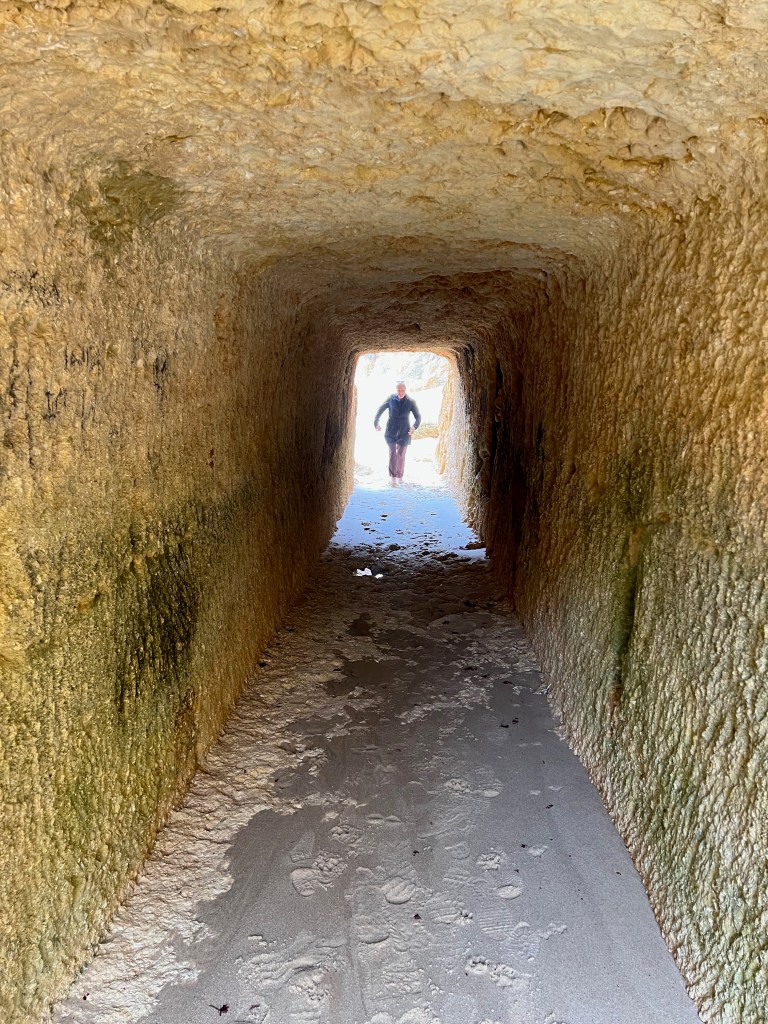
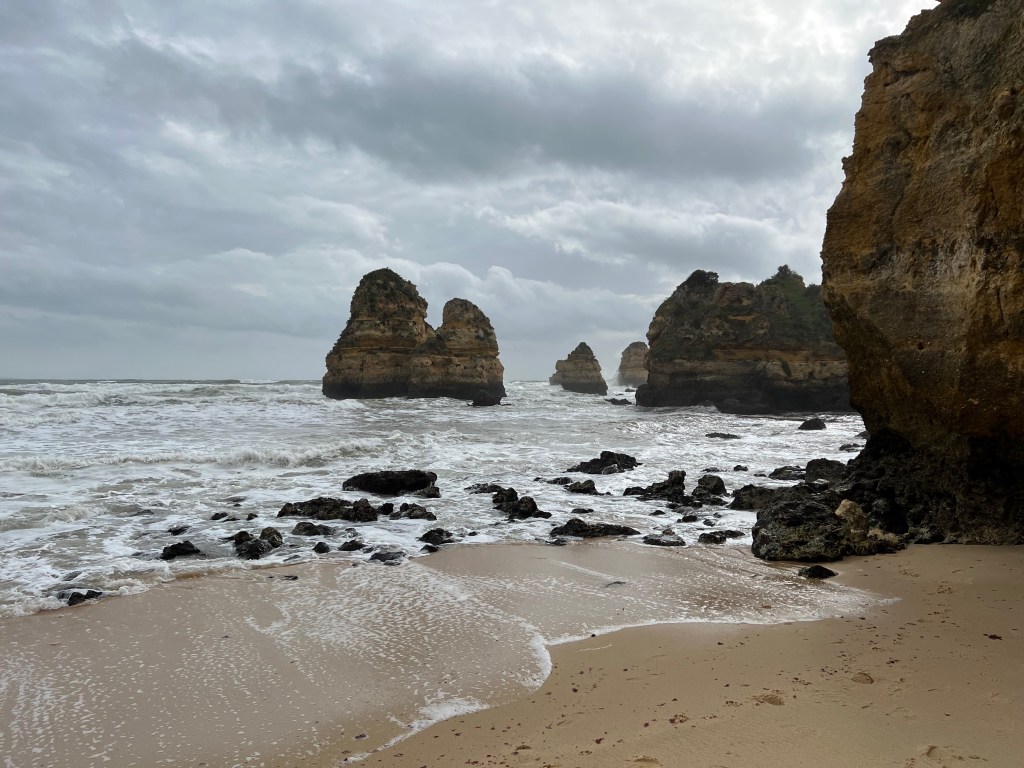
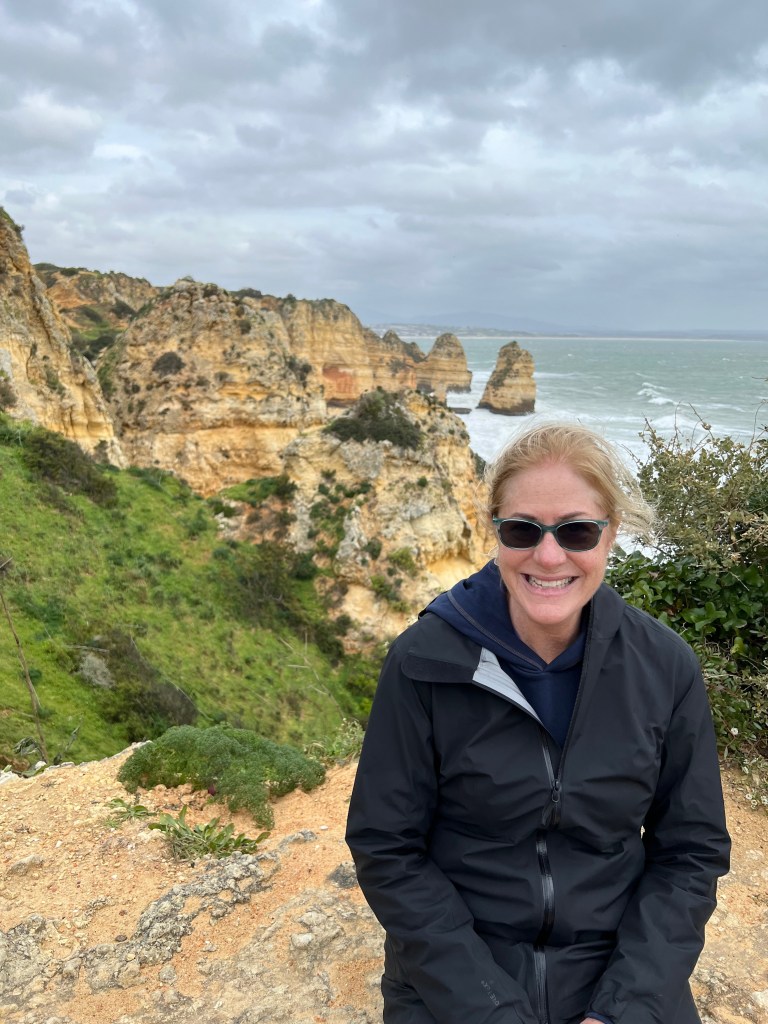
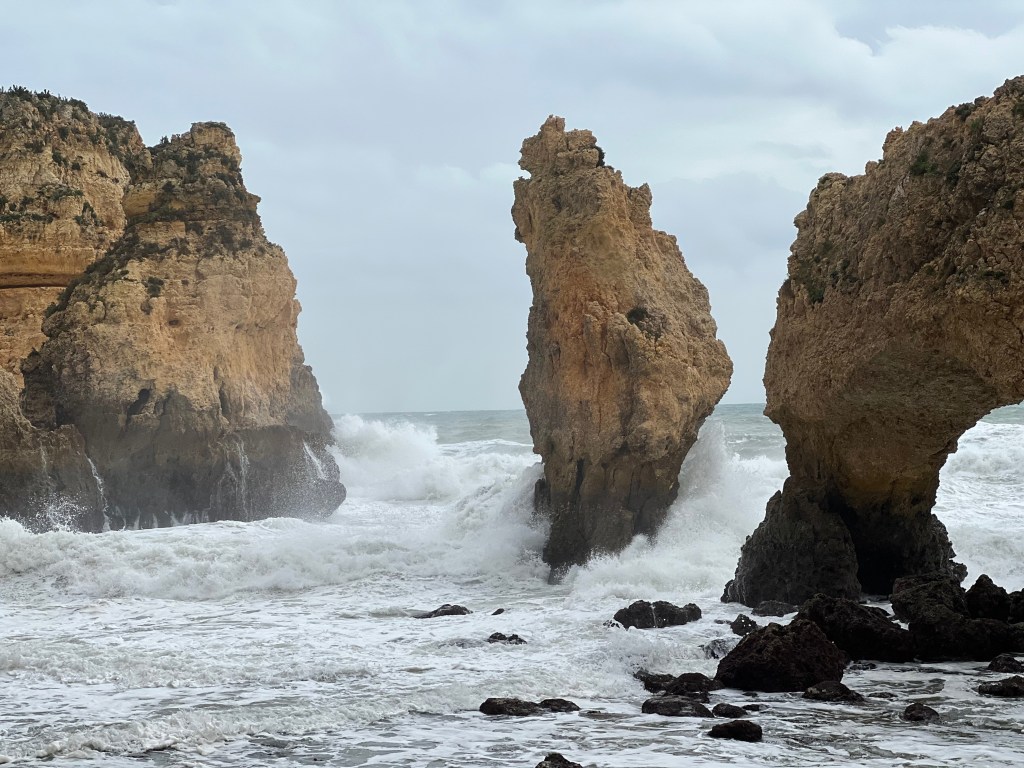
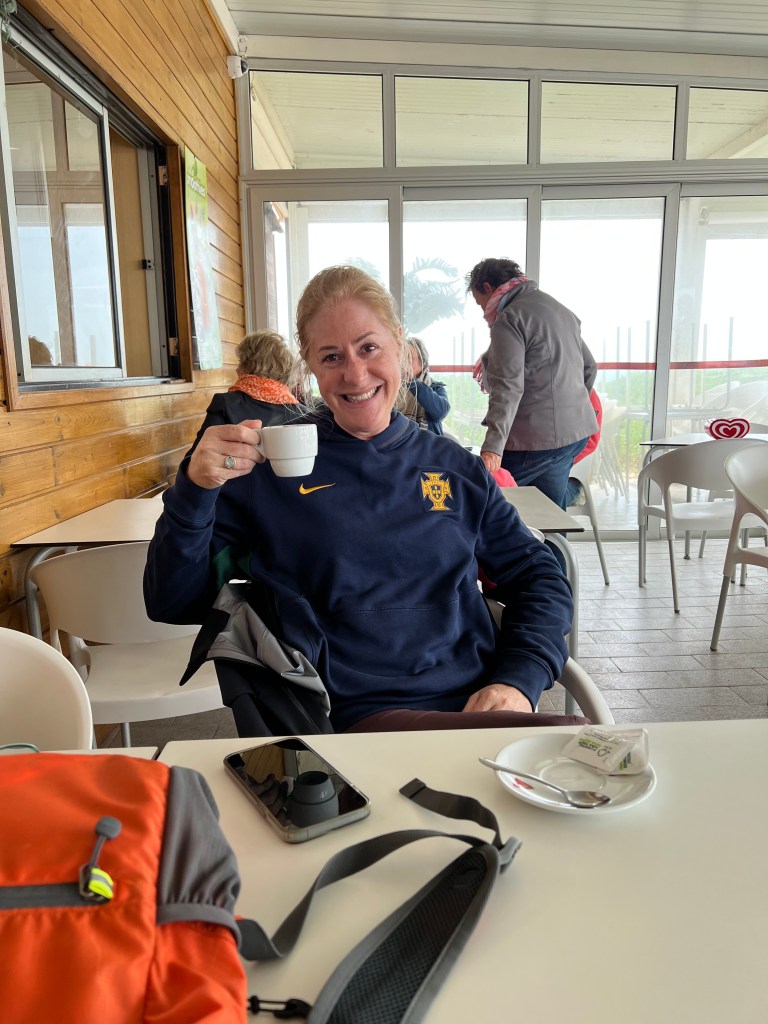
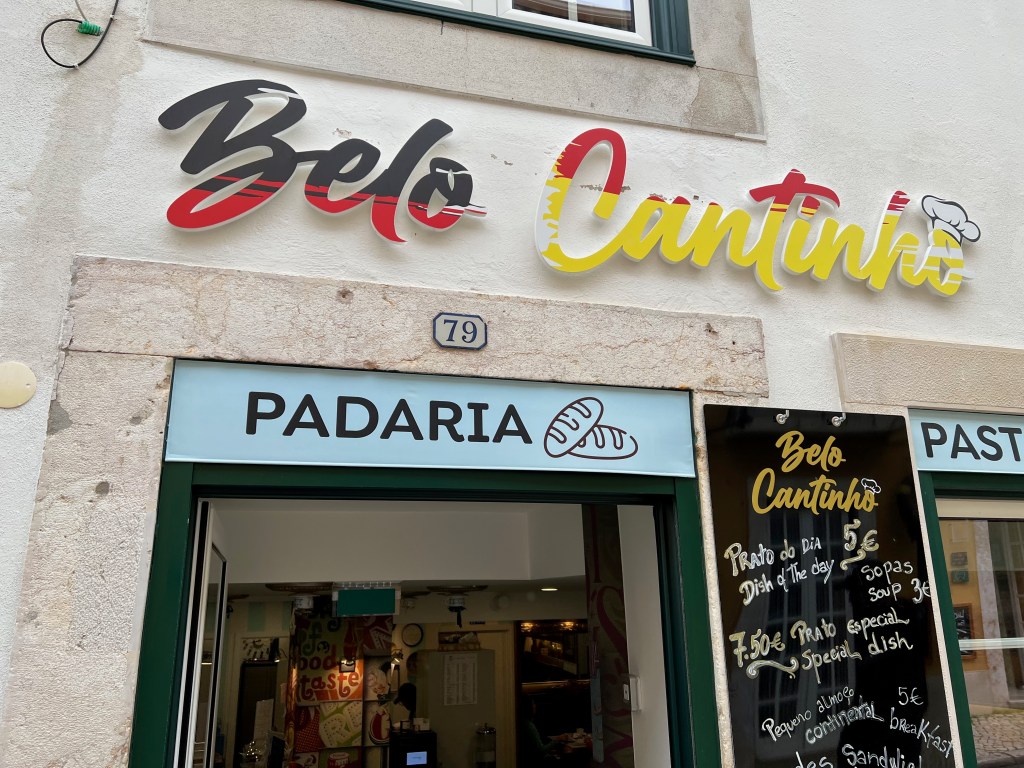
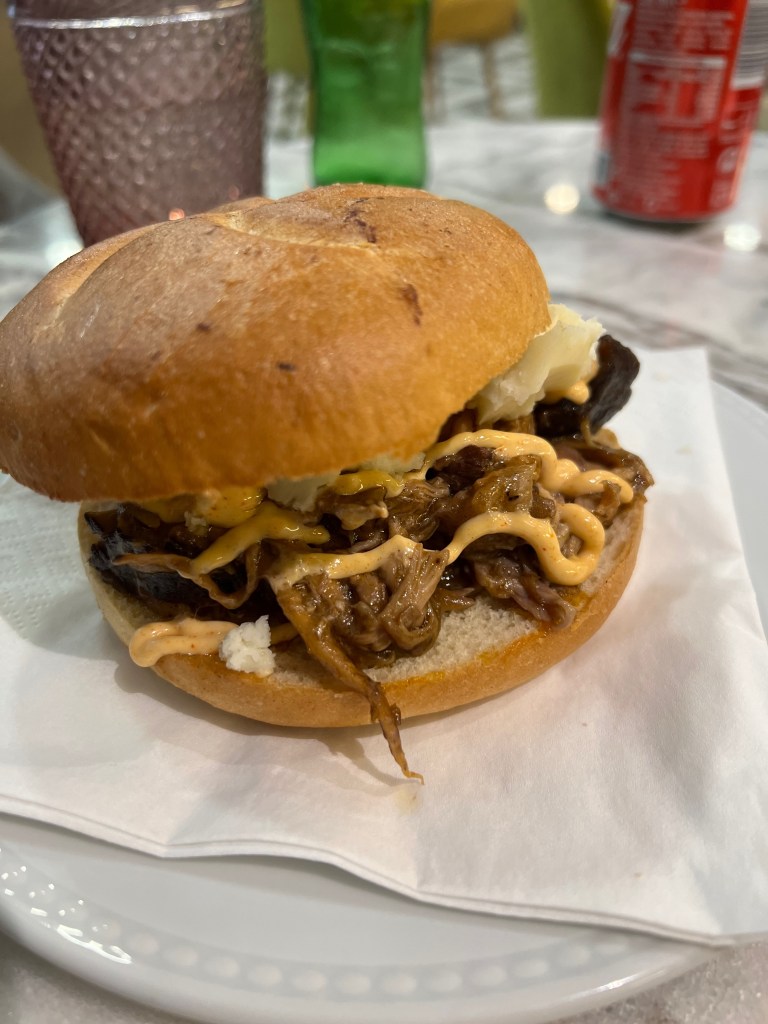
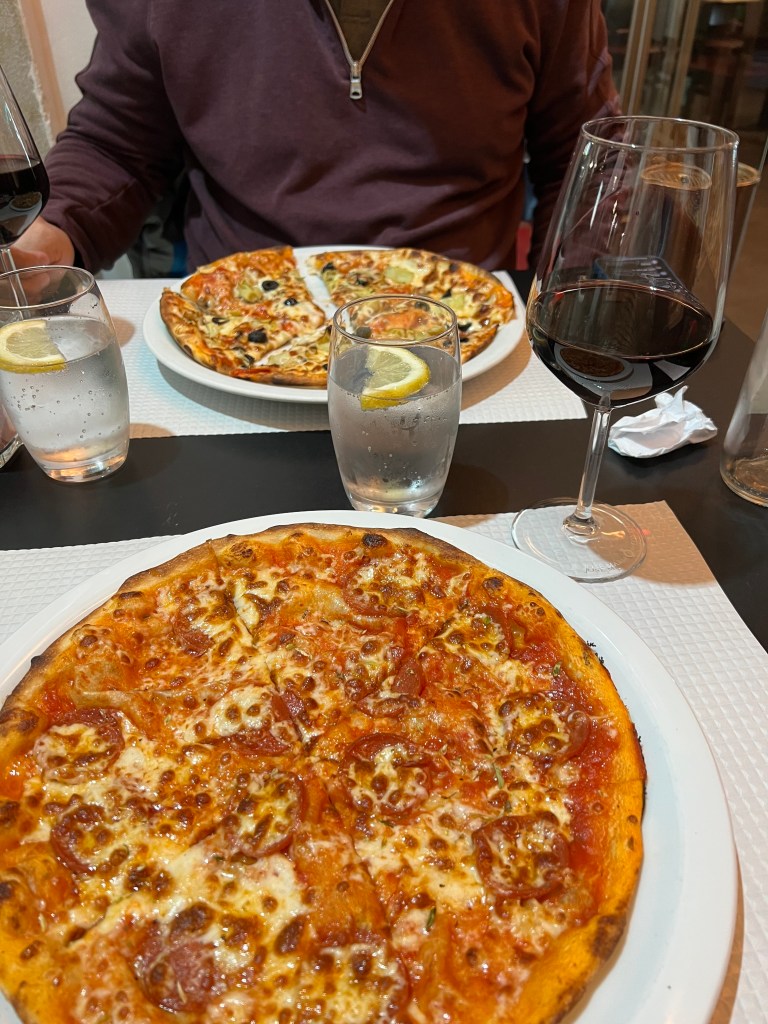
 Jill and Todd in Portugal